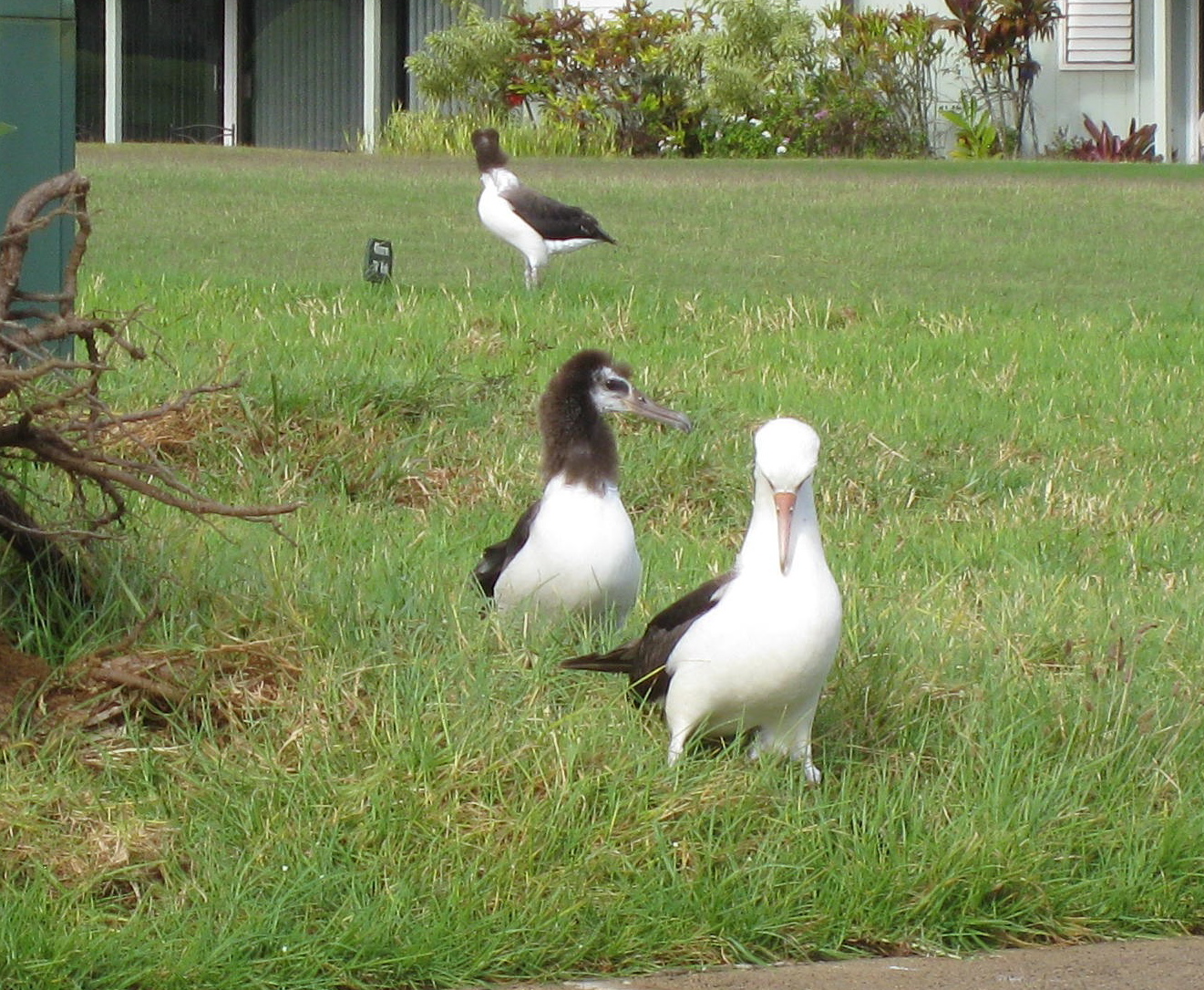
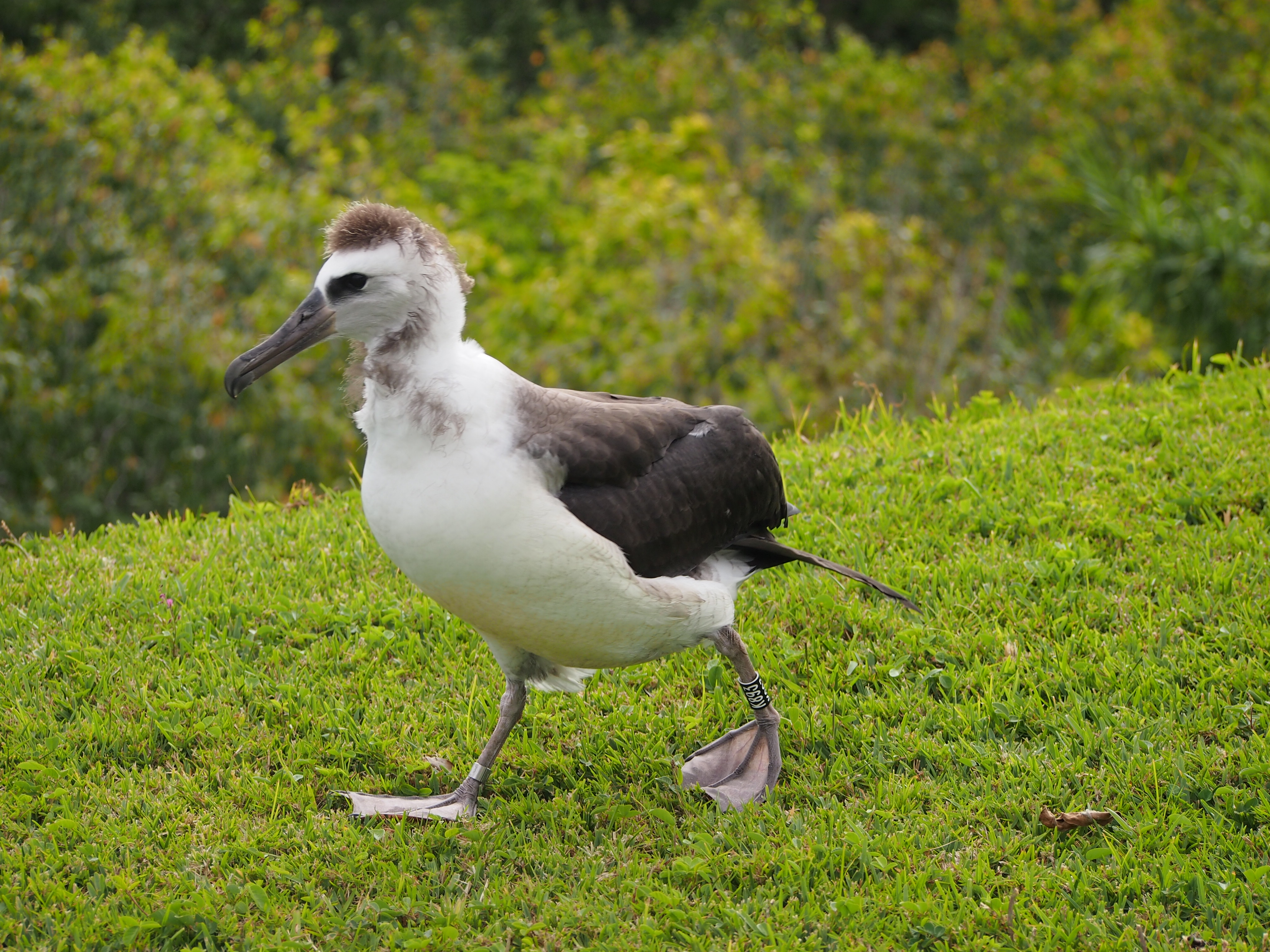
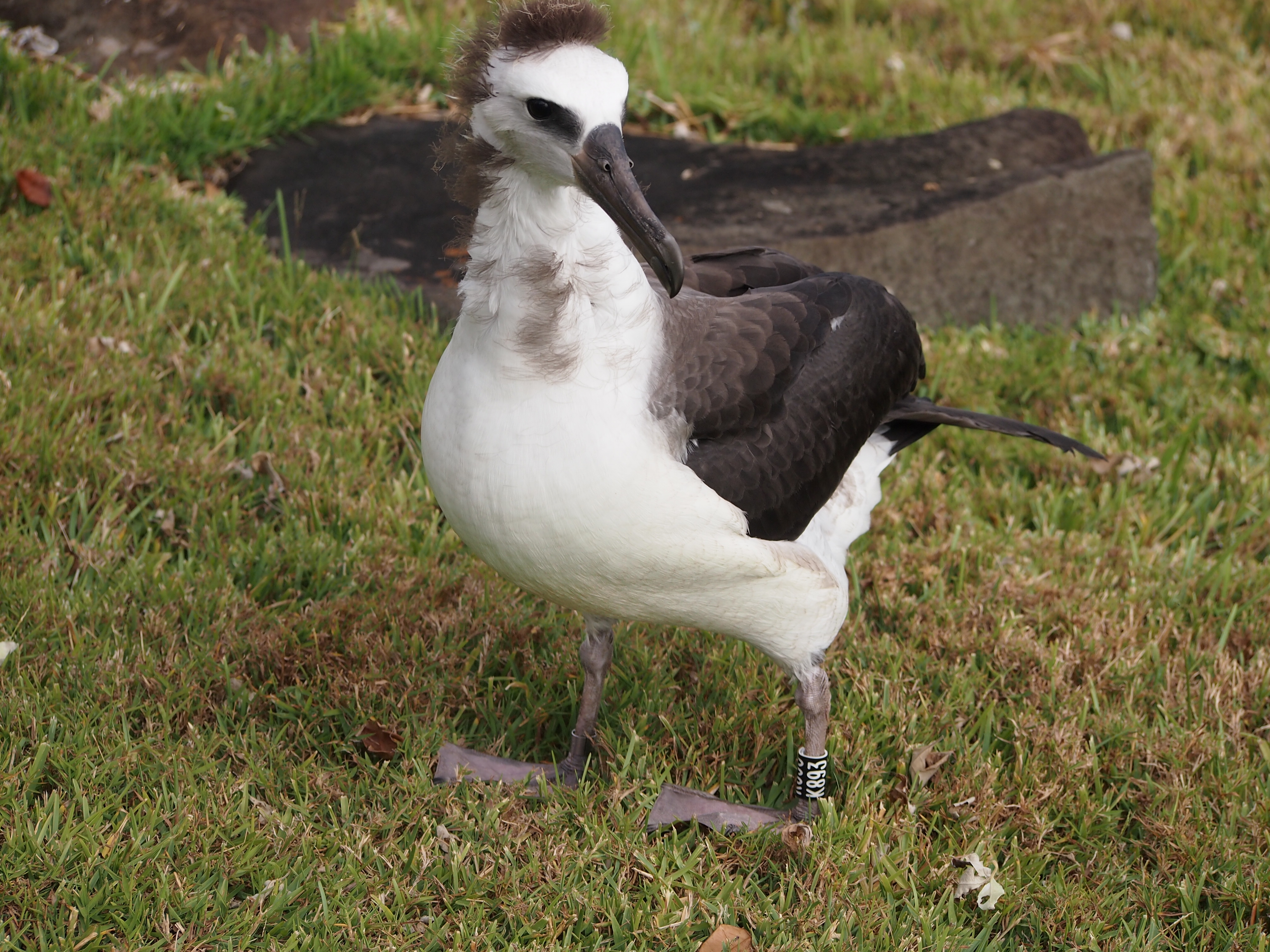
Two special albatrosses return

My two girls, albatrosses who started meeting in my garden last February after their egg failed to hatch , have met for the second time this season in the same area.  I presume that they will nest there.  They usually have one or two infertile eggs, so they will probably need a PMRF egg to adopt.  I hope they get a good one.

KP466 and K407 return to nest

Every year the albatrosses return gradually over the season, then when I count them on the Excel chart where I will store all of my data for the season, I suddenly realize that I saw more than I thought.  So far, I have seen 53, and I know that I have missed seeing others.  These are just the ones contemplating nesting, and there are more of these to come.  Later on in the season I will see the ones who do not have mates; some of these will be birds that are new to me.  I keep a list of every bird I have ever seen, along with when I saw them, and it expands as time goes by.  I always lose some birds, either to death or to relocation.

One bird I have seen several times is KP513.  Last year when she was incubating her egg, her mate failed to return.  She sat on her egg for 37 days; normally, the male will relieve the female within a week.  She must have been exhausted and very hungry when she finally had to abandon the egg.  I presume her mate died, because I can’t imagine an experienced nester abandoning an egg.

After the nesters meet up and mate, they leave for a week or so, then the female returns to build a nest and lay the egg.  The male usually returns within a few days to take the first and longest incubation shift. Sometimes he even beats the female back to the nesting area.  The whole process of developing an egg and then laying it saps the female of her energy, and she must return to sea to eat and build up her strength.

KP513 returned in January and I saw her participate in several displays, but never twice with the same bird.  I doubt if she found a mate last season.  I wonder if she is somehow thinking that she will see him again, or if her instinct to return now has just kicked in.
Posted in Uncategorized | 3 Comments

Our first nest

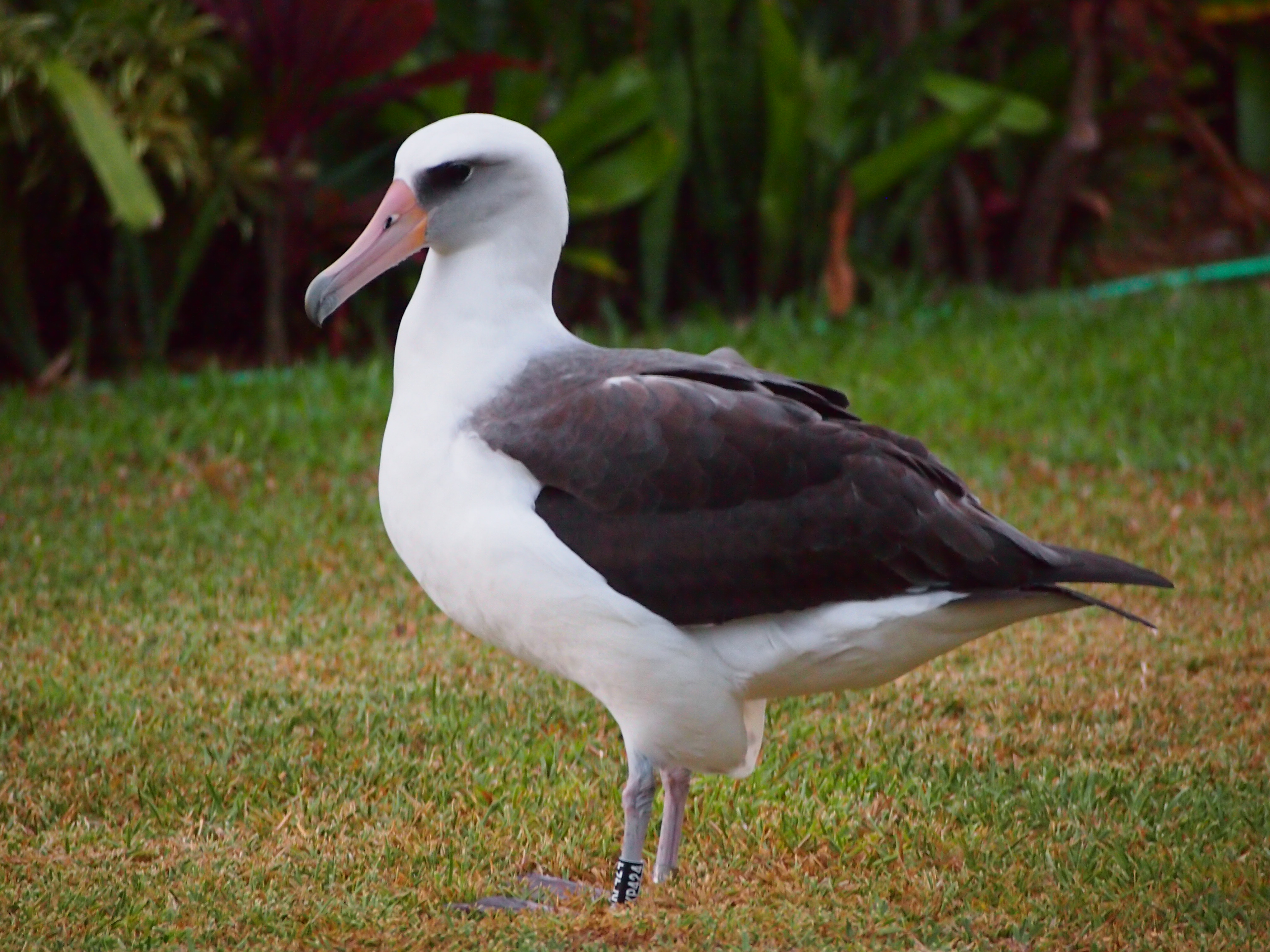
We have our first nest in Princeville, as of November 19th.  KP792 and KP505 mated on November 12th.  KP792, the female, returned on the 18th and built a nest.  When KP505 returns he will assume incubation duties.  The first shift is usually the longest, because the female has to recover her energy after growing the egg inside and then laying it.  This is a good reason for a female to choose her mate wisely!

KP792 sitting on first Princeville egg

Posted in Uncategorized | 2 Comments

Old acquaintances keep returning to Princeville

As of today, I have seen 28 albatrosses in Princeville.  I know I have missed seeing others who stayed briefly and were spotted by other people.  Sometimes after nesters meet up with their mates they will spend a little time here, sometimes they leave the same day they arrive.  For this reason, even though I am checking every day I know I miss some albatrosses.

I saw one bird on the golf course who spent a great amount of time last season interacting with a bird that was banded far from here.  GreenH162 was banded as a chick in June of 2002 on Tern Island, at French Frigate Shoals in the Northwest Hawaiian Islands.  I started seeing this bird when he or she was 8 years old.  Why did greenH162 decide to relocate to Kauai?  I would love to know.  If they nest together I will definitely let the staff at French Frigate Shoals know about it.

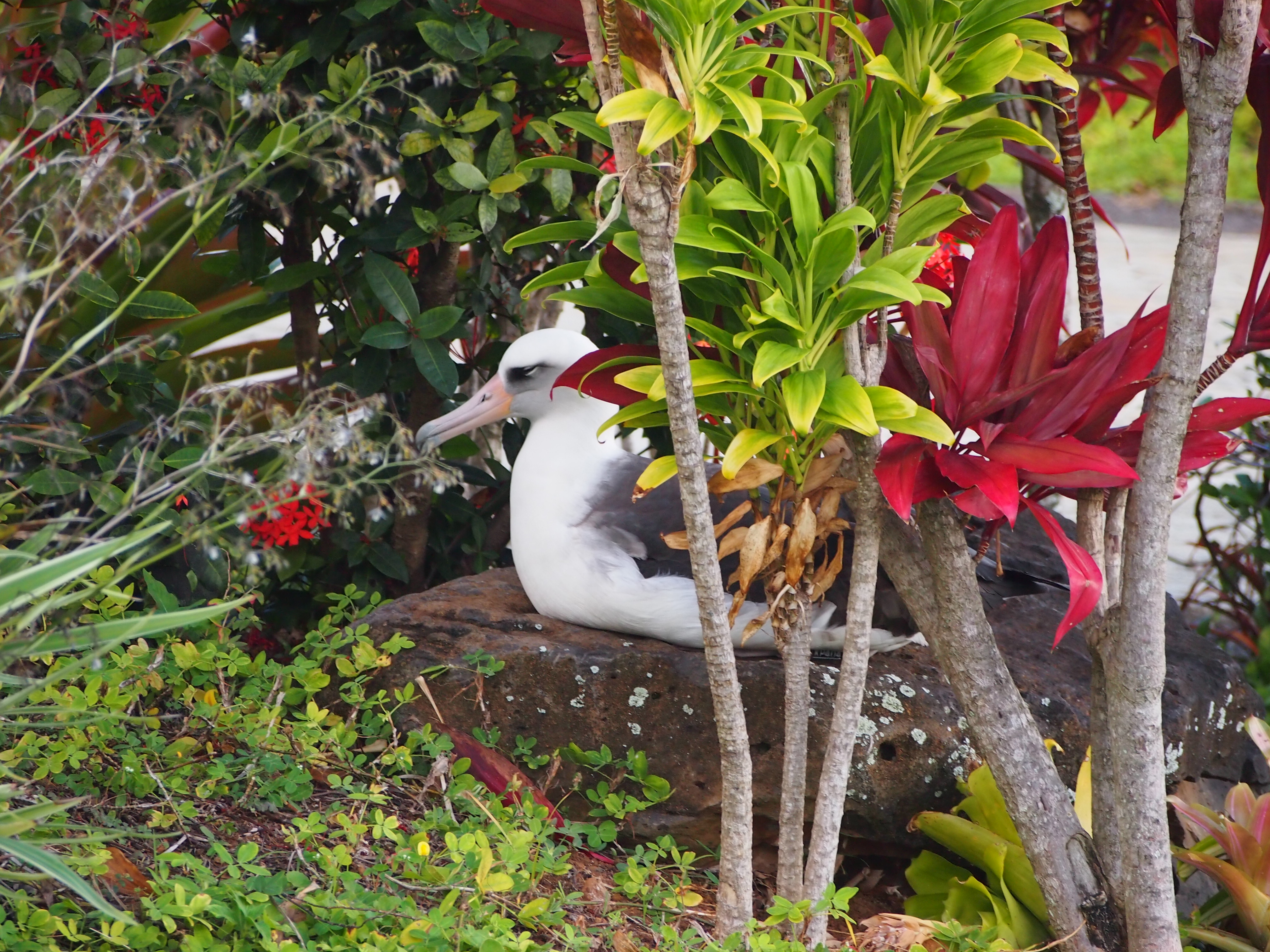
Here is a photo of a bird in my neighborhood, KP404, who helped KP756 incubate a PMRF egg that never hatched.  I hope they have a good one this year.  This picture is unusual because the albatrosses do not often sit on rocks.  Photogenic, isn’t she?

KP404 waiting for KP756

If you read my blog last year, you may remember the saga of KP531, who abandoned his long time mate in favor of a new one.  Yesterday I saw him with this first mate, sitting close to her and looking husbandly.  By late afternoon he was sitting alone.  She may have left thinking she would be coming back to the old KP531, the one who would help her incubate her eggs and raise her chicks.  We shall see what happens if his second mate returns.

I think this will be a good year for albatrosses, I look forward to some busy afternoons collecting data and recording it online.  The online data is the source of most of the information I share in this blog, so I spend a lot of time making certain that it is as clear and as meaningful as I can make it.  Writing this blog has improved my ability to organize information and to use Excel, although I could still use some instruction in both!

Posted in Uncategorized | 2 Comments

The albatrosses keep coming home

A few more albatrosses have arrived in Princeville.

Yesterday my friends Allan and Julie, visiting from California, spotted 3 birds next to the golf course.  Unfortunately, one disappeared before I arrived, but that one may be half of a couple who always nest behind some homes next to the golf course.  I know these two albatrosses as the Tuna Bird couple because someone once left one of them a tin of tuna fish.  People who leave food or water for the birds believe they are helping them, so if I leave a note telling them that the food could attract predators to the birds, they always stop.  We also have Pastry Bird, Ham and Cheese Bird, Stinky Fish Bird, Fritos Bird, Hamburger Bun Bird and Fried Rice Bird.

BlueKO027 is probably waiting for her mate, another female.  They were given an egg from the Pacific Missile Range Facility last year (refer to my December 18, 2011 post for a discussion of our egg swap) but they got a bad one.  This bird was banded as a chick in June of 1999 at an area of Princeville called Queen Emma’s Bluff.  The third albatross was KP302, who also grew up at Queen Emma’s bluff, but in the 2001-2002 season.  In 2010 this bird nested for the first time but would not incubate the egg that the mate had laid.  It is not uncommon for a bird to be a poor parent the first time they nest.  I hope that if KP302 is nesting this year, he or she will now know what to do.

I should point out that generally the first birds to return are ones who have nested before or who are planning to nest for the first time.  They mate shortly after meeting, then the female usually leaves soon after, to return in about 8 days to start nest building.  Sometimes the male leaves when she does, somtimes he hangs out for a few days.  The couple I wrote about in my last post, KP505 and KP792, are gone now.  I will be watching for them.  They staked out a spot for their nest, fortunately not under a coconut palm.  Coconut trees are beautiful, but I am happy when an albatross couple does not build their nest under one.  By the way, I forgot to mention that KP505 was originally banded in 1989 at the PMRF.  His daughter, KP465, has nested in my neighborhood since at least 2005-2006.

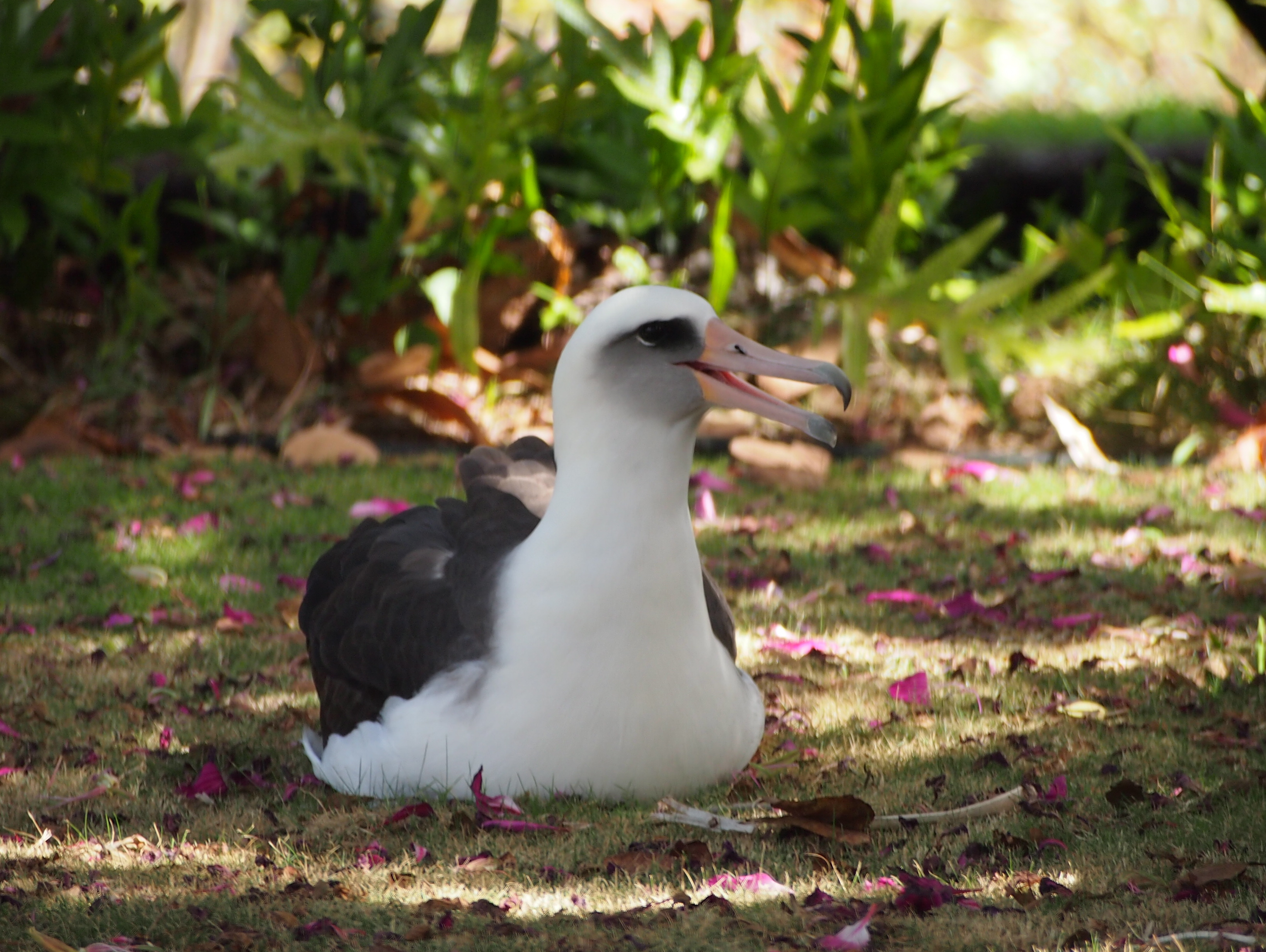
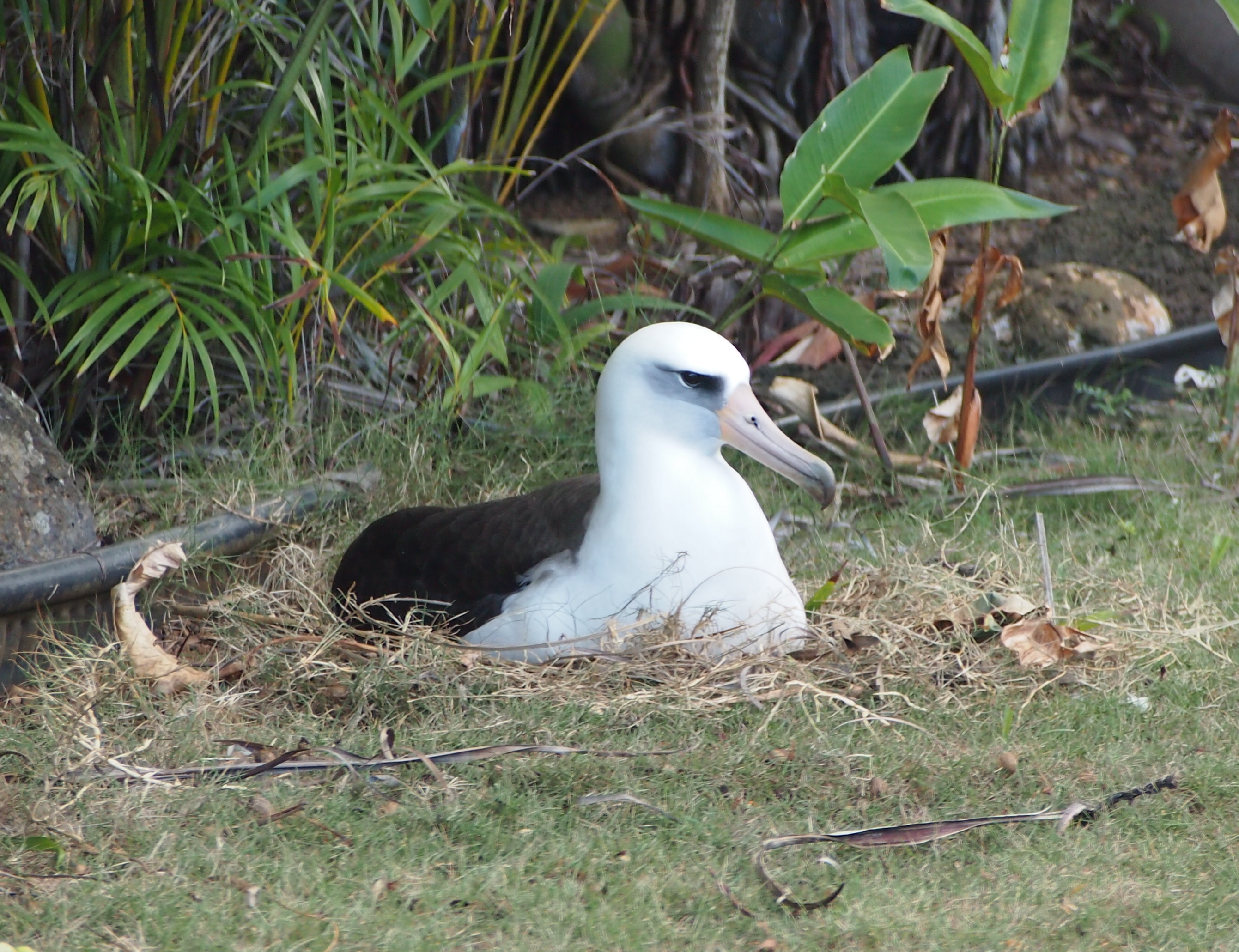
This morning I had a happy surprise.  Last season a couple who also had a bad PMRF egg started hanging out in my garden.  Often when a couple of nesters spend lots of time together in a particular spot, they will nest there the following season.  Here is one half of the couple I think will be my new residents:

K407 resting in my yard

K407 and KP466 have been nesting together for as long as I have been collecting data, maybe longer.  Now I am listening to K407 vocalizing, perhaps letting KP466 know where she is.  Every year some of the albatrosses do not return, but I am especially pulling for the survival of dedicated mates like this one.  I read recently that many of the long-line fishermen in Alaska have modified their fishing techniques to reduce the possibility that an albatross will end up hooked to the line.  I wish USFWS would insist upon this before they allow fishing companies closer to us to kill a certain number of albatrosses every year.

Posted in Uncategorized | 2 Comments

The first couple in Princeville

Last year one of the first albatrosses to return to Princeville was KP792.  Her mate, KP505, returned a week later.  This year KP792 came back a day earlier, and her mate was here the next day.  They have been spending quality time together in the back yard where they nested 2 years ago.  Albatrosses that have a close relationship, like nesters and other couples who are spending most of their time here together, sit close together and gently groom each other.

I wrote about this couple last year.  KP505 had nested with another female, KP729, in the 07-08 and 08-09 season.  In 09-10, KP505 came back with the other nesters in November, but KP729 did not come back until January, and she left in February.  KP505 met KP792 and they spent more and more time together.  The following year they nested together, leaving his first mate out in the cold.  If I could give advice to albatrosses I would tell them to spend lots of time with their mates, even when they are not nesting.  They need to keep renewing that bond, or they may end up alone.

KP792 and KP505

KP792 and KP505

Posted in Uncategorized | 1 Comment

The first albatross returns….

KP424 returns to her favorite lawn

I live in a neighborhood filled with albatross fans, people who look forward to seeing them return every year to nest or to look for a mate.  Two of their greatest friends are my neighbors, Denise and Carl.  I still remember when an albatross built a nest right under their drain pipe, and Carl immediately went out and bought an extension for it so the nest would not be inundated with the first heavy rain.

Last night around 2:30 A.M., Denise heard that familiar “clap-clap-clap” that we all recognize as the clacking sound an albatross makes with his bill.  Sometimes they do this if humans or other animals are too close to them, sometimes they just do it because they want to, for no reason that we humans can determine.

After Carl alerted me this morning to his visitor, I found out that yesterday evening around 6 P.M. another neighbor, Bob Waid (his wonderful albatross blog about the birds in our neighborhood is http://www.albatrosskauai.com), saw KP424 land at the bluff at the end of our road, then walk out into the neighborhood.   This is two days earlier than I have ever seen or heard of the first albatross arriving in Princeville.

Who is our first visitor?  Of all birds, the first to return is KP424, who spends from 2 to 10 days here in Princeville before flying on to nest with his (or her) mate every year at the Kilauea Point National Wildlife Refuge.  I have observed this every year that I have been collecting data, since 2005.  There is a record of KP424 nesting in Princeville in the 1993-1994 season.  Unfortunately, records that were kept in the 1990s were intermittent, so I have no way of knowing when he stopped nesting here and who his mate was in Princeville.  KP424’s age is unknown, but adult albatrosses are always assumed to be three; so using 1993 as a baseline, he is at least 22 years old.

Why does this bird spend valuable time coming back to Princeville?  In 8 years I have seen him displaying with other birds just twice.  He always sits by himself in the same backyard,  never anywhere else.  Is that where he once nested?  Were those happier times?  Did he feel a stronger bond with that mate?  Or is this simply force of habit, something the bird has always done and therefore will continue to do, year after year.  Perhaps KP424 would prefer to nest in Princeville and is hoping his mate will join him here.  Who knows?  Since I have no way of asking him, I have no idea what is going through his head, what compels him to take time away from meeting his mate at the refuge.  None of us have any way of determining what motivates the albatrosses because none of us can think like one.

I do know that I will be seeing more and more albatrosses in my neighborhood and in other parts of Princeville.  Each season I hope that they will all make it back, but there are always some who do not.  Some may have found a new albatross meeting place to try, others may have died of  the types of natural causes that have claimed them through their long history on earth.  Still others may have been attracted to the baited hooks used by some long-line fishing boats.  In August, U.S.Fish and Wildlife Service issued a permit which allows long-line fisheries to kill Laysan and black-footed albatrosses without requiring measures that could lessen the number of birds killed.  Two wildlife conservation groups are fighting it, and I wish them both success.

Thank you, everyone who cares about these birds and will fight to keep them safe.

Here’s to seeing plenty of fat, healthy chicks this season!

Posted in Uncategorized | 1 Comment

No more albatrosses in Princeville….

I am happy to report that our last Princeville chick has fledged, as of August 13th.  He was observed the day before trying out his wings and gaining some altitude as he attempted short flights.  Of course everyone in Princeville is pleased that he is beginning his new life at sea, but we will also miss seeing these guys for three long months.

This year the chicks here had the advantage of strong ocean breezes to fly into.  These winds directed them to the ocean and gave them the lift they needed to take that first flight from an ocean bluff.  When they get the urge to fledge, they go.  On a still day they may walk across golf courses, down busy roads, into people’s garages, anywhere.  But this was a good year for flying towards the ocean and then jumping off cliffs, the way they did before people arrived here and started putting up obstacles in their paths.

There are people who think it would be nice to have albatrosses on their property, who may not understand how inappropriate the location is.  I hope that every reader of this blog by now understands that albatross habitat:

1. Should include an ocean bluff.  This is absolutely necessary for fledging from anywhere that is not like Midway, which is at sea level and surrounded by ocean.  It also requires less energy from adults when they are taking off on a day with no breezes.

2. Should be properly fenced.  An expert must be consulted for the correct type of fencing.  Obviously, the side on the ocean bluff must be placed in an area that will allow chicks to fledge without having to fly up over a big fence, while protecting them from predators like dogs.  When they take that first flight, they do not usually fly vertically as much as they do horizontally.

3. Should not be privately owned.  For birds that will seek to return to the area where they last nested or where they fledged from, this is the only way to guarantee that their habitat will always be safe.  If someone wants to put their ocean bluff land into a conservation trust so it will always be available for albatross nesting, then they are showing that they want to want to ensure the future safety of the albatrosses; they are to be commended for their concern.

Thank you for caring about the Laysan albatrosses on Kauai.  I am not quite done with my blog, I am working on a list of questions I would love to get answers for during the next season.  Every year brings some answers but also many more questions to ponder in the future.

Posted in Uncategorized | 1 Comment

The youngest chick

There are two chicks left in Princeville.  One of them lives on the golf course and is the youngest of them all.

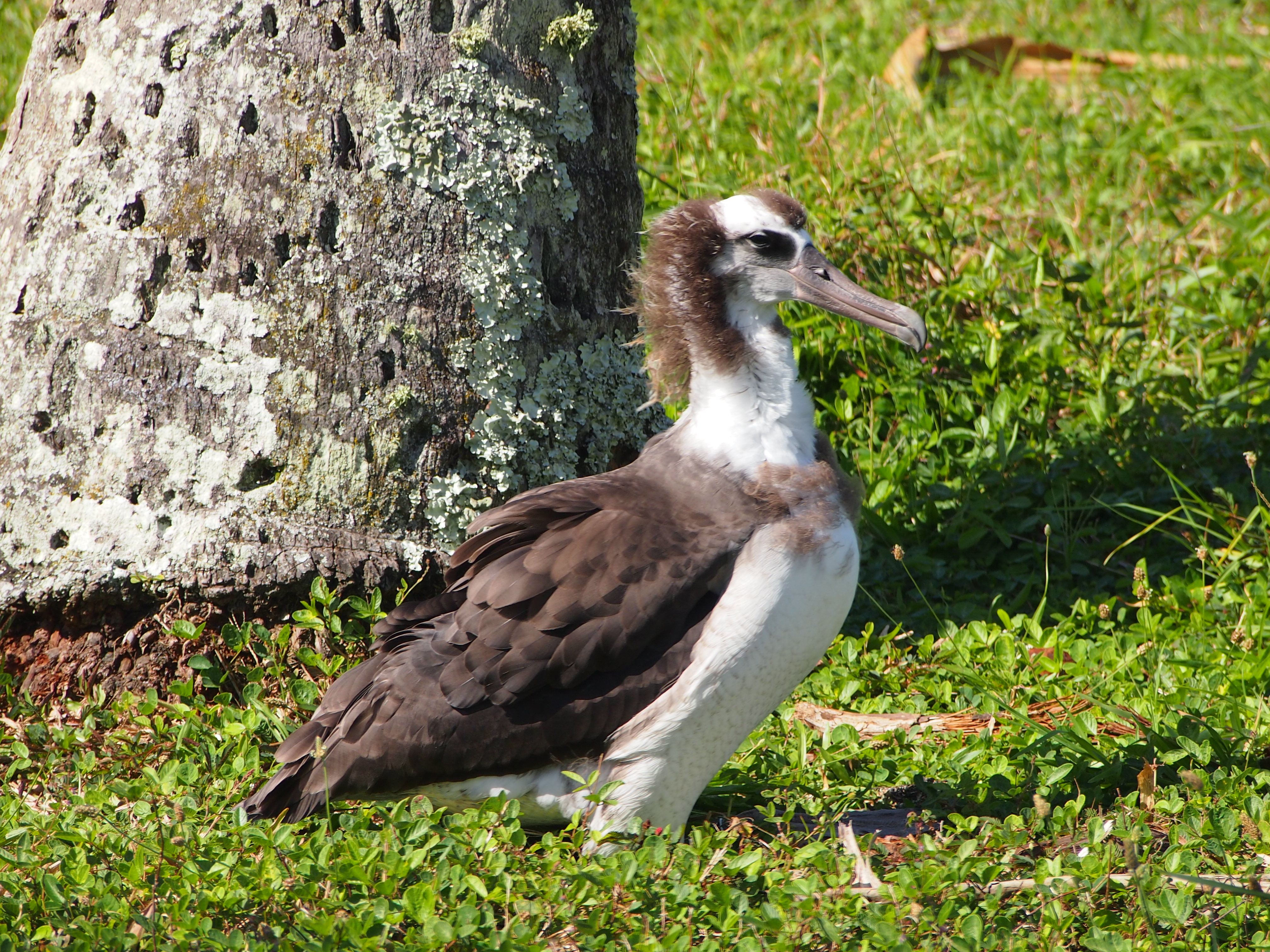
A402 feeling the breeze

His nest is across the golf cart path from a beautiful ocean bluff, with no foliage to obstruct his first flight and with ocean breezes constantly coming at him.

A402’s fledging bluff

It is the perfect spot for fledging.

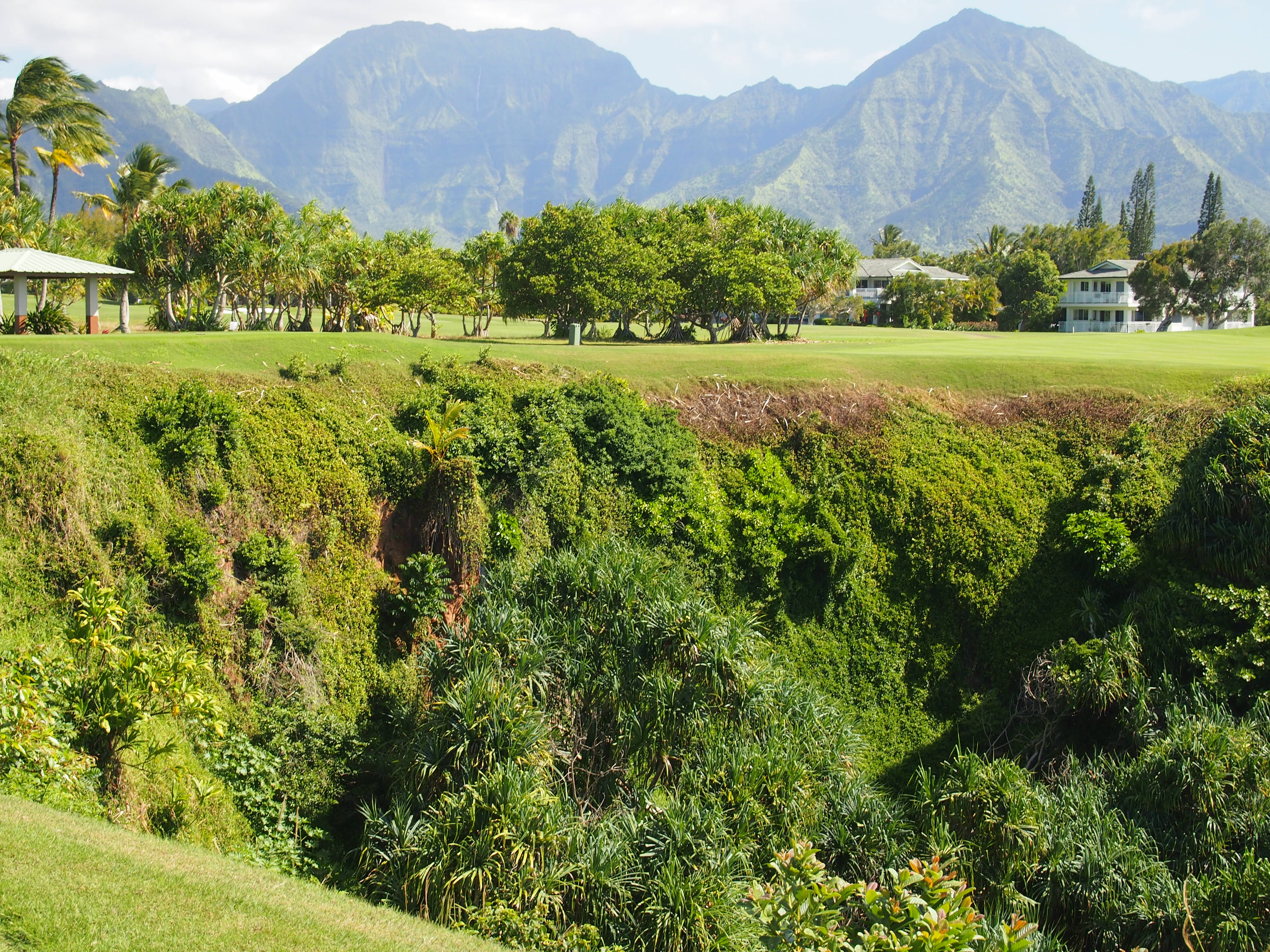
Here’s another view from the chick’s nest area.  This is a photo I took a few months ago, and the albatross in the foreground is an adult.

View from the golf course

If the chick tried to fledge in this direction, he would end up lost in “civilization.”  That is one of the challenges the chicks on private property face.  Fortunately all of the Princeville chicks are within a block of an ocean bluff, but even they can get lost if they do not fly into an ocean breeze.  So far this season the trade winds have been so strong that none of the chicks have needed any rescuing, they have found their way to the ocean.  Thanks to those winds showing them the way to the bluffs and providing the uplift they need to take their first flights from there, they have fledged earlier than usual.

It would be disastrous for chicks to attempt to find the ocean if their nest areas were further away.  Unlike the experienced adults, they cannot simply run down a street, flap their wings and take off on a long flight.  They fly low and for short distances, which would make finding the ocean a happy accident for them, would make getting over a fence impossible and would expose them to the risks posed by dogs and cars, which they have no fear of.  They could also end up lost in vegetation or unable to navigate around it.  One year a chick fledged into a greenbelt, hit a tree, and broke his wing.

The other hazard faced by albatrosses on private property is that there is no guarantee that current or future owners will protect them.  Remember, most of these birds return to the same area to nest every year, and so will the chicks that fledge from there.  Albatrosses will not necessarily stay in one small, fenced in area.  They may nest somewhere that is inconvenient for an owner, like in the best ocean bluff areas, or next to the front door, or in the yard where the dogs like to run.  It is against the law to move a nest, and a nester will not follow the egg if it is taken away.  Albatrosses are famous for showing high nest site fidelity.  I have been called to put an egg back in the nest after a parent kicked it out while tidying up.  The parents will not leave their nests to sit on a displaced egg.

One of the private properties where the albatrosses nest is currently for sale to be developed into luxury homes.  A quiet area will be turned into a busy one, with dogs and cars and people who will want to use the ocean bluff.  Nobody can say who will own any of the private properties in the future.

As much as I love Princeville and the support the community affords the albatrosses who nest here, nobody can predict what it will be like 100 years from now. The Kilauea Point National Wildlife Refuge is owned, operated and financed by the federal government, with a law enforcement officer who oversees the protection of the resident birds and with regular inspections of the fence surrounding the refuge.  It will always be the safest haven for nesting seabirds, with plenty of safe nesting areas and ocean bluffs to fledge from.  Those of us who love them have to try to ensure that the time they spend here is as safe and as tranquil as possible.

We have altered their natural world in such a short time, and in so many different ways, the albatrosses have not had time to change their behavior to cope; instead they must rely on the instincts that helped them when they nested on flat little islands in the middle of the ocean.  We humans have no such excuse, we must use our superior intelligence to see what these birds really need for survival, and act selflessly to see that they get it.

Posted in Uncategorized | 2 Comments

Two more fledgings

This has been the windiest summer I can remember here.  I think the wind contributed to the ease with which 17 of the 20 chicks have fledged.  We did not have a nest on the mauka (towards the inland mountains) side of the main road through Princeville, so that was one less worry.  The chicks from there have always required help to get safely to a good spot for fledging.  Just as albatrosses evolved with no fear of predators, they do not understand the danger of walking across a busy street.  In my post from April 18th I talked about the death of the first chick to fledge from the nest on the wrong side of the road.  He was 5 years old, and was hit by a car while walking across the street to the area where he had lived as a chick.

This season, most of the chicks either started out with a view of the ocean or moved to areas that had one, and they could feel the ocean winds urging them to leave.  They fly into the wind when they fledge, wherever the wind may be coming from, and if there is no wind they will walk.  When an albatross chick walks down a road, the sound of his flapping feet can attract the attention of people in the nearby houses.  I once watched (and joined) a parade of local residents follow a chick, at a respectful distance, the 2 blocks from his nest to the best bluff for fledging.  He walked out there, took a running start, and took off with the confidence of an experienced flyer.  I have since learned that the locations of ocean bluffs are not coded into an albatross’s DNA.  The fledglings sometimes get lost and need some guidance, especially when the breezes stop and they have no clue about where to go.

On July 11th I received an email from a resident who lives next to the golf course where 2 chicks had fledged and 2 remained.  She told me that one of the chicks, A404, had fledged early in the morning.  The other was “doing a lot of practicing.”  Within an hour, A405 had left as well.  She took this photo the morning both birds fledged:

A404 and A405, before fledging

Unfortunately, she missed seeing either one take off.  Someone once asked me if I could predict when a chick would fledge.  I would pay a very large amount of money to be able to do that.  They do not fledge in any particular order, certainly not by age.  It was interesting that these 2 birds fledged within an hour of each other.  Was the second one inspired by the first one?  Who could know?

Here is another photo that she took.  In the foreground, you can see A405 with one of his parents.  He was fed two days in a row.  When I took training to become a volunteer at the Kilauea Point National Wildlife Refuge, they told us that chicks fledged because the parents stopped feeding them.  This chick had his last meal not long before fledging, and I have seen parents return after their chicks have left.  It’s like they say, birds don’t always read the book about how they are supposed to behave….

A404 and parent, A404 in background

Posted in Uncategorized | Leave a comment

Hoku

While some chicks like KC leave their nest areas without looking back, others seem to be more reluctant to go.  Two chicks in my neighborhood were dithering about the timing of their fledgings.  Both had wandered around with the purposeful strides of birds who know where they’re going, but both ended up back in their comfort zones, the places where they feel most comfortable.  Until July 3rd, that is.

On Tuesday, Hoku decided it was time for him to leave.  He wandered around the neighborhood a bit, tried his wings, then walked to the ocean bluff at the end of my street.

He strode on out to the best spot for a takeoff:

Hoku walks out onto the bluff

He did a bit of practicing….

Feeling the wind beneath his wings

Then started to go back to his comfort zone.

Nope, not yet

Hmmm, maybe I’m feeling more confident….

What shall I do?

I’ll run and take off so quickly the humans won’t have a chance for any decent photos!

See you in a few!

Posted in Uncategorized | 2 Comments