Calypso and KC

Here is an update about the fledglings in Princeville.  As of July 4th, 15 out of 20 chicks have left.  I thought I would share a few of their stories.

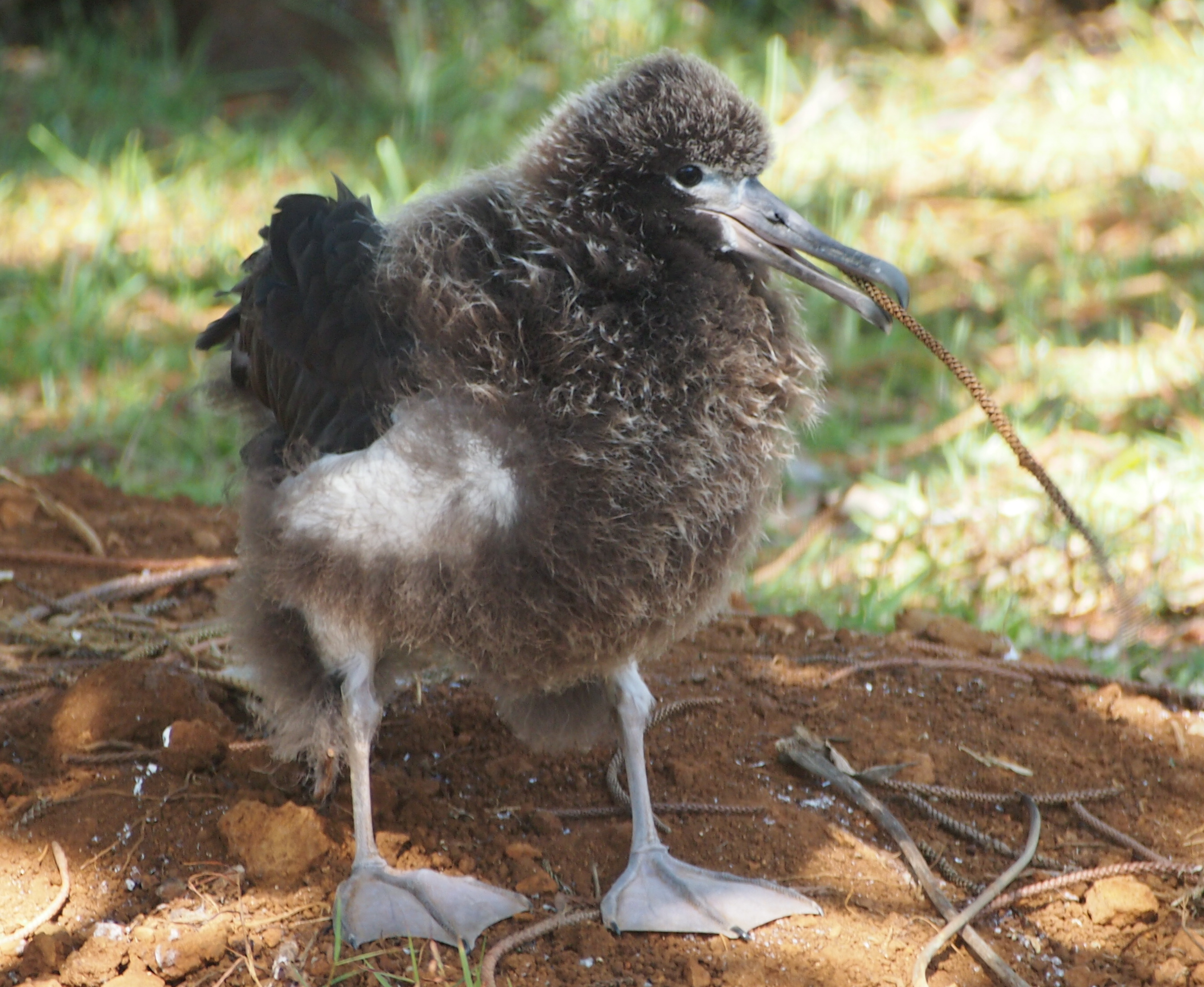
Two chicks left on July 1st.  One was Calypso, Lord of the Dirt Pile.  His favorite spot in recent days was atop a large mound of soil at the site of a new house being built near his nest area.  He left quietly, with no fuss, not even a quick good-bye.  I can tell you that when he comes back, no sooner than 3 years from now, he will be given a very warm reception by everyone who lived or worked near him or who looked for him on his dirt pile as they drove towards the fountain on their way out of Princeville.

Calypso on his (or her) dirt pile

Here’s a closeup:

Calypso’s close-up

On the other hand, KC was spotted making his way across the Makai golf course towards the nearby ocean bluff.  He took off without a second of hesitation.  As with Calypso, his fans will be looking for him several years from now.

KC resting

Every fledging is different, because every albatross is unique.  I will share more with you in days to come.

Posted in Uncategorized | Leave a comment

Nola’s big flight

Today I had the privilege of watching two albatross chicks fledge.  My neighbor, Bob Waid, called me early in the morning to say that the two were behind a house on an ocean bluff at the end of my street.  When the chicks leave their comfort zone, the area where they have spent their lives from hatchling to almost-adult, it is a signal that it is time for them to leave.  Those of us who keep an eye on them want to make sure they have an easy departure.  One year a chick took off from this area and came down too soon, ending up on top of a cliff and requiring a rescue.

Albatross chicks are not very social.  This film shows the two of them wandering around the bluff, barely acknowledging each other.  One of them had just a little bit of chick fuzz left and looked like an adult; in the film this one made a short flight and ended up on a lower slope.  Eventually the bird fledged, but I did not include that part of the film because it was poorly lit and hard to see.

Fortunately, the next bird fledged in a very photogenic manner.  Here is a film of Nola’s first big flight:

Posted in Uncategorized | 1 Comment

Bye, bye, chicks!

As of yesterday afternoon, 7 chicks had fledged and 13 remained.  The first one fledged last Wednesday.  The weather conditions are perfect for fledging, we have been having strong winds off of the ocean, with occasional showers.

Some of these chicks you may remember from my previous posts.  The first one to leave was the first chick raised by KP531 and K112.  KP531 left his long-time mate this year.  I wrote about this saga on November 27th and November 30th.  Those of you who walk through my neighborhood may remember seeing this chick sitting on a big pile of dirt in the center of Keoniana Circle.  He spent lots of time moving stuff around.  Here is a photo:

K898, chick of KP531 and K112

One of the fledglings was a PMRF chick, whose adoptive parents are KP753 and K672; the latter is a bird that was banded at the PMRF and rebanded in Princeville.  I wrote about the PMRF egg swap on December 18th.

If you check my June 17th entry, you will see a film of a chick trying his wings.  His nest was on an empty lot overlooking the Prince golf course, and the last time I saw him he was sitting halfway down the part of the property that sloped down towards the course.  When I checked for him on June 23rd he was gone.  There have been constant strong ocean breezes off of that golf course, so I would bet he caught one.  He may have stopped along the way, then picked it up again.  There is an ocean bluff at the end of the golf course.  It is very important for chicks whose nests are on land quite a bit above sea level (not on a small, flattish island surrounded by ocean, like Midway) to have the uplift provided by a cliff, and to be able to see the ocean from there.  They cannot fly high enough to fly all the way from an inland area and would be put in harm’s way if they had to somehow find the ocean while making short, low flights.

One bird whose nest is in a yard bordering a golf course had disappeared by late afternoon, June 25th.  A resident saw him in walk down the fairway, stop at a sand trap as though  it had him stumped, then walk back to his nest area.  I am guessing he finally figured out his way around it.  The ocean breezes have been strong on the golf course this season.  A few years ago a chick on this course ended up near the main road through Princeville.  The trade winds were not very strong that summer, and he may have started walking when he got the urge to fledge, or a breeze could have been blowing in the other direction, or he flew with the breeze instead of against it.  At any rate, we had to help him to a spot that was safe, with an ocean bluff just tailored for a fledgling’s first flight.

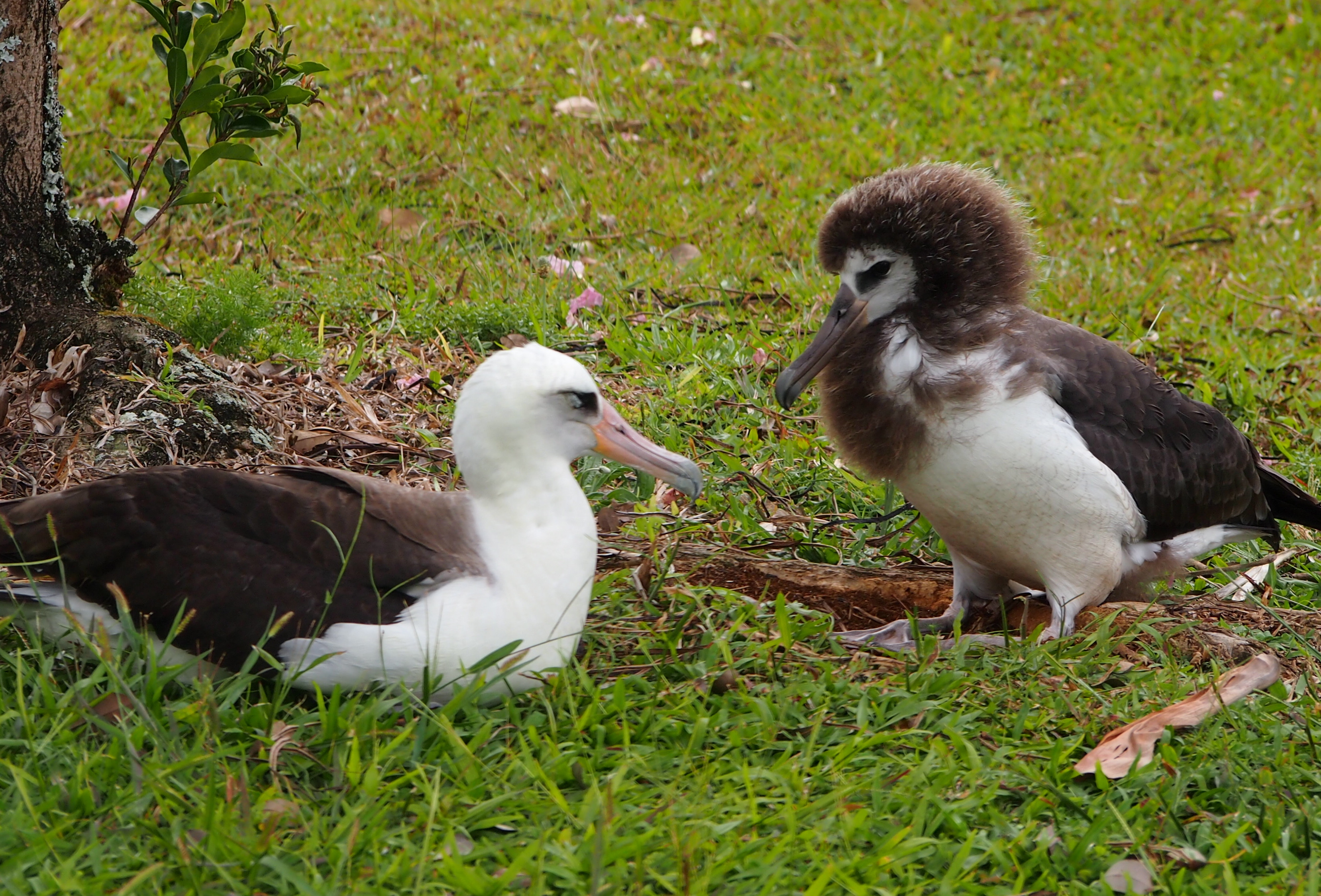
This is “Scotty,” the last bird to be banded in Princeville, sitting next to his father:

Scotty and his father, KP400

Scotty fledged on June 26th.  He walked all the way down the street his nest was on to an empty lot overlooking the golf course, then took off from there, out over the golf course to the ocean.

So we have 7 gone, 13 to go.

And I will miss each and every one!

Posted in Uncategorized | Leave a comment

Banding day

This week all of the 20 Princeville chicks were banded.  On one leg they have a small silver band.  This is the official band recorded with the North American Bird Banding Laboratory, under the auspices of the United States Geological Survey.  Each albatross is given a unique 9-digit number by the BBL.  The band also has a toll-free number and a website address; if someone finds a dead bird or a detached band, they are asked to report their discovery.

On the other leg, the bander puts on an auxiliary band so that observers can record the number while watching the bird with binoculars.  Every albatross band has one or two letters followed by three numbers.  Each location has a unique color/letter combination.  Sometimes adults here need to be banded, and they are given the same type of bands as the chicks.  This year, all birds banded on Kaua’i were given black bands with white letters and numbers.  Birds banded at the Pacific Missile Range Facility have bands with P###, on the rest of Kaua’i the bands begin with K### or A###.

All of the birds on the North Shore were banded by Kim Uyehara or Bongo Lee or by someone they are training to be a bander.  Kim is the Fish and Wildlife biologist on Kaua’i and she is responsible for banding the albatrosses at the Kilauea Point National Wildlife Refuge.  Bongo Lee is the Wildlife Biologist who is in charge of the banding of all of the chicks on private property.  She also bands the nenes, which I have been told is a lot more difficult than banding albatross chicks.  She works for the Division of Forestry and Wildlife, under the Department of Land and Natural Resources, for the state of Hawaii.  She was assisted by two DOFAW employees, Lindsey Ibara, Wildlife Biologist, and Jarrett Fujioka, Wildlife Technician, and volunteer Janelle Pang, a University of Hawaii at Manoa Animal Science Graduate student.  Marilou Knight, who works with Save Our Shearwaters, worked at both KPNWR and Princeville to collect feathers from chicks to be used for DNA tests to determine their sexes.

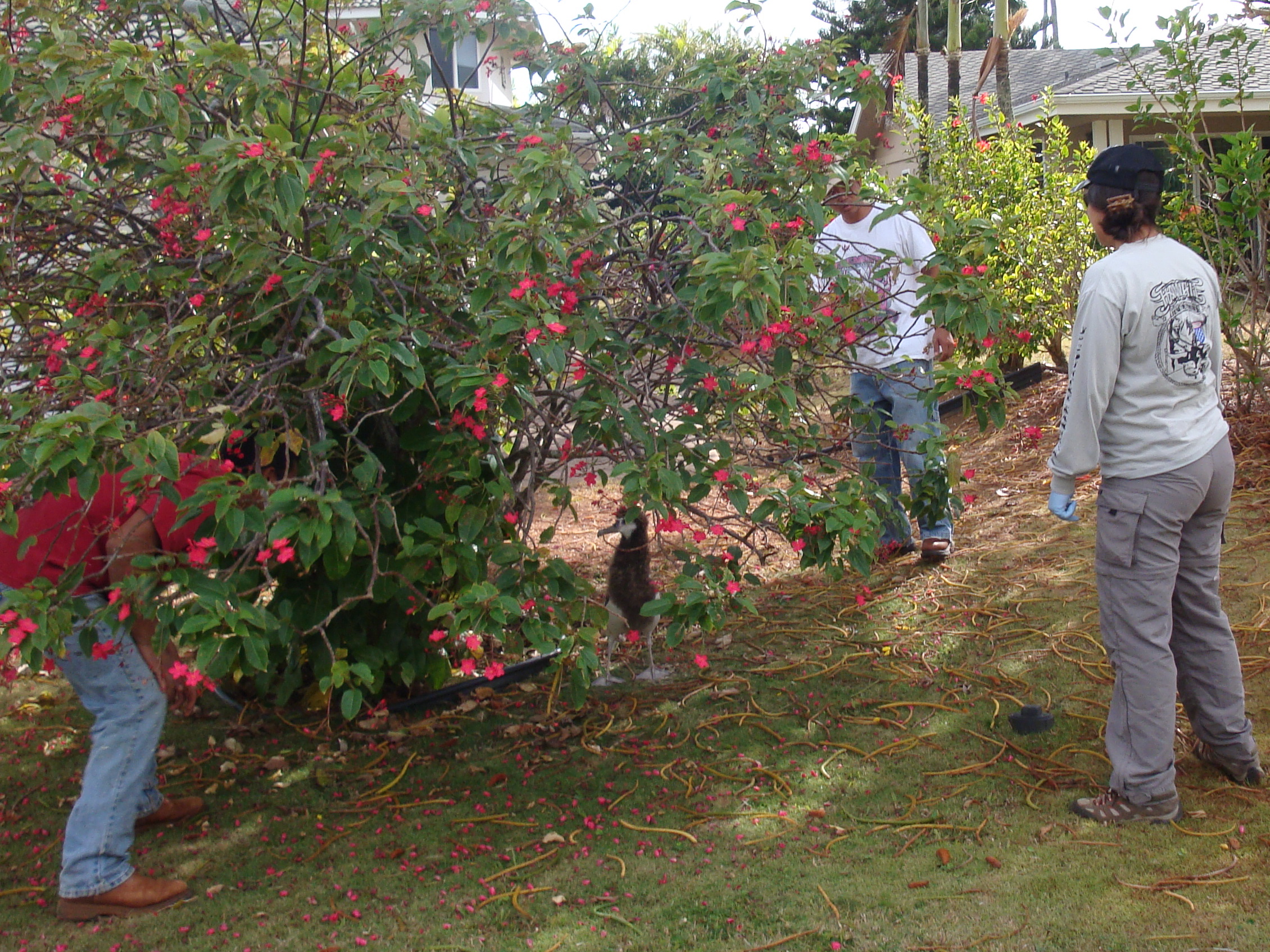
It helps to distract the bird so someone can sneak up from behind and grab him.

The chick is surrounded!

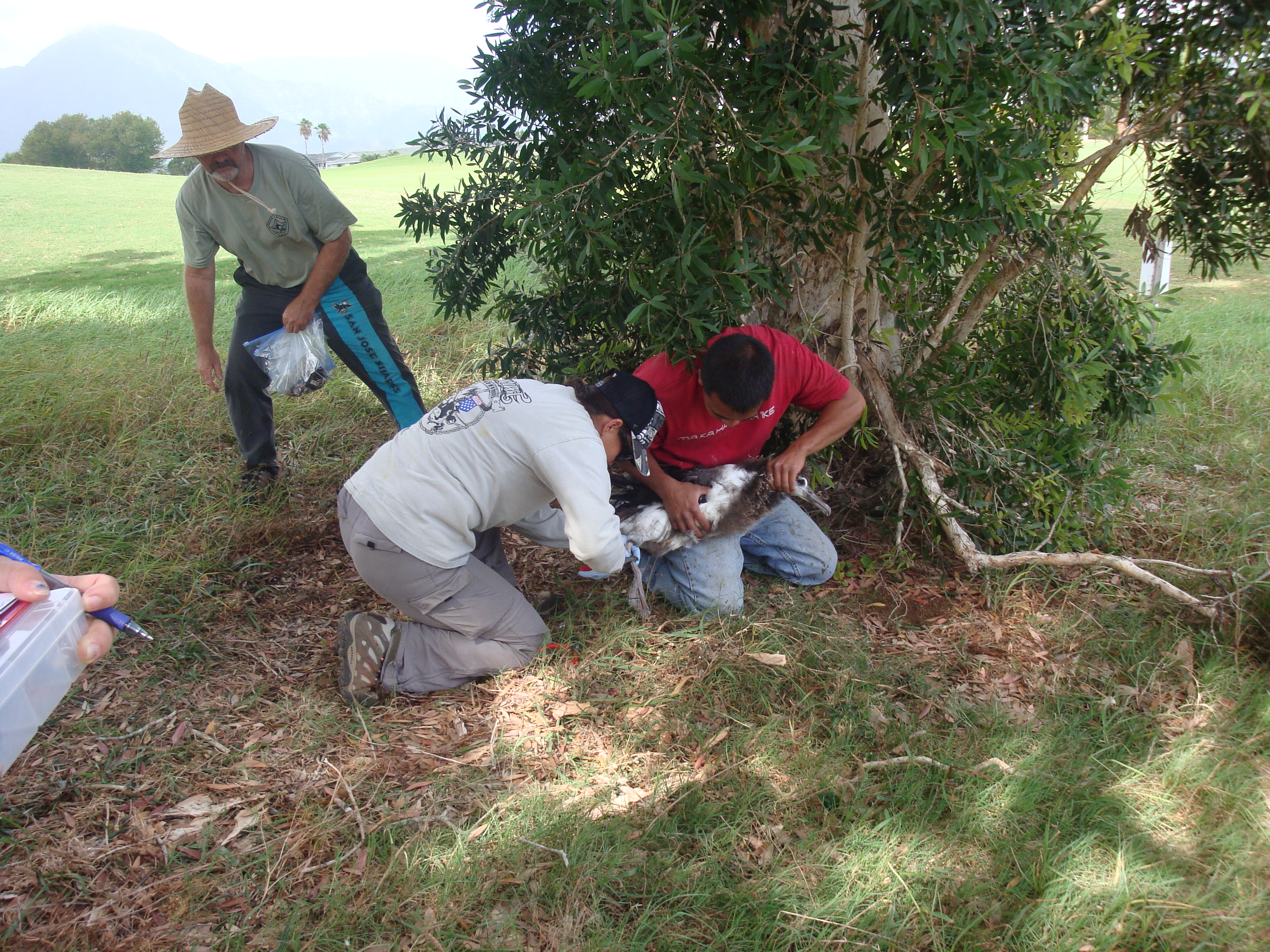
Bongo is holding the chick behind his neck, making sure that his wings are safely folded up close to his body; this prevents injuries to the bird.  If this were an adult, Bongo would be holding the bill closed so he didn’t bite her.  The chicks are not as strong as adults and not as aggressive.
Bongo holds chick while Lindsey does the banding.

In this photo, the chick’s father is waiting in the background while Bongo bands the chick, held by Janelle.  Three of the chicks had parents with them when the banding crew arrived.  In each case, the parent moved away but went back to the chick when banding was over.
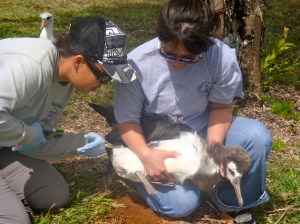
Chick’s father waits for banding to be over.

DOFAW volunteers John Bowen and Roger Brookman collected boluses found near the chicks.  Here John is waiting for a golf course chick to be banded.
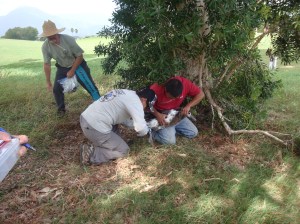
Golf course chick at nest 15 being banded.

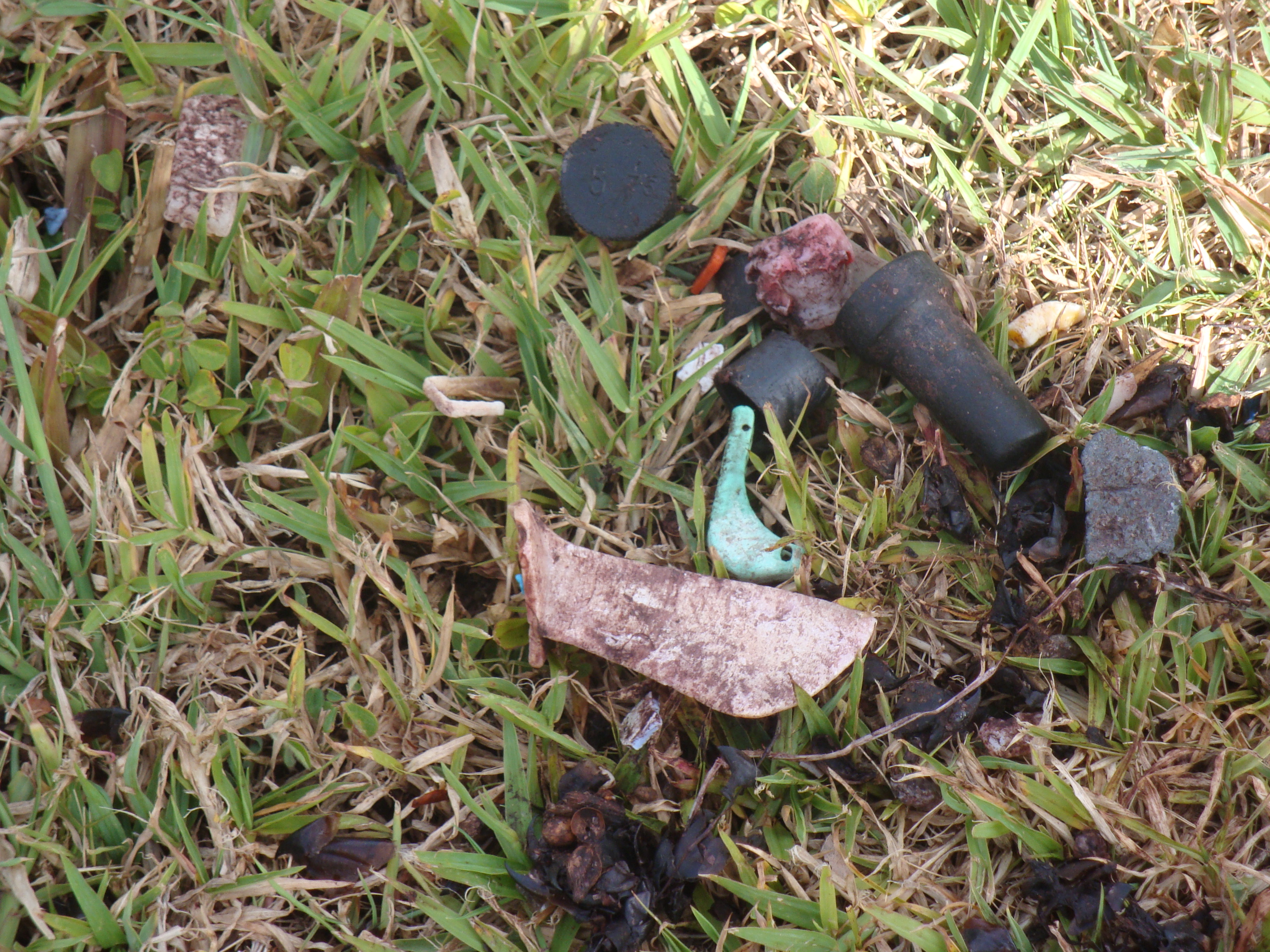
Some of the materials fed to the chick by the parent are indigestible; when the chick reaches a certain age, he is able to regurgitate these items.  Here are some objects found at one nest:
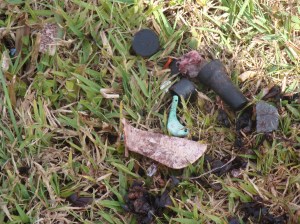
Undigested items from chick’s meal

The natural objects that would be found in a bolus are:  squid beaks, which are made of chitin, a substance which is also found in the exoskeletons of insects and crustaceans; and small bits of lightweight pumice stones, which may have flying fish eggs on them.  The unnatural objects are plastic, from small pieces to items as large as disposable lighters and toothbrushes.  Young chicks are unable to regurgitate, and sometimes accumulate so much plastic in their stomachs that they have not room for other food or even for water.  For more information about plastic in a young albatrosses diet, please see the “It’s dinnertime” entry from June 13th.

Without banding, we would have no way to identify these birds and their lives would remain a mystery.  Their band numbers are like names to an experienced observer.  Every November I look forward to seeing my old friends, like KP874 and KP642, who nested on my lawn 3 years in a row.  I also keep an eye out for the two chicks they raised in my yard, K234 and K555.  Although the literature says they return in 3 or 4 years, it is not uncommon for albatrosses to return to their nest area when they are older.  Last year I had a 7-year old who returned for the first time— the year before that, an 8-year old.  When I see “my” chicks, it will be cause for celebration.

So thanks to Bongo and her crew, to all the volunteers who helped, and to the homeowners who help to protect these birds.  And thank you, Laysan albatrosses, for putting up with the Homo sapiens who sometimes annoy you and who keep showing up in the backgrounds of your lives, and sometimes, I’m afraid, much closer than that.

Posted in Uncategorized | Leave a comment

I can fly! (almost)

Now is the time of year when the chicks are trying out those great big wings.  Eventually, their wingspan will be about 6 1/2 feet.  That may sound like a lot, but consider the fact that the Wandering Albatross has the largest wingspan of any bird, up to 11 1/2 feet.   The length of their wings may be one of the factors that determines when the chicks will fledge.  They generally start to fledge in late June, with the last ones leaving at the end of July or in early August.

Once they leave land, they will be depending on their strength to see them through life at sea, so while they are still on land they must practice using their wings to build up their flight muscles.  This chick was giving it his all yesterday.

Posted in Uncategorized | Leave a comment

It’s dinnertime!

I was watching one of the chicks when a parent landed a couple of houses away.  The chick had been watching the bird flying overhead, as had the other two chicks in the area, and when KP507 finally touched ground her chick clearly recognized her and started vocalizing excitedly.

KP507 ran towards her chick and I started filming them almost immediately.  I did not get close enough to worry the parent; the worst thing an observer could do would be to scare away one of the chick’s meals.  The minute a parent notices me, I move away.

The chick harasses the parent until feeding takes place.  I am guessing that a chick that was ill and could not do this would not be fed.  The chick I was filming was definitely not going to stop bothering Mom until she regurgitated something yummy, probably squid, or fish, or fish eggs, with bits of plastic mixed in.

Albatross parents do not swallow plastic because they think it is a healthy addition to the chick’s diet.  Flying fish eggs are a favorite food, and these eggs will adhere to objects floating on the water’s surface.  For this reason, lightweight pumice stone is often found in a bolus, which is a clump of the undigested parts of a meal that the chick regurgitates.  Pumice stone has smooth edges and will not harm the chick’s digestive system.  It is easily regurgitated.  The eggs may also stick to plastic floating on the ocean.  Plastic may chip and break, exposing sharp edges that can cause damage to the chick on the way down or up.  In some cases, chicks are fed so much plastic that they feel satiated and lose their appetite.  The chicks can actually starve to death, or die of dehydration.

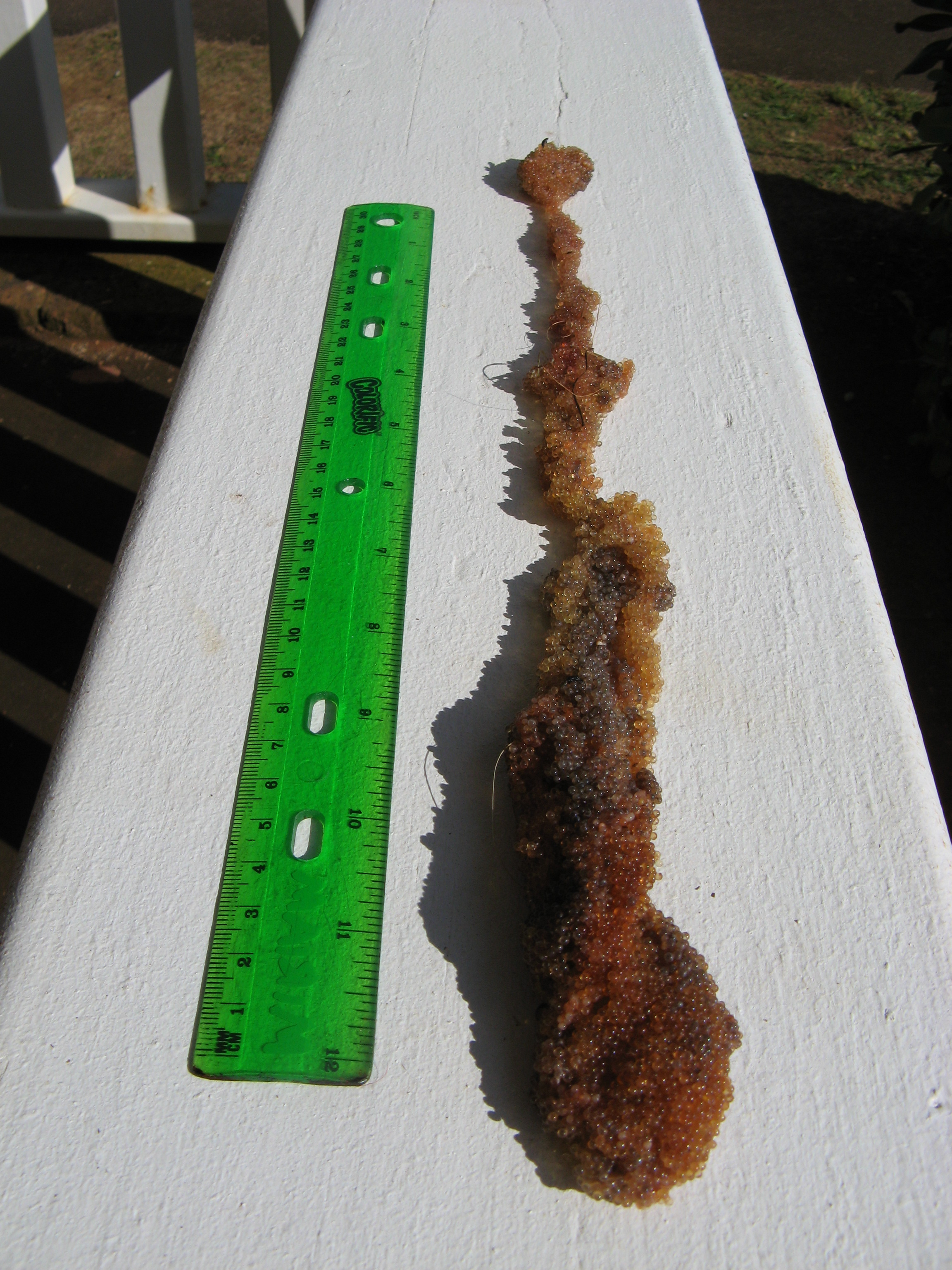
My sister Cindy and I once found a chick who appeared to be choking.  There was a bit of plastic fishing line sticking out of his mouth.  It is always possible for a hook to be attached to this line, so we would never just yank on it, but the line came out easily.  Here is a photograph of it:

Flying fish eggs on fishing line, removed from albatross chick

The pestering of KP507’s chick paid off, and he eagerly ate his meal.  Here is a little film of the happy event:

Posted in Uncategorized | Leave a comment

What do chicks do?

The first chick will probably fledge sometime in the end of June, and some may even wait until August.  Until then, what do the chicks do to pass the time?

1.  They move stuff around.

2.  They watch other birds fly above them.

Chick checks out other birds.

3.  They redecorate.

Home sweet home!

4.  They weed lawns (not too effectively) and try out those big wings.

5.  They work as security guards at building sites.

A comfy nest always makes the job easier.

Posted in Uncategorized | Leave a comment

The Mystery of KP424

Every year one of the first albatrosses to arrive in Princeville is KP424.  In the last 7 years, she has spent from 2 to 10 days in my neighbor’s back yard, always in November when the nesters are first returning.  I have only seen her displaying with other birds twice in all that time, she usually just stands or sits on her favorite lawn.  Then she leaves Princeville and flies to the Kilauea Point National Wildlife Refuge,  where she nests with her mate in an area called Mokolea Point.

Time spent by KP424 in Princeville:

2005-2006: 10 days

2006:2007: 6 days

2007-2008: 2 days

2008-2009: 2 days

2009-2010: 3 days

2010-2011: 4 days

2011-2012: 4 days

I recently found out that KP424 used to nest in Princeville.  There is a record of this bird nesting here in the 1993-1994 season.  Unfortunately, record keeping was very sketchy in the 1990s so we do not know when else she may have nested here.  But we do know that in every season since 2005-2006 she spent her first days back on land on my neighbor’s lawn, then flew to the KPNWR to nest with her mate there.

Why?  What practical reason is there for this behavior?  What draws her back to Princeville every year, taking days away from her nesting schedule?

The more I observe these birds, the more I realize that they are more complicated individuals than they have been given credit for.  That makes observing them such a splendidly satisfying way for me to spend my time.

Posted in Uncategorized | 2 Comments

the fate of the rhinoceros

I timed my trip to Los Angeles to coincide with an important event put on by zookeepers every year at zoos all over the country.  Zookeepers are not isolated people who care only about the animals at their zoos, they are conservationists deeply concerned with the survival of these animals in their wild habitats.  They are not the best paid people in the world, but they can convince zoo volunteers and paid personnel to volunteer their time to raise money to send to parks in Africa and Indonesia to support all five of the remaining rhino species.

Thus was born “Bowling for Rhinos,” a national bowl-a-thon that answers the question, “Can a charity event that donates 100% of the money it raises to save rhinos and their habitats be more fun than any party has a right to be?”

The answer is, “You bet!”

Unfortunately for rhinos, not everyone appreciates their unique personalities and body design.  People who make money by selling animal parts have decided that rhino horn is a cure for cancer.  Their horns are made of keratin, the material that our fingernails are made of, but to ignorant people susceptible to fairy tales, keratin may be the miracle drug.  They may as well chew their fingernails.

Rhinos are now in so much danger that zoos are putting special guards on their rhino exhibits.  Even stuffed heads of rhinos hanging from the walls of hunters have been vandalized for the horns.  Rhinos in the wild are disappearing with terrifying dispatch; in South Africa alone, almost two rhinos are being killed every day.

There are five species of rhinoceros:  black rhino, white rhino, Indian rhino, Javan rhino and Sumatran rhino.  I once went with a group of docents, keepers and friends to see Sumatran rhinos that were being held in a zoo in Malaysia.  Did I tell you that zoo people plan their vacation trips around what animals they can see?  Sumatran rhinos are smallish, hairy, and very talkative, making a sound that reminded me of humpback whales.  They are harmless animals that can not cure any disease.

Last year, the Javan rhino became extinct in Viet Nam, and the African Western black rhino was also added to the growing list of extinct species.  They are lost forever because of the greed and ignorance of human beings.  Every time we lose a species, the world is diminished; it can never be restored to completeness.

So Bowling for Rhinos is one chance for humans to show that there are plenty of people who do care about these animals, who do not want to live in a world without them, people who may never see a rhino in the wild but who want to be assured that they are still there.  I always cringe when I hear someone ask, “What does this animal contribute to the world?”  No non-human animal has ever produced world wars, or Holocausts or Great Inquisitions, those contributions are specifically human.  But they do give us a glimpse of the timeless beauty that we can still see in the world if we keep our eyes and our hearts open.

Posted in Uncategorized | 1 Comment

Chimpanzees and me

I know this is an albatross diary, but I want to explain why I am traveling to Los Angeles and leaving my albatross observation for the next 11 days in the capable hands of my sister, Cindy.

For 27 years I have been a docent at the Los Angeles Zoo.  The docent training program there is one of the best, if not the best in the country, a 23-week training course taught in conjunction with UCLA Extension.  If you are the kind of person who is interested in all types of animals, this is the perfect type of education; you also meet other people with the same interests, the sort who love to watch those nature shows about animals most people have never even heard of and don’t care about.  We zoo people care!

I go back to Los Angeles twice a year to get some volunteer hours in and to catch up with the latest zoo collection events: births, deaths, acquisitions.  I also go to visit my friends, both human and chimp.  Since I started as a docent, I have worked primarily with the chimpanzees.  I began as an observer for ChimpanZoo, a project run by the Jane Goodall Institute to study the behavior of captive chimps, and then I moved into enrichment.  With other volunteers I worked to provide novel experiences for the chimps, usually connected to the search for food.  For example, we stuffed little holes in dead tree limbs with food items, then left branches to be modified as tools for digging the treats out.  The two best at this were Toto, the old man of the exhibit, and little Gracie, just a few years old.

Toto died a few years ago, leaving his many human admirers missing his toothless smiles and exuberant greetings.  He loved to race people from one wall to the other in the back of the exhibit, but he habitually cheated by running back to the start before touching the wall.  I once joined a group of people for an evening behind-the-scenes tour at the chimp exhibit.  Toto scanned the crowd, saw me, and did a double-take, as though he could not believe his good fortune at seeing my familiar face.  Immediately he started into his pant hoot routine, beginning with slow, soft hoots, ending with a loud, raucous display.  I felt deeply honored.  I understand that when Jane Goodall met Toto, she was totally charmed.

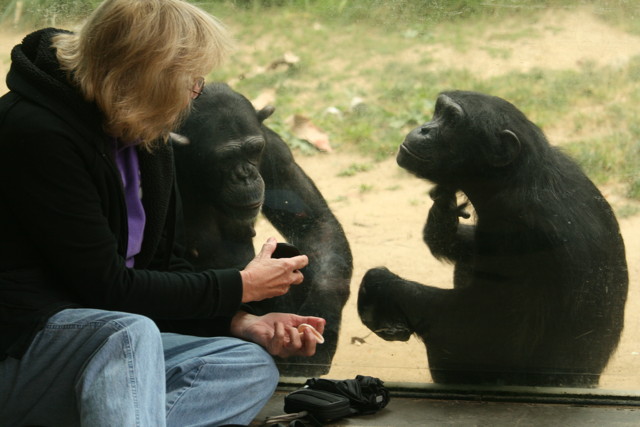
This is a photo my friend took last year when I visited the chimps.  The one on the right is Jean, Gracie’s daughter.  Gracie is now in her early twenties.  Jean always comes over to sit by me when I am at the exhibit.  Zoe is the other chimp, and she is looking at her reflection in my mirror.  They are both pretty young ladies, teenagers as of this year.  I remember them as babies, just as I remember seeing Gracie for the first time with her mother, Pandora.  Gracie had another daughter this year; I am looking forward to seeing the two of them.  And I will sit with Jean, and whoever else might join her.  I don’t need to say anything to Jean, she seems to just enjoy my company.

Did I say I am a very lucky person?

Cathy, Zoe and Jean
photo by Anita Machlis

Posted in Uncategorized | 1 Comment