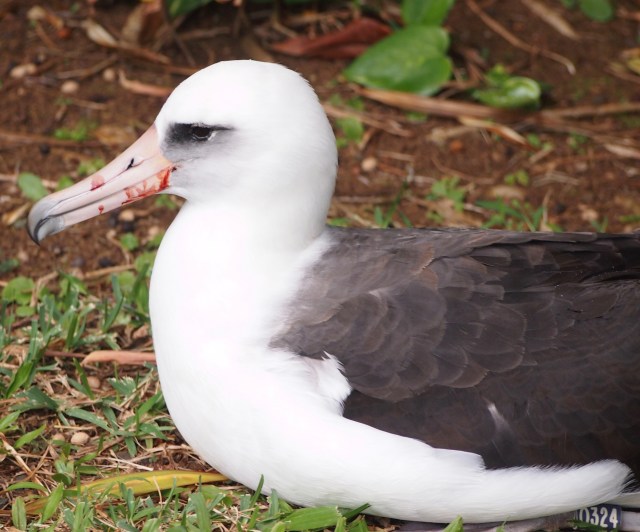
After being attacked by K233 and his new mate, purpleO324 left Princeville. But first she spent the night less than 20 feet from her former mate and KP465.
I looked back at my data and found that the year before she first mated with K233, purpleO324 was in Princeville on 50 days! It is an accepted “fact” that an albatross spends a small fraction of time on land, but 50 is close to two months. That is not 50 days straight, she obviously had to eat occasionally. She tried different areas of Princeville and associated with a number of birds before finding K233. In that same year, K233 was here for 33 days.
In their next non-nesting year, 2010-2011, she was here for just 15 days, and K233 was here for 35 days. They displayed what I call married couple behavior, quiet contact, on 9 days. She never socialized with other birds, but K233 displayed with other birds on 7 days.
Their next non-nesting year was 2012-2013. PurpleO324 was here for 9 days, her mate for 21. They were engaged in quiet contact on 3 days, and he displayed with other birds on 3 days.
Last year, they displayed together on one day, and had quiet contact on another.
K233 also displayed with 4 different birds, but then displayed 4 times with KP465 and had quiet contact with her on 2 other occasions. That might not sound like an impressive amount of time, but he was with his mate only twice.
It is always tempting to give them attributes we associate with humans, but we really should not judge them when they fail to live up to the expectations we have for people. So even though I felt terrible when I saw the blood on purpleO324’s bill, and saw how isolated she was from her former mate, I am not going to judge K233 the way I would judge Homo sapiens. They are birds, that’s a pretty good excuse.
I talked about K233 in my last post. He and his mate, purpleO324, have been together since the 2009-2010 season, and have raised 4 chicks together.
Last season, they did not have an egg.
If I ever run a marriage counseling office for albatrosses, one of my first rules will be, “In seasons when you are not nesting, make a point of coming back to your home base frequently; work on keeping your relationship with your mate strong.”
Last season, K233 came back on November 18th. He waited alone for 4 days, then purpleO324 returned, and they displayed together. They were together on only one more day, and she was here for another 2 days on her own.
But another female, KP465, spent a total of 41 days in Princeville, and K233 was here for 29. They spent at least 5 of their days here together, either displaying or gently grooming each other. That was enough to convince K233 to end his partnership with purpleO324.
My neighbor saw two birds in her yard attacking another, and she said the third bird was bleeding. I got my camera and went over to see.
As of yesterday, there were 4 albatrosses in Princeville. I told you about KP400. The others live down the block from me.
I watched K233 get banded by Brenda Zaun, USFWS wildlife biologist, in 2007. Since he was unbanded, nothing is known about where he came from or how old he is. His mate, purpleO324, was originally banded on Whale-Skate Island in French Frigate Shoals in the Northwest Hawaiian Islands in June of 1989. Then she was rebanded by Lindsay Young at the albatross colony at Kaena Point, Oahu. By the late 1990s, Whale-Skate Island was completely submerged, thanks to the rising sea level associated with climate change, so this albatross could not return to her original home if she wanted to. She first came to Princeville in 2008. She and K233 started spending time together.
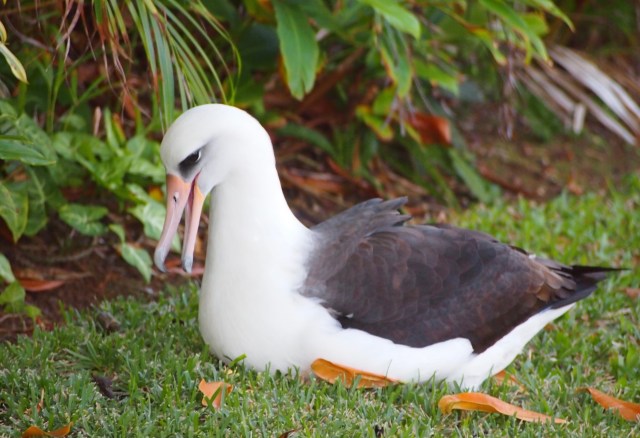
K233 talking to himself
They first nested in the 2009-2010 season, and raised a healthy chick. They have raised 3 more since then.
The other two males that returned were sitting about 10 feet away from each other. If they were people, this part of the story would be a soap opera. To make this a bit easier, I am going to give them names. KP424 will be Bob, KP531 is Steve, KP467 is Mary and K112/A478 is Ann.
When I first started to observe, Steve and Mary were a couple. In fact, they successfully raised 6 chicks in a row, which is quite an accomplishment. The following season, 2010-2011, Mary laid an egg but she would not sit on it, and neither would Steve. Perhaps they knew if was time for a rest. During this season, Mary was in Princeville for 25 days; Steve was here for 50. During those 50 days, he spent some time with Mary, but he was also displaying with other females. In fact, he came to know Ann during this time, and they engaged in the quiet contact I associate with nesting couples.
In the 2011-2012 season, both Mary and Ann laid eggs, and I would assume that Steve had fathered them both. He had to decide which egg he would help incubate, and he picked Ann’s. Mary had to leave her egg eventually, and it never had a chance to develop.
I wrote about Steve and Ann’s relationship in my blog post of January 6, 2015, so I will not repeat that. It is another episode of the albatross soap opera.
And what happened to Mary after Steve left her for Ann? She met Bob.
Bob nested in Princeville in the 1993-1994 season. I have never seen an albatross younger than 5 nest, so he is probably at least 28 years old. Since at least 2005, he was nesting at the Kilauea Point National Wildlife Refuge. But every year he stopped first in Princeville, staying here for 2 to 10 days before flying to the refuge to nest with his partner.
His partner eventually failed to return to the refuge, and Bob relocated to Princeville. In the 2012-2013 season, he spent many quality hours here with Mary, now on her own after Steve left her. Bob and Mary nested in the 2013-2014 and 2014-2015 seasons and raised two chicks together. They came back last season, but did not nest. However, they did spend time together here, and I saw them displaying together and sitting quietly grooming each other.
If Bob and Steve were humans, they would probably not be as likely to share my neighbor’s back yard.
This is why I must observe them every day. Their lives are rich in variation and filled with surprises. As I always say, the more I learn about them the less I “know.” They always challenge what I think I understand about them and keep me interested enough to keep trying to figure out what it is to be an albatross.
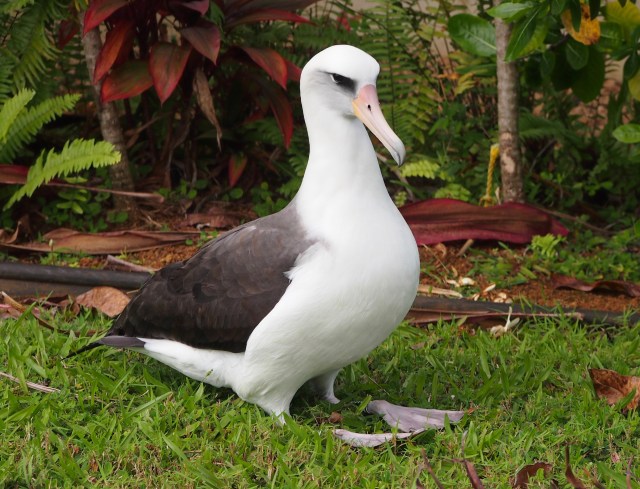
KP400 is always one of the first albatross residents to return to Princeville, after several months of fattening up on all the ocean goodies, perhaps flying as far north as Alaska.
KP400 – First albatross to return to Princeville
He was raised in the same neighborhood that he returns to every year. He fledged in 2003, then first returned in 2007. In 2009 he nested with K206, and they raised three chicks together. Sadly, his mate did not return in the 2013-2014 season, but he met another female, bluKP216, and they nested together the following two seasons.
In both seasons, this couple had a fertilized egg that did not result in a chick. Both of them incubated these eggs faithfully. Let us hope that this year they are able to raise a healthy young one. KP400 was a devoted father, and judging by his mate’s ready acceptance of incubation duties, she should be a superb mother.
I was interviewed by a Princeville homeowner and writer, Mary Ann Colihan, for the July/August issue of the Troon Golf & Travel digital magazine. The story is about the albatrosses who nest on the Makai Golf Course. If you would like to read about them, please check it out.
I took this photo of Manu, the last chick left in Princeville. His mother had returned to feed him, and in the photo he is just beginning to tap on her bill to beg her for food.
Manu and Mom
You have probably noticed the baby feathers adorning the heads of the chicks. Many still has most of his left, but as they lose them they sometimes end up looking like “Three Stooges” characters, or like Bozo the Clown or Harpo Marx. Notice Mom’s head feathers. The nesters all show molting on their heads at this time of year. You may also see a black spot on her head. That is one of the ectoparasites that inhabit the bodies of albatrosses, either a louse or a flat fly. I read that the waved albatross, which lives in the Galapagos Islands, is critically endangered, and that the louse that is only found on that bird is critically co-endangered, a new expression for me. Why would this matter? Who really cares if a louse is endangered? Ew, gross!
For anyone who might find this topic interesting (and as a founding member of the Slug Appreciation Society comprised of some of the odder Los Angeles Zoo docents, I am afraid that I count myself in that weird little group) please read this short article from ACAP, the Agreement on the Conservation of Albatrosses and Petrels. You can follow a link to an article in Oryx that is actually quite fascinating, in a lousy, parasitic sort of way.
The ACAP website, by the way, has short articles about the latest research related to albatrosses.
And if you think parasites are quite fascinating, check out the book Parasite Rex, Inside the World of Nature’s Most Dangerous Creatures, by Carl Zimmer. It is a world most people are happily unaware of, with life forms much more terrifying than than any old prehistoric dinosaur.
I saw him when I walked my dog earlier that morning. He gave Chico stink eye as we walked by, as he always did. Ten minutes later I glanced out my living room window. My neighbor, Roger, was looking around the area where Kirwan had just been sitting. Roger shrugged as if to say, “I can’t find him!”
I grabbed my gear and went outside. Roger was already walking down Keoniana Street, and indicated that Kirwan was walking ahead of him. We followed him as he headed down the street. I contacted a few people who do not mind getting 6:30 A.M. calls and who will stay to observe an albatross if I have to leave to check on another bird. My backup team!
Kirwan spent most of he next hour and a half exercising his wings.
Keoniana Point is a favorite takeoff and landing spot for all of the local albatrosses. There is no vegetation but grass along the area that they leave from. If there is any wind in the area, it can be felt there. The ocean winds come directly at them. I have seen a fledging that began as a chick was being lifted off of his feet by a strong breeze, then the chick flapped his wings and steered out over the ocean.
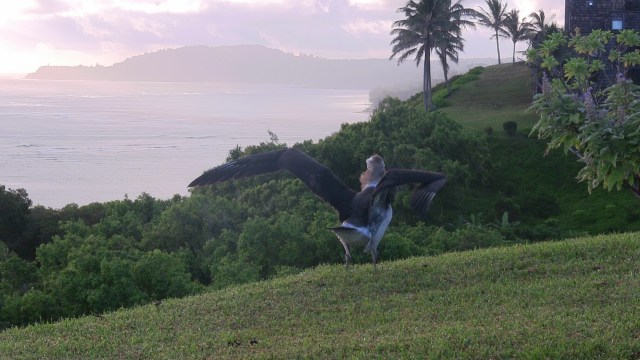
In the photo below, the point of land above the ocean to the left is the Kilauea Point National Wildlife Refuge. The trees below the hill where Kirwan is standing are in the area where the path to Sealodge Beach is located. One year a chick took off and we watched her fall slowly into those trees. Roger and I went down to the Sealodge path and found her thrashing around in a tree at the top of a cliff. I was afraid she might hurt a wing. We could not find any younger person willing to risk breaking something to climb up after her, so I made my way up up and grabbed her while Roger followed, testing shrubbery right below me and showing me where to put my feet when I carried her down. The bird did not move at all while I was carrying her down the cliff, but the moment I stepped onto flat ground she bit me. When we got to a little stream that involved a bit of boulder hopping, an activity which I shun, I waded in after telling Roger, “If I start to fall, grab the bird!” He said, “I know!”
Kirwan scans the area
There is a vacation rental located on the next promontory of land to the west of this one. The people who are currently renting it were walking by during a previous fledging and had come out then to see what was going on. They had patience enough to wait for some time and were hooked when they got to see the chick take his first flight. During Kirwan’s fledging, they saw us out there from their rental house and came over. Two fledgings on one trip! I don’t know how the home owners will top that if this family comes back next year.
Kirwan tried another part of the bluff, perhaps feeling how the breeze felt in a different area.
As the wind grew stronger, his wing flapping increased in intensity. Near the beginning of this clip you will see him do a “sky moo.” This is a part of the albatross courtship display; the albatross lifts up his bill to the sky and makes a soft mooing noise. When an adult is doing it, it does remind one of the noise a cow might make. However, when a chick does it, he seems to do it when he is alone and is excited about something, and the sound he makes is so tiny that it is usually difficult to hear.
The flapping continued to intensify. Often the chicks poop just before fledging. To a bird, particularly to a chick making his first flight, every tiny bit of weight counts.
At last the moment Kirwan has been gearing up for.
Bye bye, Kirwan! I’ll see you in 4 or 5 years! If you should run into your mom and dad, please tell them that I am saving a patch of garden for them for their next chick. That offer is good for you, too. The moment I first see you back here, I will notify the humans who watched you leave Princeville. They will remember that moment when your feet left the ground and you flew off into adulthood. Such a great leap for one so young, so inexperienced.
I wish you tons of squid, and fish, and flying fish eggs, and the wisdom that will make you a good parent. I hope all of your future journeys are safe ones, and that you find your way back here when instinct compels you to return to us.
Princeville is a safe harbor in many ways, visited and lived in by people who will always value the wild things that are still left on this island, and who realize that it is their responsibility as human beings to offer them sanctuary. It is not always easy or convenient, but in the words of a native American proverb, we do not inherit the world from our ancestors, we borrow it from our children.
Almost two weeks ago I got a call from a friend who lives next to the Makai golf course. She had seen one of the chicks walking down the fairway straight towards the ocean, with the confident stride of one who knows where he is going. That is the sure sign that a chick will be heading out to sea for his first flight, the one that ends his childhood and throws him into the big, adult world of the Pacific Ocean.
Of course I hurried over to watch. It was Moses, the oldest of the chicks. There were three of us humans there, and we watched him wander around the fairway a bit. Then we followed him across to the center of the golf course where four more chicks are located. He riled up a couple of them. They were the first albatross chicks he had ever seen.
The first chick he met was Glitter. That’s Moses on the right. Glitter was interested in this new bird, but was not very welcoming.
I love their squeaky, high-pitched albie chick vocals.
Then Moses checked out the Pacific Ocean. His nest was in a yard halfway down the fairway, so he had not really seen the ocean before, except as a distant band of blue.
He wandered around the course a bit more, just missing some golfers aiming at the seventh hole, then met the chick Dory. Dory is the first child of Dixie, who was named by my neighbor Heather for the Dixie Chicks. Dixie fledged from my neighborhood in 2007, and this is her first chick. Her parents are currently raising a chick named Paris in Heather’s yard.
Moses made a few more practice runs. Chicks cannot sustain much height when they fly, unless they have consistent breezes to buoy them. That is why they need to fledge over the ocean. They evolved on islands and spend most of their lives at sea, so they are not equipped for long flights over land. It would be almost impossible for a chick to fledge from a nest far removed from the ocean. Even if the wind blew in the right direction, there may be obstacles to crash into and predators along the way. On Kaua’i, even though there is a county-wide leash law, there are many people who do not obey it. An albatross chick coming in for a landing would trigger aggression in many dogs. Princeville is unique in that respect, residents agree to rules that include the leash law.
Glitter saw the attempts Moses made, and decided to try some as well.
I was on the golf course for about three hours. Moses spent most of that time asleep, resting up after his exertions. I returned the next morning at 7:30 A.M., but he was still sound asleep.
He fledged about two hours later. I heard that he stumbled a bit at the ledge, but regained his footing and stepped off into his new life as an adult albatross.
Here is a photo of him that I took several days before he fledged. He lost almost all of the baby down before he left. That does not always happen, some chicks fledge with lots of baby feathers left.
Moses
I will not be seeing him for at least 3 years, probably more. I may see him interacting with some of the other albatrosses. Or I may get a call from someone who is concerned about an albatross that seems to be having a problem walking. Maybe his leg is injured. I will see if either leg is discolored, or swollen, or at an odd angle. If not, I will check my list of every chick who ever fledged from Princeville.
And then I see the band number, H227. Moses! Fairway 6, Makai course. I will remember his father, KP304, who was a chick in a nest within sight of where Moses was raised. His mother, K674, was unbanded when she first arrived in Princeville. I will find my storage box labeled “2015-2016” containing 12 field notebooks, and find the one describing the last days Moses spent in Princeville. I can check this blog to see the film showing his first steps to adulthood. My Moses memories will return, and I will be happy to record that he returned to his home.
Sometimes when a chick returns for the first time since fledging he comes back just once or twice during that initial season. Even observing every day I miss many of these special days. I think they may sometimes come back the first time somewhere else, perhaps an ocean bluff on another part of the north shore. I hate missing that piece of data, that is a part of the reason why I have to observe them every day. It drives me crazy to miss so many first returns, but if I checked them less often I would probably never see any of them.
There are plenty of times when I really do not feel like driving around to check on all of the albatrosses in Princeville. I give up travel from mid-November to early August, even missing the annual Pacific Seabirds Group Conference, which I will probably never get to attend. Then I remember when I saw an albatross on fairway 14 who was stumbling around, talking to himself, periodically sitting down when walking seemed to be too difficult. It was Tater, a chick who had been raised outside my mother’s window, and he was trying to get his land legs after 6 years at sea. He fell down when he tried to groom himself while standing. He had no idea how to interact with other adults, but he was willing to try. When he fell against another albatross while attempting a clumsy display, he was displaying his eagerness to get into the game, to learn the albatross Code of Conduct, no matter how inept his initial efforts were.
That is when I realized that I will be doing this until they cart me away, there is just too much to learn about these individuals. I will not get rich doing this, every year I spend a small fortune on recording behavior, making signs, and maintaining my blog, not to mention many long hours, and being on call for albatross emergencies in Princeville. But the whole point of what I do is not to make money, it is the pure pleasure of finding things out. I get to observe these long-lived, interesting birds that do not live on a deserted island, but in the middle of “civilization,” which they tolerate with aplomb.
It has been a monumental pain in the tuchus. And it has been a singular privilege.
Now is the time when we are starting to see the albatross chicks try out those beautiful, big wings, particularly when there are strong winds. I have seen Kirwan practicing a few times, and I do not always carry my camera with me so I do not have an extensive film library of his attempts. But here is a little film I made combining a couple of days of his efforts.
An adult albatross can take off by running and flapping his wings vigorously. A chick flies low, they cannot gain the height needed for sustained flight over land. It will take more experience to strengthen the wings enough for adult flight. That is why they must be near an ocean bluff or on a beach to take off safely. They must fly into the wind, and they will be safe if that wind is blowing off of the ocean. Once over the ocean, they can utilize air currents that will help them remain in the air.
When someone told me that she thought an albatross chick could take off by flying down a hill, I thought of the poor chick who tried that in a greenbelt in Princeville, hit a tree, and broke his wing. These are not experienced flyers, they need all the help they can get. If the hill is overlooking the ocean, great. If there are any obstacles between the chick and the ocean, not so great. And if the breeze is blowing from somewhere that is not safe for an albatross chick, that is potentially the end of a short life.
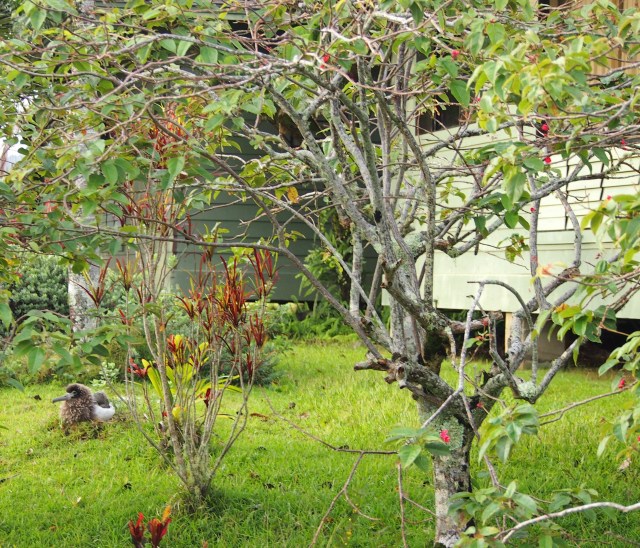
When I was editing my film for yesterday’s post, I heard the distinctive sounds of an albatross chick below my living room window. Kirwan could hear his food-begging vocalizations on the tape, and I think he wanted to know why there was a chick in my house, possibly stealing one of his meals. Was Mom in there, too? He had moved from his stump, where he was sitting in this photo, to a spot under my window.
Kirwan sitting below my window
When I opened the curtain to see, he was looking up at me. Of course I did not have my camera there, so I ran to get it. when I came back, he was checking under my house for that albatross.




 My Albatross Diary