Happy Thanksgiving!

Here is your Happy Thanksgiving news….

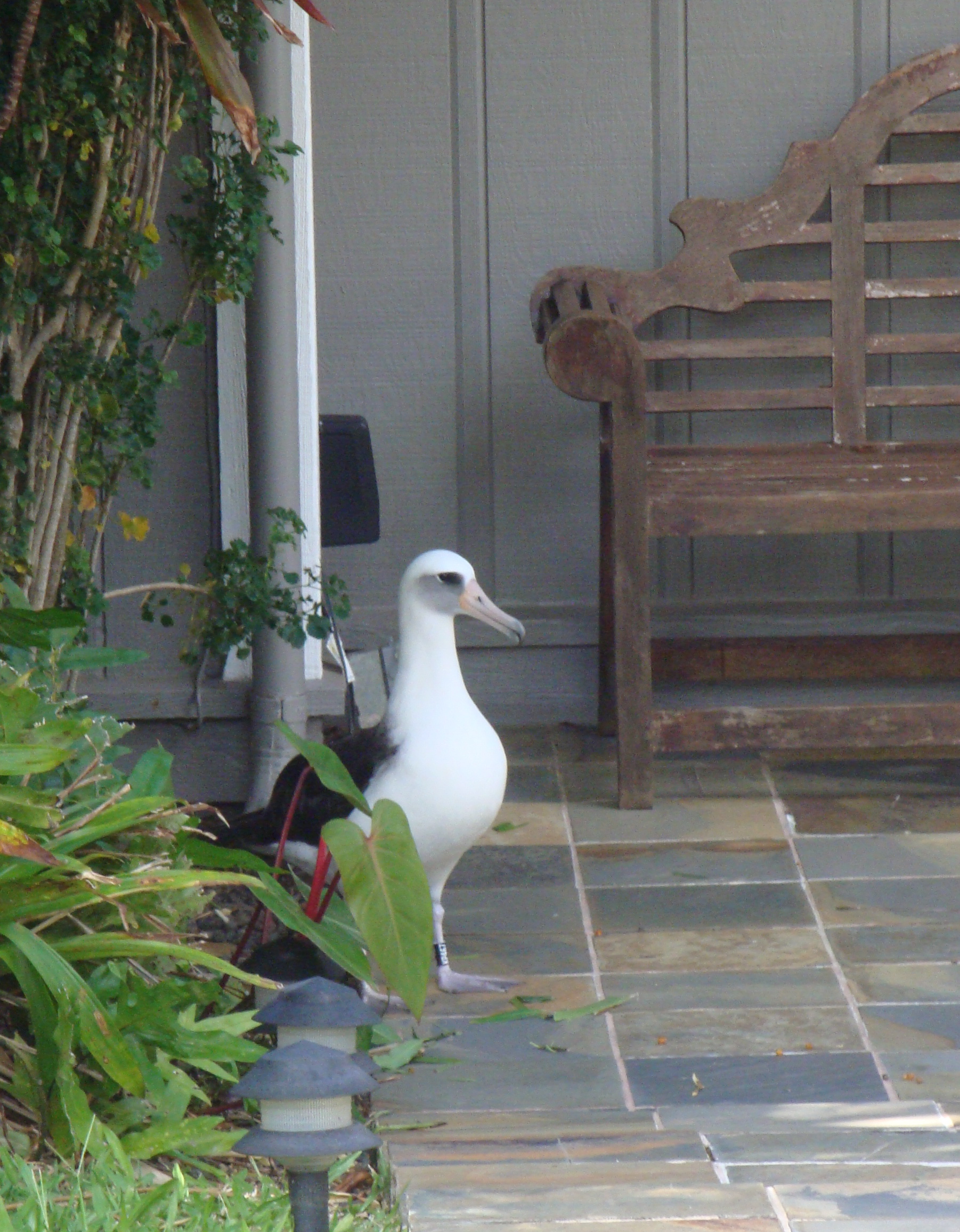
KP467 at nest #1

We have our first egg in Princeville.  KP467, one of the topics of yesterday’s post, was sitting on the egg in the mid afternoon.  There isn’t much to the nest right now, but the parents will improve it as the days go by.

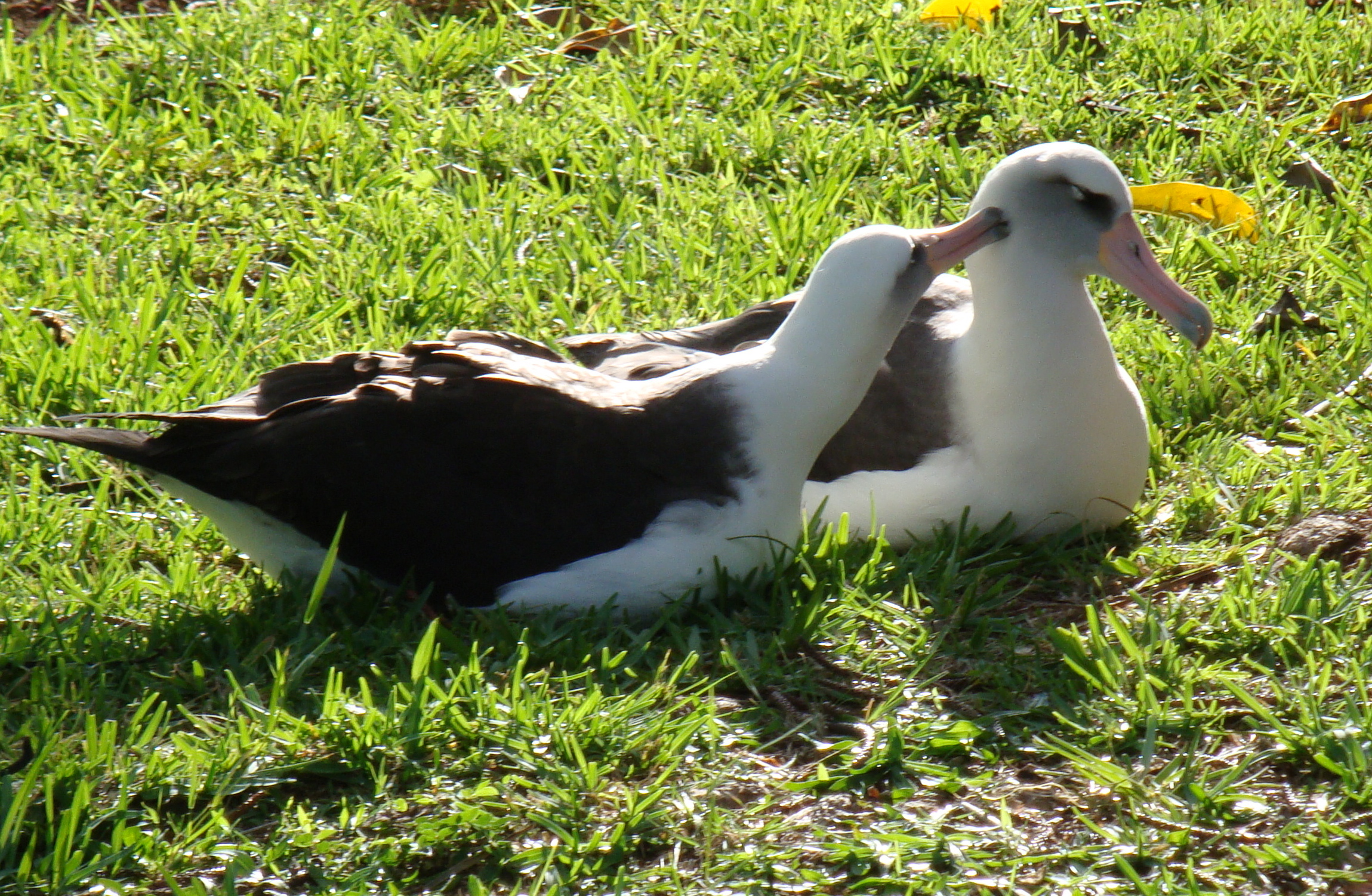
Her mate, KP531, was over in the next yard watching and vocalizing with birds next door.  Bob Waid calls him the Walmart Greeter, because last season this bird would often sit where he could meet albatrosses as they walked into our street after landing on a favorite bluff.  One of his favorites was K112, the bird he was displaying with yesterday.  They were also grooming each other, as the photo below shows.  KP467 could see them from her vantage point in the next yard.
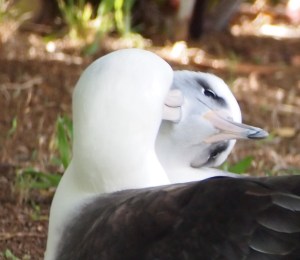
KP531 and K112

I expect to find Kp531 sitting on the egg at nest number 1 tomorrow.  KP467 will need to go out to sea and eat, to build up her strength for the months of incubation and chick feeding to come.  It is not unheard of for a male to take a while before sitting on the egg. Two years ago I observed one who took 15 days to finally accept his fatherly duty.  During that time he would sometimes sit near his mate, but he did not seem too eager to replace her on the nest.  Once he did, though, he accepted his fate and was a dedicated parent.

KP531 has been raising chicks with his mate for at least as long as I have been collecting data.  That instinct is strong, and I have faith in its hold on him.

Don’t make a liar of me, buddy!
 

Posted in Uncategorized | 2 Comments

Albatross drama

There is a little bit of albatross drama going on in my neighborhood.  Last week,one of the first birds to return to Princeville, KP467, met up with her mate from previous years, KP531.  Last year this couple abandoned their egg soon after it was laid.  Today I saw KP531 displaying with another bird, K112.  I knew I had seen them together last year when KP467 was gone, so I checked my database from last season.  I found 6 days when I observed KP531 and K112 in quiet contact, the gentle grooming and nuzzling that nesters do. KP467 may very well lay an egg this season.  Will K112 lay an egg, too?

We may have a threesome here, rather than the more traditional couple.  I have seen two of these in Princeville: two females and one male, with two nests near or at least within sight of each other.  In each case, the male did not go back and forth between the two nests, incubating two eggs.  He chose one female’s egg to incubate.  The other egg did not survive.  There was a threesome on the golf course that nested like this from 2007 into 2010. In spite of the fact that the male never sat on her egg, the second-fiddle female, KP470, stayed in that relationship. Here’s an interesting fact. The year before she joined the others in the threesome, KP470 incubated an egg for 54 days straight. No male ever sat on that one, either.

The more I observe the albatrosses and pore over my data, the more I realize that it is not so easy to make generalizations about these birds.  Just think of KP470 sitting on her egg, day after day, with nobody coming to relieve her.

What albatross pattern of behavior does that fall under?

Posted in Uncategorized | 1 Comment

More and more albatrosses

I was asked how many albatrosses I had seen so far so I checked my data.  I  was surprised to find that as of today I have already seen 29.  Of those, 28 have nested in previous years.  The one who has not, unfortunately, is unbanded.  I checked last year’s data and found observations of one banded bird in that area who had an unbanded partner that he was spending time with in the quiet contact typical of nesting couples.  If they nest I hope we can get a band put on this mystery bird.

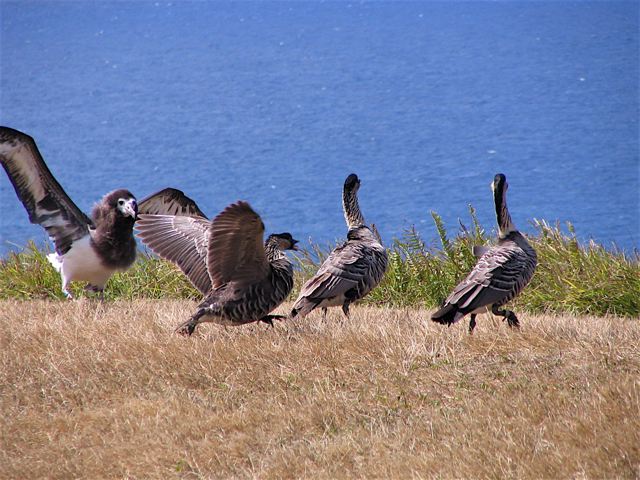
One of the golf course nesters may have been chased off by nenes.  Many albatrosses are intimidated by these Hawaiian geese, who can be quite aggressive during their nesting season.  Sometimes the nenes chase albatrosses coming in for a landing at Albatross Hill at the Kilauea Lighthouse.  About six years ago we had an albatross chick in our neighborhood that turned the tables on the nenes.  Papaya was at a safe fledging spot but was in no hurry to leave.  A few nenes landed near him and started to chase him.  Did he run away?  Check it out:

photo by Cindy Granholm

Papaya came back to Princeville last season at the age of five.  He made his first appearance on the golf course, where I saw him trying to stand up on his wobbly legs and not having much luck.  The next day he was back in the neighborhood where his nest had been, displaying with a four year old named Dixie.

I’ll be happy to see him again this season.


Posted in Uncategorized | Leave a comment

A few albatross tidbits

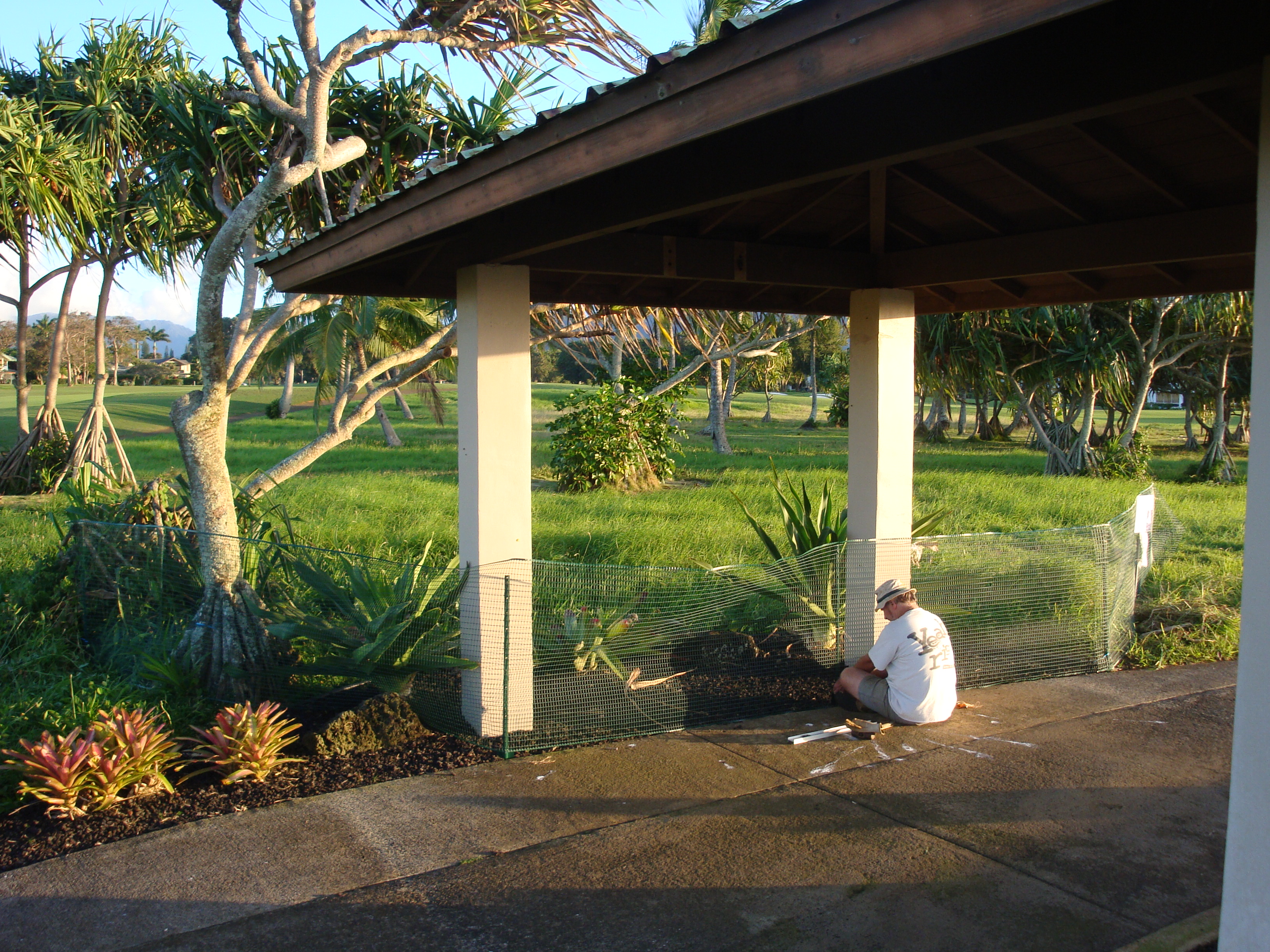
I wanted to add a note to my last post, about Gaga and the fence we had to put up to keep her off of the golf cart path.  The fence did not totally surround her, it just separated her from the path.  The parents might be able to get into an area that is totally fenced off, but unless the fence covered a very big piece of property, they would not be able to leave.  They need to be able to run to take flight.  We were lucky Gaga never figured out that she could have walked around the fence.

Most of the albatrosses that I see at this time of year are the birds who have nested in the area before, along with some new nesters that spent a lot of time with each other last season. Usually the males come back first and wait for their mates. Sometimes, the female is the first to return. Timing is everything, because the eggs will be laid in late November and the first half of December. If the mate returns too late, the couple will not nest that season.  Today I saw an albatross I mentioned in another post, one who nests at the Kilauea Point National Wildlife Refuge.  Every year this bird shows up on the Hoglunds’ lawn either with the first nesters or in mid-December.  Why?  Do any birds from this area show up like that in other places?

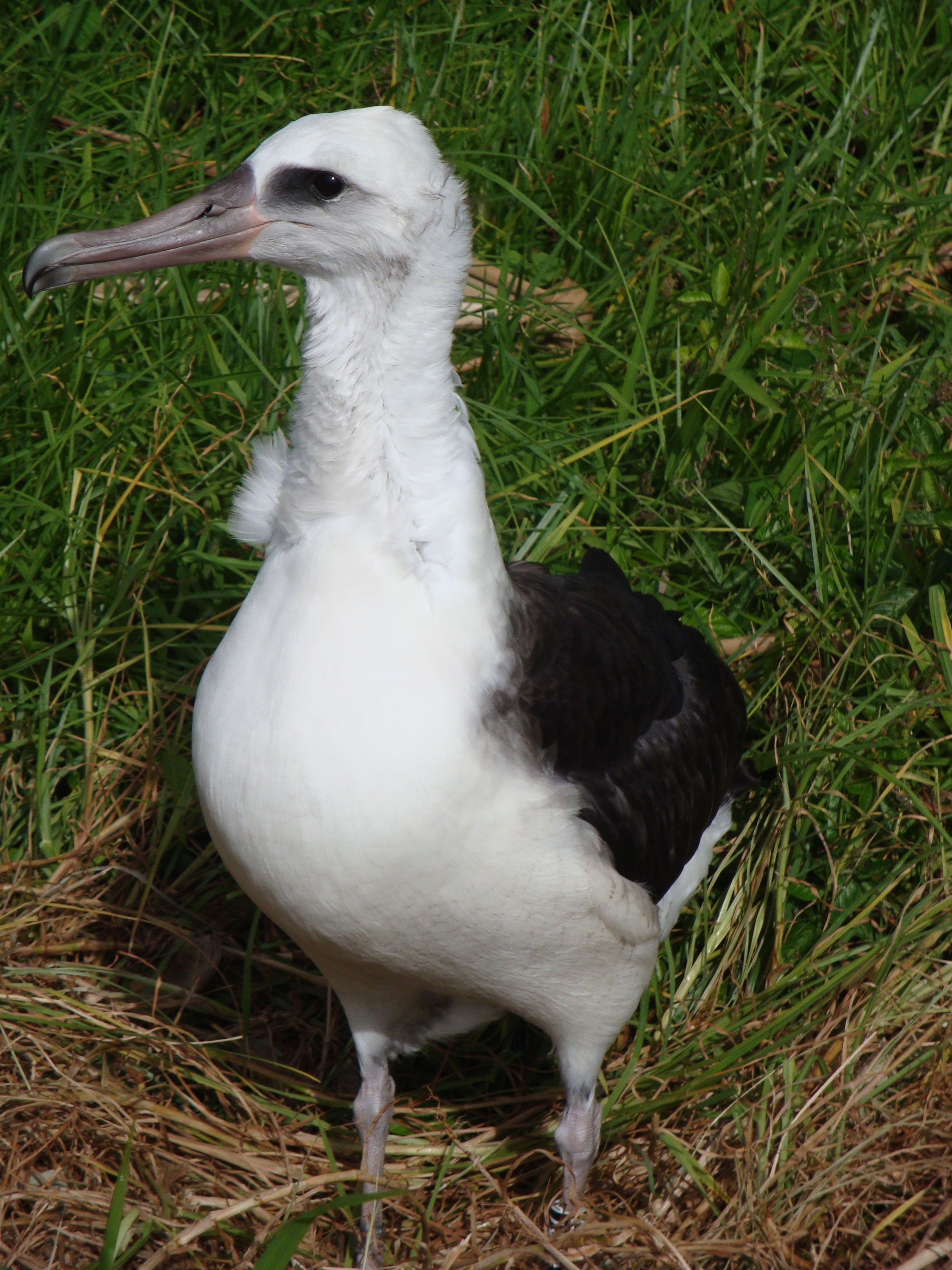
I will close this post with a photo I took today of K407, half of a female-female pair. When my sister, Cindy, and I first started observing we called her Green-Green because of the two colored auxiliary bands she wore. She was originally banded in the 1995-1996 season at the Pacific Missile Range Facility. The couple used to nest next to a path to a local beach, but for the last two years they found a quieter spot off the beaten path, in a neighbor’s garden.

K407 waits for KP466

Posted in Uncategorized | Leave a comment

Introducing….Gaga!

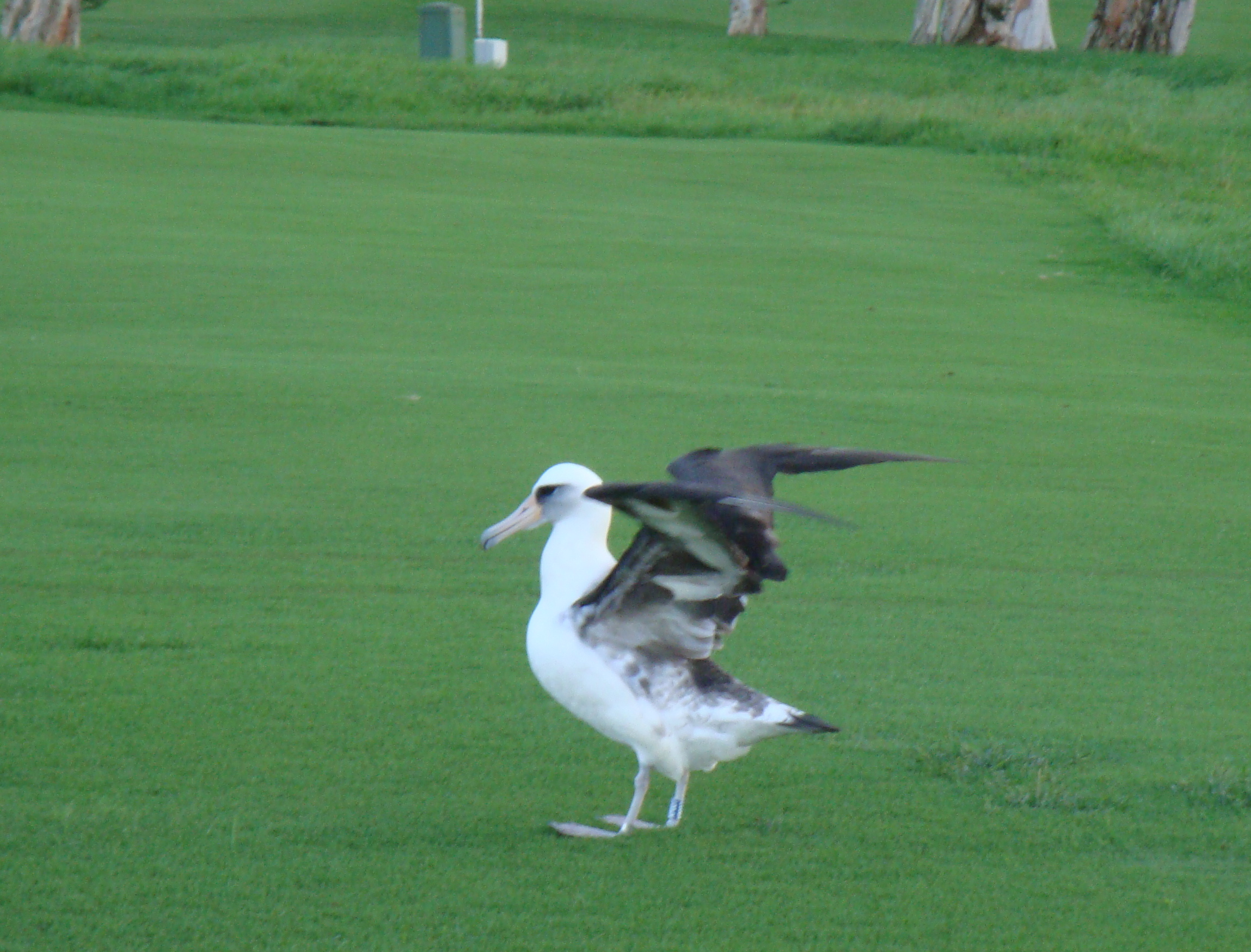
It was another quiet day on Wednesday.  Blue 027  continues to sit in the middle of the golf course, waiting for her mate.  KP731 has not been joined by his mate on the same golf course yet.  KP792, the female from my neighborhood who sat with Blu 027 a couple of days ago, is back in the yard where her nest was last year.

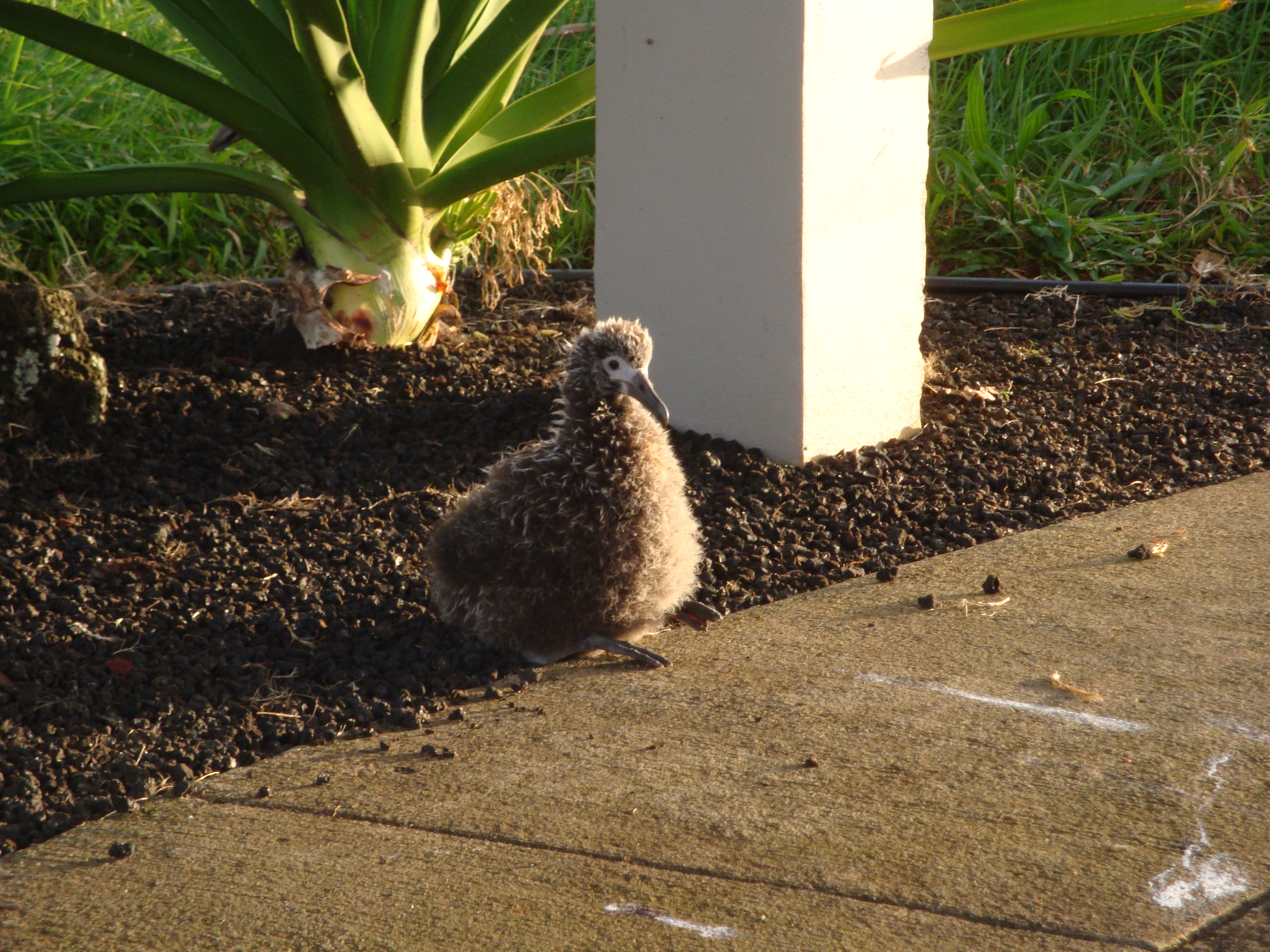
So I thought I would introduce you to a chick from last season.  Meet Gaga, the golf course chick who created some problems for me by insisting upon sitting on the nice, warm golf cart path.  She would not be dissuaded by a mere human like me.  In this photo  you can see from the marks on the path that she was moving around.  She was only about six weeks old then.

Gaga near the golf cart path

I bought some fencing and John Bowen offered to put it up.

John puts up fence for Gaga

She stayed behind the fence, fortunately.  She was well cared for by her two moms.  About 30% of all the albatross couples nesting in Kaua’i are female-female pairs.  Sometimes they have one or two infertile eggs in the nest, sometimes they have a good one.  This couple had a fertile egg, which hatched into Gaga.  I have been referring to this bird as a “she,” but we will not know the sex until we can get a DNA test on a feather that was taken from her when she was banded.  I think the human Gaga would appreciate the unique beauty of the albatross Gaga.

Gaga!
Posted in Uncategorized | 1 Comment

One chick’s story

There were no new albatrosses in Princeville today.  Yesterday KP467 finally met up with her mate in my neighborhood, today she was gone and he was sitting alone.  They should meet again in ten days more or less, then she will lay an egg and the male will take the first incubation shift, which is usually the longest one.

I would like to share a photograph of a chick named Liho, sent to me by Mona Gardner from Tampa, Florida  Liho’s parents used to nest in a vacant lot which is now covered in condominiums.  As their nesting area disappeared they crossed over to the other side of Ka Haku, the main road through Princeville. Theirs is the only nest on that side of the street.  Two other chicks of theirs fledged from there and both times they began their journey by walking across Ka Haku.  They were lucky they were not hit by cars.

Last August Liho started making practice flights over the 9th fairway on the Makai course.  John Bowen and I started spending more and more time keeping an eye on him.  Mona was one of the people who stopped by to see how he was doing, and she took the photo below.   On August 2nd, when the wayward chick started getting closer and closer to Ka Haku Road, we brought him to a safe fledging spot on an ocean bluff.  He attracted a small group of interested humans but disappointed them by spending the night out there, and he did not fledge until after 5 P.M. the next day.

It takes patience, a lot of free time and a good helping of luck to see an albatross chick fledge.

Liho thinking about fledging...

Posted in Uncategorized | 1 Comment

They’re never boring.

Today KP467, who has been waiting in my neighborhood several days for her mate, was reunited with him. The behavior in this photo is typical of nesting couples.  They sit close together and gently groom each other’s faces.

When I checked this afternoon I could not see KP792, the female who had a chick last year with the male who left his previous mate for her.  (See November 12 post.) She was not here this afternoon.  Later I went to the golf course and found blue KP027 still waiting for her mate.  As I was walking away, I saw an albatross fly over the golf course, circle it and land near blue KP027.  Great, I thought, her mate has returned.  If I didn’t know these birds better I might have left it at that and put that information in my notebook.  Instead I walked back to check.  It was KP792!  What was SHE doing there?  I have looked back at data from other years and can find just one observation of her at the golf course.

If someone in my neighborhood had asked, “Where did KP792 go?” I might have answered, “Maybe she went back to the ocean to get something to eat.”  I would not have said, “She probably went cruising around to see if there were any other albatrosses anywhere that she could sit near.”

I love these birds.


Posted in Uncategorized | 1 Comment

No new faces today….

Today I saw blue KP027 on the Lakes golf course.  This is her third day there, not far from the area where she and her mate usually nest.  Last year her mate built a nest and laid an egg and incubated it for three days.  The next day she was gone.  Normally, the one who lays the egg leaves when her mate takes over incubation duties.  But blue KP027 was sitting far away from the nest, leaving the egg unattended. Last year almost half of the eggs were abandoned.  After that the two periodically met there and sat close together, gently grooming each other.  They were both gone by the end of February.

In my neighborhood we had the same three albatrosses that were here yesterday.  One waited by my neighbor’s front door, not far from where she and her mate had a nest two years ago.

KP467 waiting for her mate....

Posted in Uncategorized | Leave a comment

Two new arrivals came today….

Another female nester arrived in my neighborhood.  KP792 came in the morning but was gone by the afternoon.  Last year she had a nest with KP505, a male.  Both In 2007-08 and 2008-09 KP505 raised a chick with another female, but in 2009 he returned in November and his mate returned in January.  By the time she got here, he had already met KP792 and they spent more and more time together, sitting quietly and grooming each other, the quiet contact that is typical of a nesting couple.  Last year KP792 and KP505 were the first albatrosses to return to Princeville and they raised a chick that was named Coconut.

Occasionally when one of them was incubating the egg, KP505’s former mate would sit near the nest, but later in the season I did see her displaying with other birds.  Albatrosses who are looking for a mate begin the search by participating in courtship displays characterized by a variety of vocalizations and movements.  Sometimes these displays involve two birds, often more take part.

The female that Bob Waid saw yesterday came back briefly today, and a male who nests on the Waids’ lawn returned.  I will be looking for one bird who is a nester at the Kilauea Point National Wildlife Refuge but always comes first to my neighborhood and hangs out for a few days on one lawn in particular.  Why?  It is those intriguing questions, the behaviors I may never understand, that help to fuel my curiosity about these birds.

Posted in Uncategorized | 3 Comments

Welcome home, albatrosses!

Blue KP027 stretches her wings....

Today the first albatrosses returned to Princeville.  The first ones that I saw were on the Makai Lakes golf course.  I saw one I know as Mr. Pastry Bird, KP731.  We once found a Danish pastry sitting next to his nest, hence his nickname.  And no, albatrosses are not big fans of baked goods.

The other bird I saw was one with a blue auxiliary band with KP027 on it.  This one is waiting for KP458, a bird whose last mate was hit by a car. KP458 and blue KP027 have been together since 2007.

My neighbor, Bob Waid, saw KP467 arrive and depart today.  KP467 is a female.  She and her mate raised a chick in 2003-04, skipped 2004-05, then raised chicks in the next 5 seasons.  Last yearKP 467 laid an egg in front of Bob Waid’s house, but no nest was built; the egg just sat on the ground and the couple abandoned it.  It may have been that raising five chicks in a row meant that it was time for a break, which nesters need periodically.  At any rate, I would much rather have a couple abandon an egg than abandon a chick.

Posted in Uncategorized | 1 Comment