Albatross vignette: Larry

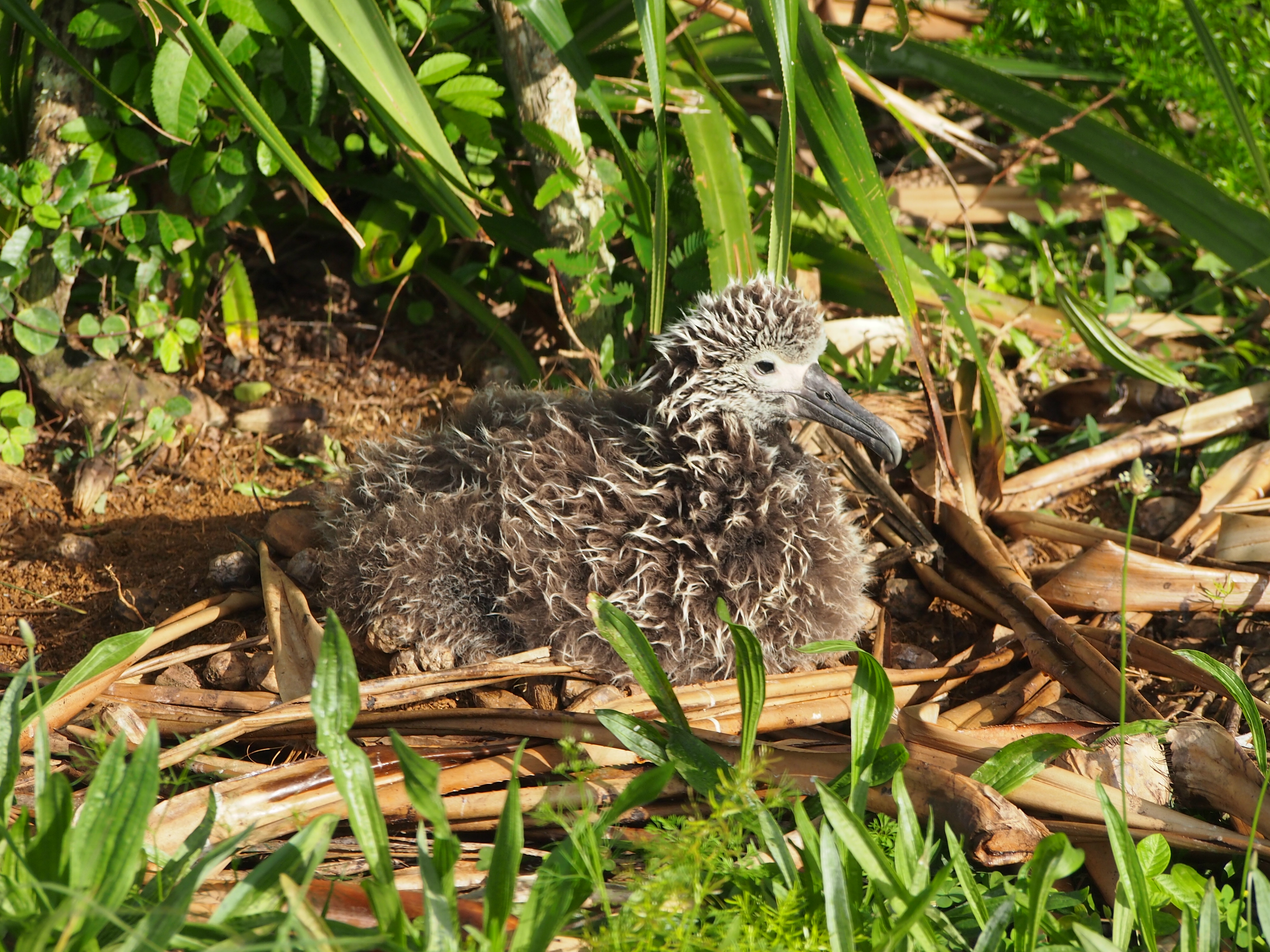
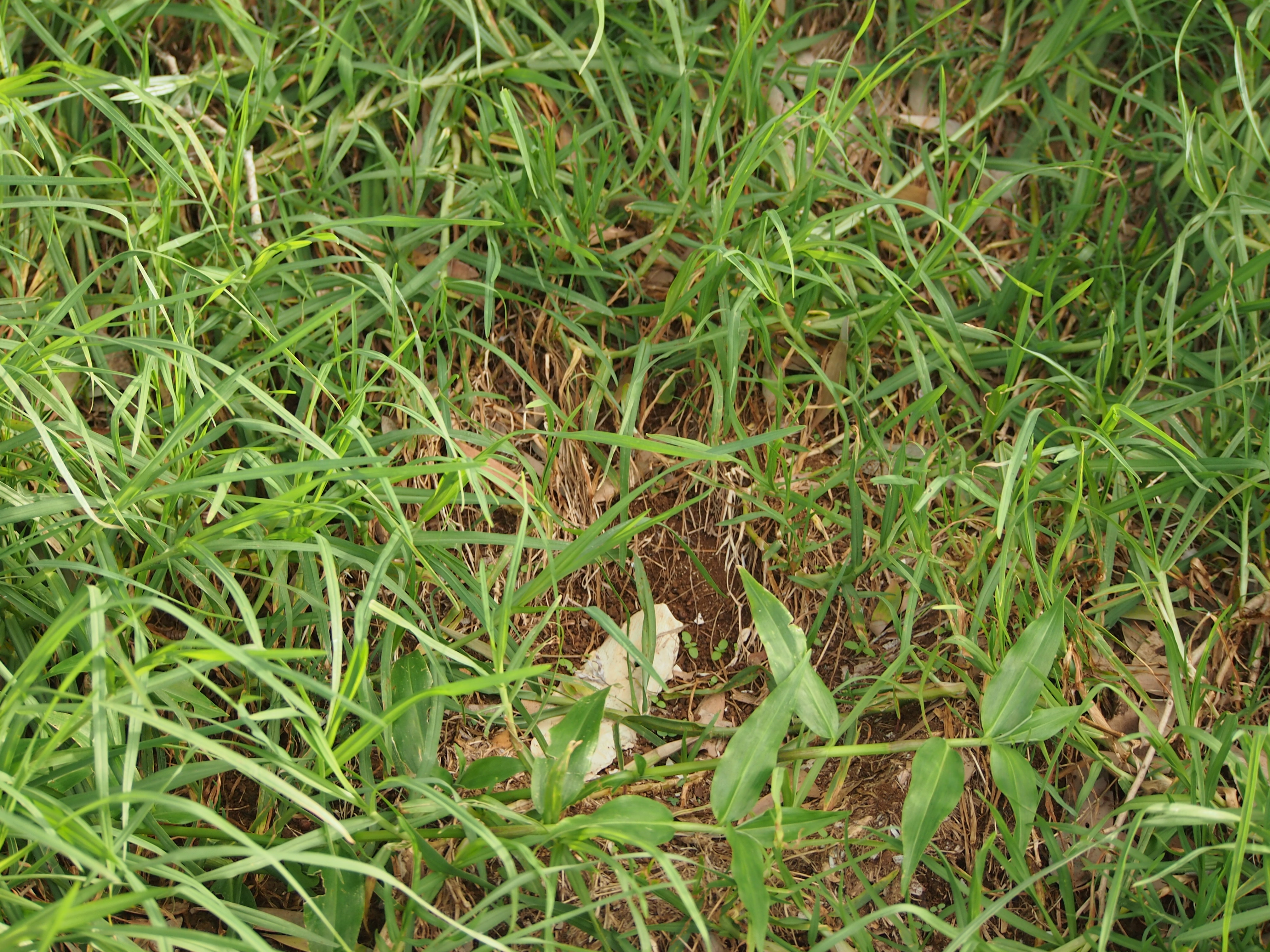
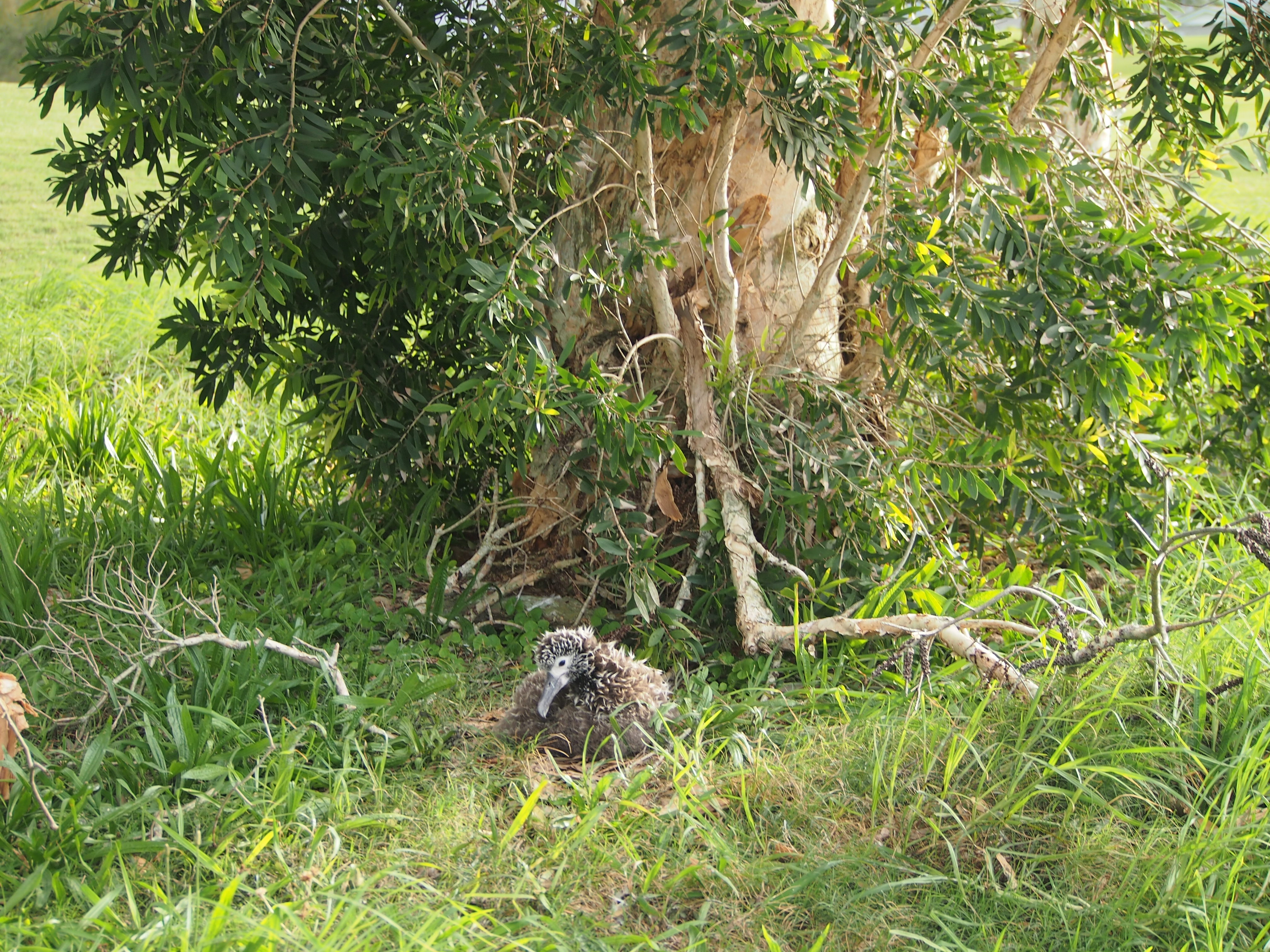
The photo below is not that great.  Sometimes we get so used to seeing something that it becomes ordinary to us and we forget to record it, or we take a bad photo and do not bother to go back and get a better one.  The chick is looking away from the camera, so what do I find interesting about this picture?

The adult is Larry, a 5-year old.  My neighbor, Roger, named him after a Sears repairman. We know albatross Larry is a male because he was DNA tested.  He is the chick’s brother.  Almost every time I have seen him this year, Larry was either sitting near his sibling, or in the yard next door or directly across the street from him.

The parents of Larry and the chick are KP468 and KP507.  They are two females who raised chicks in 2004-2005, 2005-2006, 2006-2007 (Larry), 2008-2009, and 2010-2011.  4 of the 5 chicks fledged successfully.

Is it a coincidence that Larry spends all of this time near his sibling’s nest?  He was in the area when his mothers were incubating the egg, he was even there the day the chick hatched.  Did he recognize his mothers, and did they know who he was?  Albatrosses have a good sense of smell.  Do they have a scent that is detectable to close relatives?  Larry’s mothers have been given PMRF eggs at times, but Larry and his sibling were both the biological chick of one of the females.

All of this couple’s nests were in the yards of just four houses in my neighborhood.  Larry’s nest was across the street from chick 8.  So is he hanging out near his sibling simply because he is so attached to this area?  I went back to my database for last year, the first time that Larry returned to Princeville since fledging, and checked carefully to see where I had observed him.

Almost always, I saw Larry in the yard where his nest had been or in a couple of other houses near by.  I have never seen him in any other area.  Many returning albatrosses feel drawn to the area they lived in when they were chicks, but some of them move between areas.  Out of 13 adults who were chicks in Princeville and returned here to nest, and for whom we have data on the locations of the nests where they hatched,  9 built their nests in the very area where they had lived as chicks, and 4 moved to different areas.

These questions about Larry will be on the list of the ones I will ask when someone deciphers albatross language, somewhere after, “How do you choose a mate?” and “Why would you abandon the mate you successfully raised chicks with for this other albatross?”

Whoever is working on that code, please let me know when you have cracked it!

Larry and his younger sibling

Posted in Uncategorized | 1 Comment

Jason, Woodstock and Dora

This is a little film of an interaction between 3 albatrosses who all fledged from nests in Princeville.  Unfortunately, I do not know the sexes of these birds.  I wish English had a pronoun that could be used for a male or a female, as some other languages do.  I will not call them “it” so I am going with the pronoun that goes with the names homeowners gave them.  Woodstock could be male or female, so I am picking female.  I don’t think that the world will come to an end if I do that.  If it does, sue me.

Blu234 is a 6 year old who was named Jason as a chick.  He first returned to Princeville in 2010, and came back in 2011 as well as this year.  His mother disappeared.  When nesters disappear,  I always assume that they died, they are so duty-bound to return to meet their mates and have more chicks.  At any rate, I never see them again.  His father found a new mate and has been raising chicks with her; they have a chick this season.

Blu236 is also 6, and is named Woodstock.  She came back for the first time last year.  Her parents are still together and they have a chick this year.  My sister named the father “Mr. Clacky Pants” because he is the noisiest, clackiest albatross in my neighborhood.  On at least two occasions he was seen jumping females other than his mate, so we think he is probably well represented in our local gene pool.

Dora is 7 years old and I saw her for the first time this year.  Her mother disappeared, and I presume she died; her father has nested with 2 other females since then.

The first year a chick comes back, he may come here for just a day or two.  That means that even observing them daily and keeping excellent records, I will probably miss many of those first reappearances.  In Princeville, they almost always show up first on the golf course, no matter where their nests were.  I think a huge expanse of open grass is a much less intimidating place for that first touch down than someone’s yard is.

I hope to video a first return, but I have not seen one this year.  It takes a while for an albatross to get his “land legs,” and they stumble and fall, rest a bit, then resume their clumsy attempts at walking.  We once had a bird in Princeville who had suffered some terrible leg injury in the past and walked with a permanent limp.  He could not participate in courtship displays because he could hardly stand up, let alone dance.  He happened to be there when an albatross returned for the first time.  When he saw the bird stumbling around, he limped over there and tried to initiate a display.   Unfortunately for him, the bird appeared to be horrified by his clumsy movements.  It was not meant to be, and he eventually gave up.

Both Jason and Woodstock have participated in displays with other albatrosses, and I have see the two of them displaying together and in quiet contact.  I saw Dora for the first time on April 10th.  Mostly she has just been hanging out in my neighborhood.  She is so anxious to participate in the display in this film, and clearly has no idea what to do.

Please excuse the quality of this video.  For some unknown  reason it gets a bit blurry in places, but I hope to remedy that with a new camcorder.  In spite of the poor quality, I think the content justifies having to look at some shimmering and waviness.

At first Woodstock and Jason humor Dora a bit when she tries to join in, but their patience finally wears thin, and…well, you’ll just have to watch.

Posted in Uncategorized | 1 Comment

In memory of K243

When I first moved to Princeville there was a large weedy piece of property not too far from my house, with two albatross nests on it.  The land was zoned for condominiums and  eventually work began on two developments that now cover the lot.

One of the couples relocated directly across the street from the condos, close to the bike path that parallels the main street through Princeville.  When the chick hatched, tour buses started including a stop at the nest on their schedules, and although we put signs all around the nest asking people not to get too close, and volunteers from the Kilauea Point National Wildlife Refuge sometimes sat nearby to educate people about the need to give the birds space to themselves, it was a stressful situation for the albatross family.

I once watched one of the parents walk to the street and take off there;  I could feel a breeze on the street and I assume the bird did, too.  Fortunately there was no traffic at the time.  But the male’s luck ran out one day when he was hit by a car and suffered injuries which eventually resulted in his death.

I said that there were two couples nesting on the empty lot before the condos were built.  The second two albatrosses were the parents of K243.  They also relocated across the main road, but they were further away from the street and bike path in a location that gave them more privacy.

K243 was their first chick to hatch at this new location.  That year all of the chicks were DNA tested to determine their sex, so I know he was a male.  As fledging time grew closer and he started walking further from his nest, he would sometimes wander out onto the fairway.  Once there was a golf tournament on this course and several people volunteered to sit by the fairway and keep an eye on the chick, gently walking him off when golfers approached.

When it is time for a chick to fledge, they fly into the wind, whichever direction it may be coming from.  If there is no wind, they just walk; I don’t know how they choose the direction they will take off in, but they may end up in an area that is not safe for a chick.  K243 walked across the main road.  Fortunately, a resident saw him and escorted him as he began his journey.  I used to think albatross chicks would instinctively know how to find an ocean bluff, but this guy ended up on a residential street wandering around.  My sister and I brought him to a safe bluff with unobstructed exposure to the prevailing winds, and at the entrance we put a sign warning people that there was an albatross chick out there.  K243 fledged safely.

The next time I saw him was last year, when he was four.  Often when chicks first return to the area they fledged from, I see them only a few times, sometimes only once or twice.  I assume I miss many of the albatrosses making their first trip back since fledging, even checking every day as I do.  I was glad that he never went to his old nest site, he spent his time across the street on the side of the course on the ocean bluff.

This year, I saw him several times on the ocean side.  Once he was on the other side of the golf course away from the ocean, across the street.  I assume that when he was hit by a car last Monday he was walking across the street to or from that area. I got the call when I was volunteering at the Kilauea Refuge, and I immediately called Marilou Knight, who left at once; by the time I got there, she was already preparing to take K243 to the seabird rehab facility at the Kauai Humane Society, the Save Our Shearwaters group.  Marilou is also a trained albatross observer and does rehabilitation work at the busiest time of the year at SOS.  There is nobody I would rather have respond to an albatoss medical emergency.

Unfortunately, K243 suffered terrible injuries and had to be euthanized.

My last memory of K243 is from my Sunday observation on the ocean side of the golf course.  He was in the middle of the course, between the greens, watching other albatrosses fly overhead and whistling to them as they passed.  Eventually he was able to convince three other birds to join him in a display, and I watched them for awhile.  Sometimes these displays look almost choreographed, with the more experienced birds changing partners several times.  I am never bored by these dances and I don’t think the albatrosses are, either.

I am so glad K243 had that one last dance before he had to leave.

Posted in Uncategorized | 4 Comments

Albatrosses can read!

Posted in Uncategorized | 4 Comments

Albatross chicks build new nests

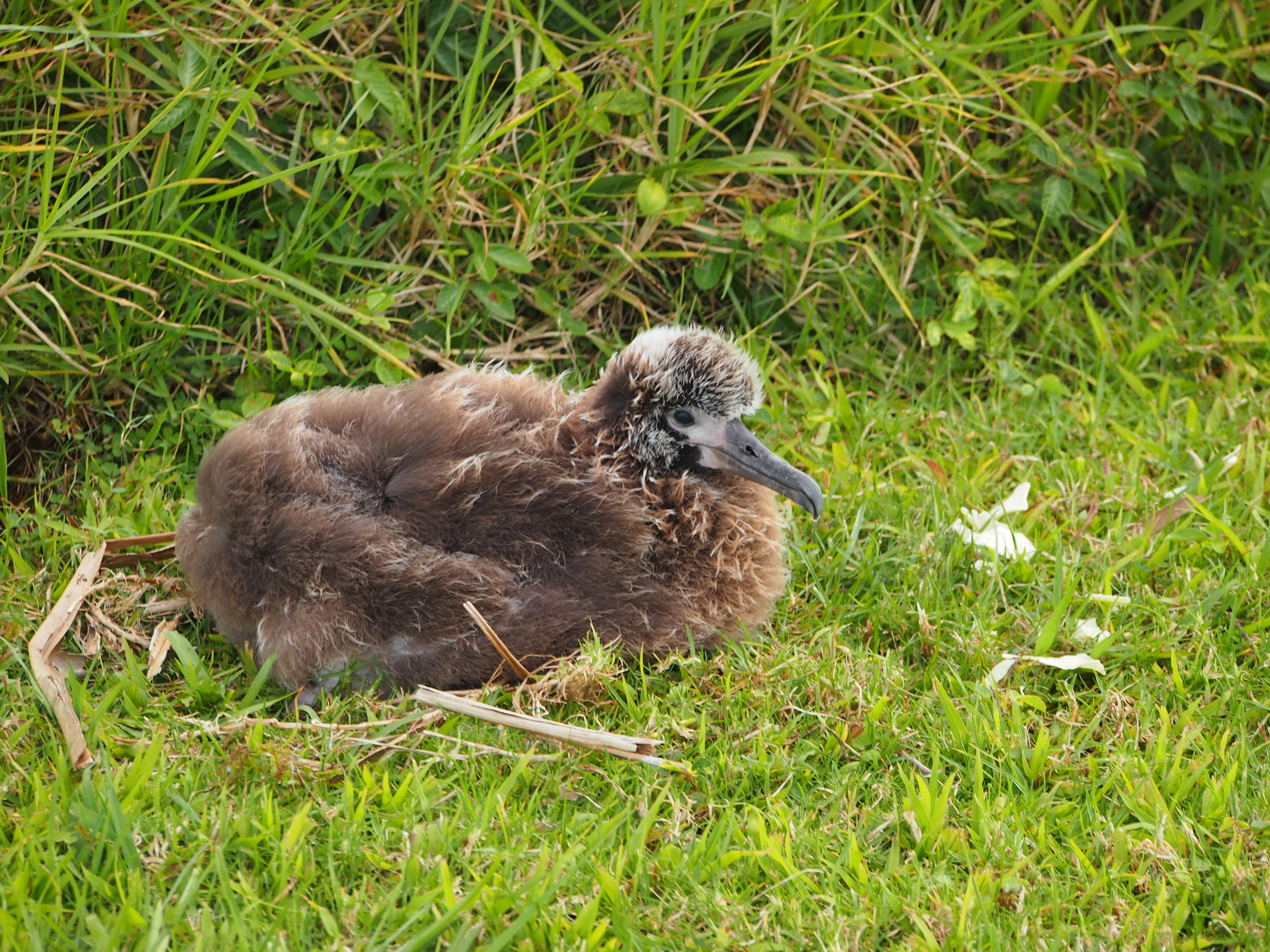
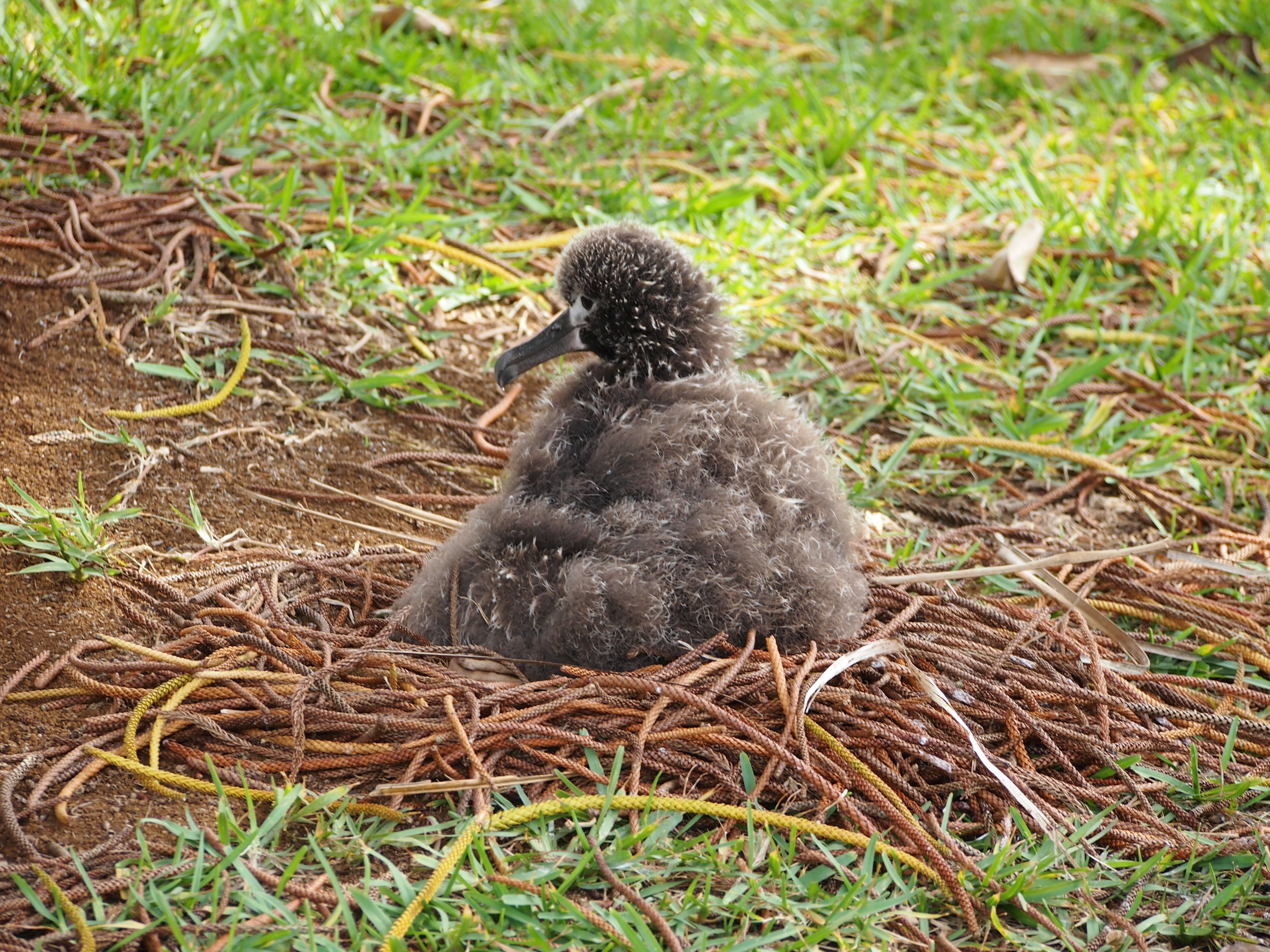
The chicks are spending more and more time working on what I call their auxiliary nests. As they move away from the nests their parents built, they use their bills to grab whatever materials are nearby and place them around their chubby bodies.  If they are sitting on dirt, they will often dig depressions to sit in, scraping them out with their feet.  Chicks have a variety of materials to work with: dirt, leaves, grass, twigs, bark, whatever happens to be in the area.  Some of the chicks build a nest and stay in it for a while, others seem to move on shortly after completion.

This guy used little branchlets from a Cook pine tree, building up spongy layers conducive to comfortable naps.

Chick below Cook Pine tree

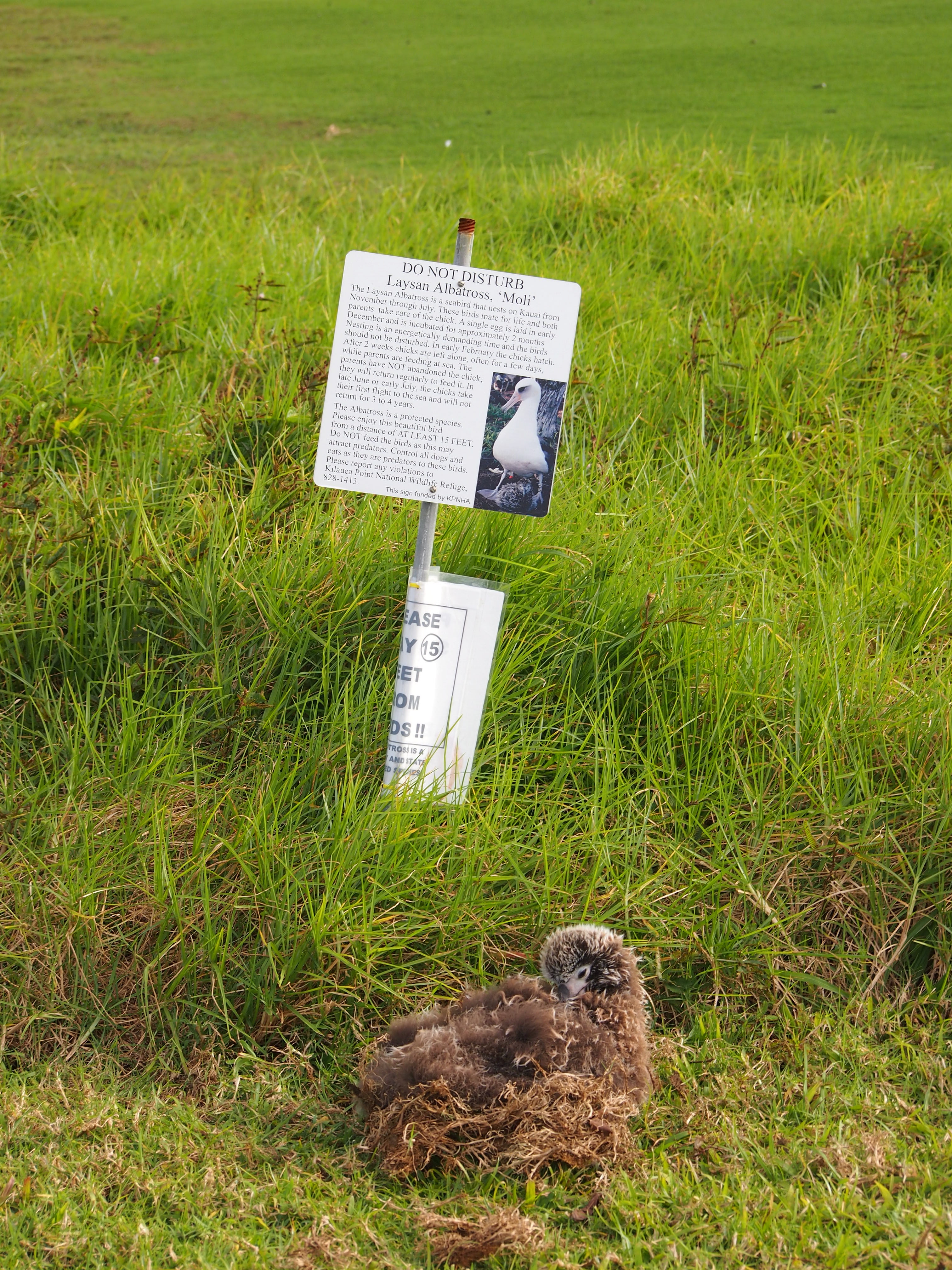
This chick on the golf course moved away from the original nest that was further away  from the albatross sign.  I guess he wanted people to be able to read his sign while checking him out.  I recently had someone ask me if  “that brown bird” was a penguin, so maybe the chick had the right idea.

At first he found lots of mown, dead brown grass in the area:

Chick at nest 3 uses mown grass for nest

When that was gone and he felt the urge to build another nest,  he had to yank his own grass and grab any leaves that the wind blew by.  Since he was already sitting on grass he didn’t really need too much cushioning.

Chick at nest 3 and his spartan accommodations

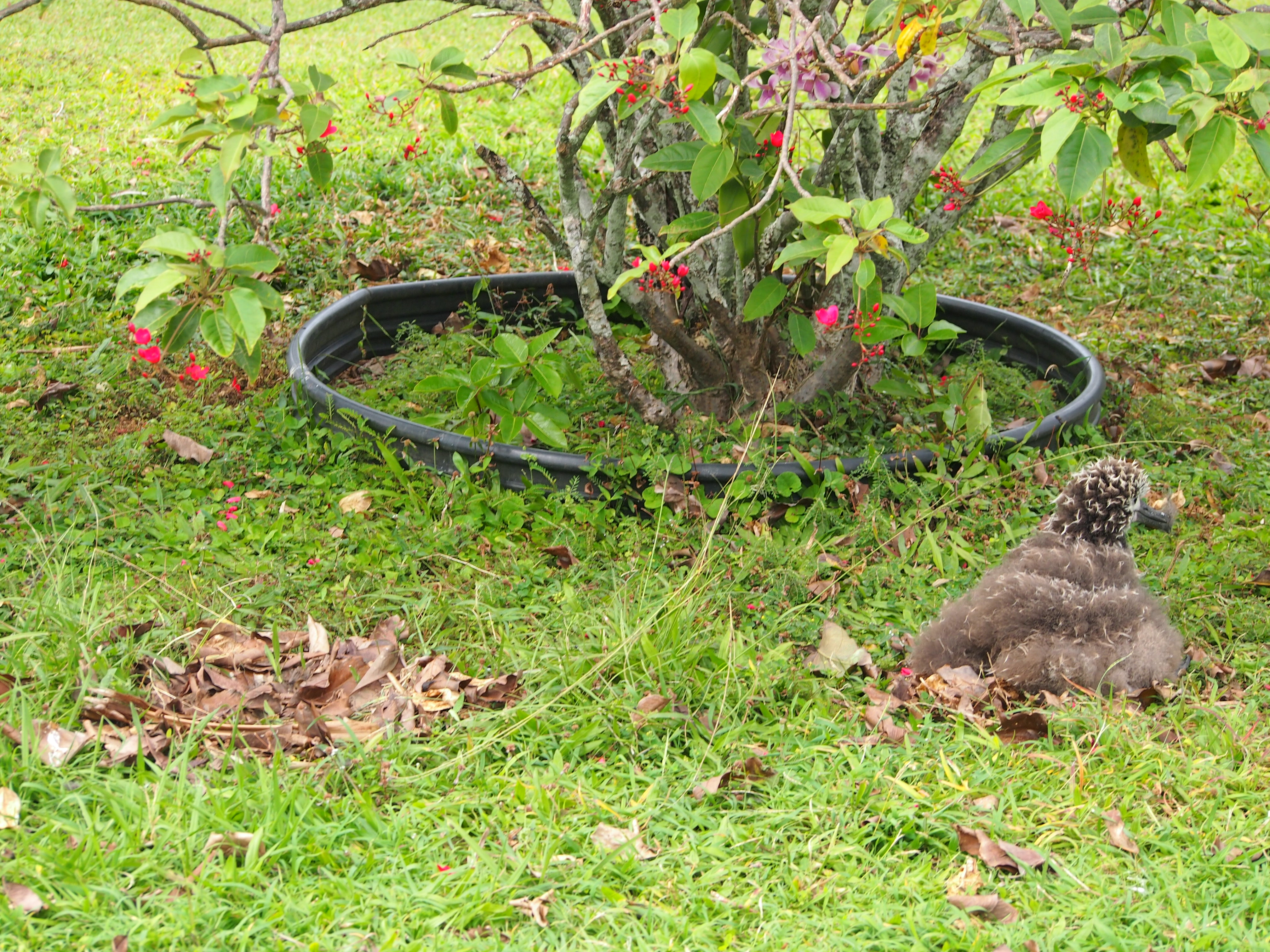
This chick built the nest to the left in this photo, then moved over and made a new one, using leaves from the jatropha bush.

Chick moves on to another nest

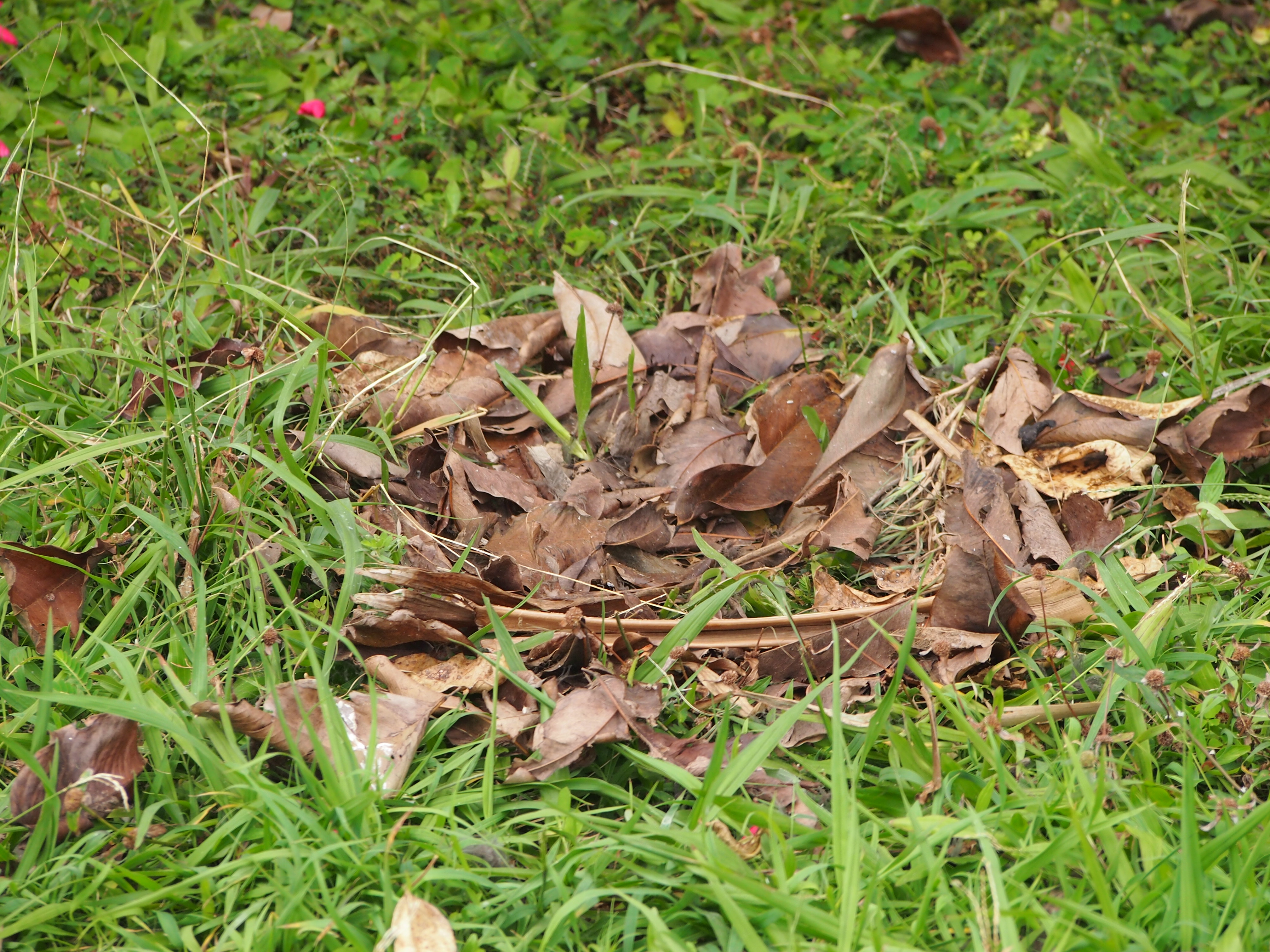
The nest is a loose conglomeration of leaves.

Closeup of nest

The youngest chick has not left his parents’ nest yet, but he has been adding little architectural flourishes.  He pulled hala (pandanus) leaves close to himself.  I love seeing an albatross use a native plant to complete his nest.

Chick embellished parents' nest

When someone asks me about “suitable albatross habitat” this is one of the aspects I think of, the availability of nest building materials for the adults and chicks to use.  In that aspect they are quite adaptable, and therefore this is by no means the most important qualification for selection of possible future nest sites.

When the chicks start to fledge in June, I will revisit the topic of areas appropriate for albatrosses nest sites.  Most of a habitat’s  suitability has to do with how far it is from the ocean and how safe the areas surrounding the nests are.  We are fortunate that Princeville attracts residents and visitors who keep an eye out for the albatrosses and who are willing to obey the rules that help to keep these birds safe.

Posted in Uncategorized | Leave a comment

So you think you can display….

I live in a neighborhood where about half of the albatross nests in Princeville are located. At times I can hear adults displaying, both during the day and at night.  Somehow this ritual helps them to choose a mate.  For a long-lived bird who must depend on the mate to share incubation, chick-guarding and feeding duties, this is a critical choice.  They scream, whinny, moo, whistle, clabber and honk.  The singing becomes more frenzied as the display continues.  The groupings of birds change, with individuals joining and leaving groups.  Occasionally someone is chased away from a group; I have no idea why.  As the season progresses I start to see couples displaying alone and repeatedly, with noticeably more synchrony than they showed at the beginning.  Then I will often see them progress to the “quiet contact” stage, where they sit close to each other, often grooming the partner’s face.  Odds are this couple will nest together the following year or the one after.

Some of these birds are juveniles who are too young to nest or who are old enough but have not found a partner yet.  Some are of unknown age, birds who were banded as adults and were assumed to be at least 3 at that time.   Some are birds who have lost their mates.  The more I observe them, the more I see that there are clearly birds who would win the “So You Think You Can Display” contest and the ones that the judges would ridicule mercilessly.

So watch this short clip of 4 birds displaying and you be the judge.  You may notice the chick in the background.  Chicks are magnets for adult albatrosses, they love to hang out near them.  This chick tired of the displaying, eventually he started snapping at any adult who ventured near.

I dedicate this film to albatrosses like the guy in the back on the right side, who keeps looking at the coordinated couple in the foreground to see if he can learn the moves from them.  He doesn’t really get it, he’s got two left feet; he can’t even do a proper “sky moo,” when the skilled birds point their bills into the air and utter a soft, cow-like sound.

I would also like to dedicate this to all human beings who have ever ventured out onto the dance floor and suddenly realized that they have made a horrible mistake.

Posted in Uncategorized | Leave a comment

Feeding time

I sometimes forget that many people reading this blog have never seen any albatross interactions except in documentaries.  Even checking the birds every day I miss seeing most of these albatross activities, but now that I have this blog to write I am trying to film behaviors that may be of interest.  At this time of year, most of the parents spend so little time with the chicks that I am always happy to see that a little one is being fed and to know that the parent doing the feeding is still alive.  In seven years of collecting data, I have never seen an albatross parent desert a chick.  If a parent disappears while the chick is still here, I never see that adult again and I assume he or she has died.

The chick in this video hatched from a PMRF egg and is being dutifully reared by two mothers, KP753 and K672; the latter bird was originally banded at the Pacific Missile Range Facility.

Here is a short history of this couple:

In 2005-2006, KP753 displayed on several occasions with another female and a male.  The following two years, I often saw these females with this male; both females nested near each other but the male chose to sit on the other female’s egg.  Both years KP753 finally had to abandon her nest to feed herself.  In 2008-2009, she met K672 and displayed with her several times that I observed.  The following year they had a nest, and each laid an egg.  Often the bird who lays the second egg will stay with that one, and the other egg is shoved to the side.  They incubated an egg which turned out to be infertile.  They were given an egg from the PMRF and raised that chick to fledging. (For those of you who have not read about the PMRF egg swap, please see my December 18th post.)

Last year they abandoned their nest, as did a number of other birds.  This year they each laid an egg again.   Again the egg they incubated was infertile so they were given a good PMRF egg.

Albatross chicks must beg for food, the parents do not initiate feeding.  This may be a way of eliminating chicks that are not strong enough to survive being left on their own for periods between feedings.  In this clip you can hear the chick vocalizing as he demands his meal, and pecking at the parent’s bill.

Posted in Uncategorized | Leave a comment

Albatross art

This is actually, no way to put this very delicately, albatross poop.  As my neighbor Roger is my witness, this was in a neighbor’s driveway.  I guess if we could have jackhammered it out, we could have sold it on eBay for a small fortune.  Unfortunately, I think our homeowner’s association frowns upon using heavy equipment to lift a chunk of concrete from a resident’s property.  I think the residents might not care for it, either.

Albatross art

It falls in the category “ephemeral art:”  here today, gone with the first heavy rain.  I do not think the artist fully appreciated the beauty of this piece, but we can all appreciate the eerily accurate but unintentional self-portrait.

Posted in Uncategorized | Leave a comment

Chicks explore, and build new nests

The chicks are starting to leave their nests.  Often they will build nests of their own, sometimes in better locations than the ones their parents built.  For example, one chick hatched in a nest in tall grass, taller than he is.  He moved a bit uphill under some trees, where he is more protected from rain, wind and sun.

The old nest, with the egg shell still in it:

Old nest, KP750 and KP968

The one the chick built:

Chick's new nest

And now he has moved a few feet away to a new nest, built on bark from a eucalyptus tree.

New nest for chick at nest 15

Building a new nest is important for another reason.  When the chicks fledge, they have to start getting their own food.  Albatrosses are not divers, they sit on the water and grab squid, fish, crustaceans and flying fish eggs from the area around them.  Every day now I find the chicks pulling up leaves, grass, any small objects, often moving them from one place to another.  They are learning how to manipulate their bills, so superbly adapted over the millennia for a variety of uses.  Catching dinner at sea will be easier because of this daily practice.

The form of locomotion they use is what my sister Cindy calls “shmoo-ing,” based on a character created as part of the Li’l Abner comic strip back in the 40s and 50s.  Google it, young people, and you will see what a shmoo is.  The resemblance to an albatross chick is striking.

In this little film you will see two chicks.  One is exploring the area around his nest and moving bits of vegetation around.  At the end of the film he walked back to his original nest, and he has not yet built a secondary nest.

The other chick was actually building a nest around him, by moving twigs and leaves around his body and by kicking out an indentation in the ground with his feet.  He now resides in his new nest full time.  You can see him in the photo following the film clip.

Here is the chick who built a new nest.  It is not very far from the old one, and since there are no other nests anywhere near, his parents will easily find him when they come back.  Even so, sometimes parents will return to the old nest and wait for their chick to waddle over to them.

Chick at nest 16 sits in new nest

Posted in Uncategorized | Leave a comment

The youngest chick in Princeville

I usually see the first albatross in Princeville in the second week of November.  Most often the nesters return first, usually the males precede the females.  Sometimes the males jump females other than their mates; this is how female/female couples end up with fertilized eggs.  Couples meet, copulate and usually both then leave the area and return about a week later, at which time the nest is built and an egg is laid.  Sometimes a nest is built around the egg.  Sometimes an egg that will be abandoned is laid on bare ground.  In the case of a female/female couple another egg may be laid in the next few days.

For the last two years, the youngest chick has belonged to the same Princeville couple, K063 and K164.  Birds with K### bands were banded starting in 2007.  These two were banded as adults in 2007 so they were at least 3 years old then.  We cannot tell the age of an albatross by looking at him, and we assume an adult comes back to land 3 years or more after fledging as a chick.

I recorded these two birds being near each other, displaying with each other or in quiet contact with each other starting in the 2007-2008 season, and continuing their association into 2008-2009 and 2009-2010.  Every time I saw them together they were on the Oceans golf course, in the same general area.  In 2009-2010 I saw them together so often that I guessed that they would be nesting together the following year.

In 2010 K063 and K164 were the last nesting couple to get together, on December 2nd.  The egg was laid December 10th and hatched February 15th, a week after the previous egg hatched.  The chick was the 7th out of 10 chicks to fledge from Princeville.

In 2011 they were again the last nesters to meet up with each other, on December 7th. The egg was laid December 19th and hatched February 21st, 9 days after the next youngest chick hatched.

The parents of the other chicks are away most of the time now, finding food for themselves and for their growing offspring.  All of the chicks look plump and healthy.

The parents of the youngest chick spend more time with him than the other  parents do with their chicks.  I took this photo of K164 with the chick on March 12th:

K164 and chick,March 12

Not long after I took this photo, K164 got up and walked behind the nest, at least 50 feet away.  The chick could not see his parent because there is vegetation behind the nest.  K164  would stop and look back, then continue walking.  After I had checked other nests in the area I went back and saw K164 walk back to the nest and stand next to the chick.  The chick was alone later.

This type of parental behavior often precedes leaving the chick alone.  It appears as though the parent is testing the chick to see how he reacts to being left by himself.  The chicks are always quite calm about this, at least the ones I have seen in this scenario.  Leaving the chick and walking where the chick can’t see the parent is often preceded on other days by the parent moving away from the nest but remaining in sight.  Sometimes the chick will follow the parent, but most often at this stage they remain in the nest.

This behavior may be an adaptation for birds who may have to spend days or even weeks at sea looking for food.  If the birds live in a crowded habitat like Midway, the parents must be able to find their chicks quickly after returning from the ocean.  A wandering chick could lose a meal, and every bit of food they get from their parents is important.

I urge everyone in Princeville and in any other place where albatrosses nest, please do not get close to these chicks.  We all want the little albatrosses to feel totally safe wherever they are, they do not need to have us giants standing close to them.  Their parents teach them by example to be wary of humans, to see people as a potential threat.  That’s a good thing;  not every human is benign.  If you want to take a photograph, please use a telephoto lens and stand far away if you truly care about them.

Posted in Uncategorized | Leave a comment