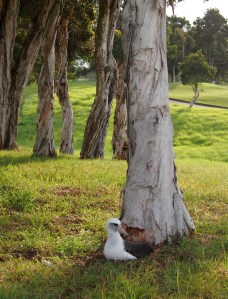
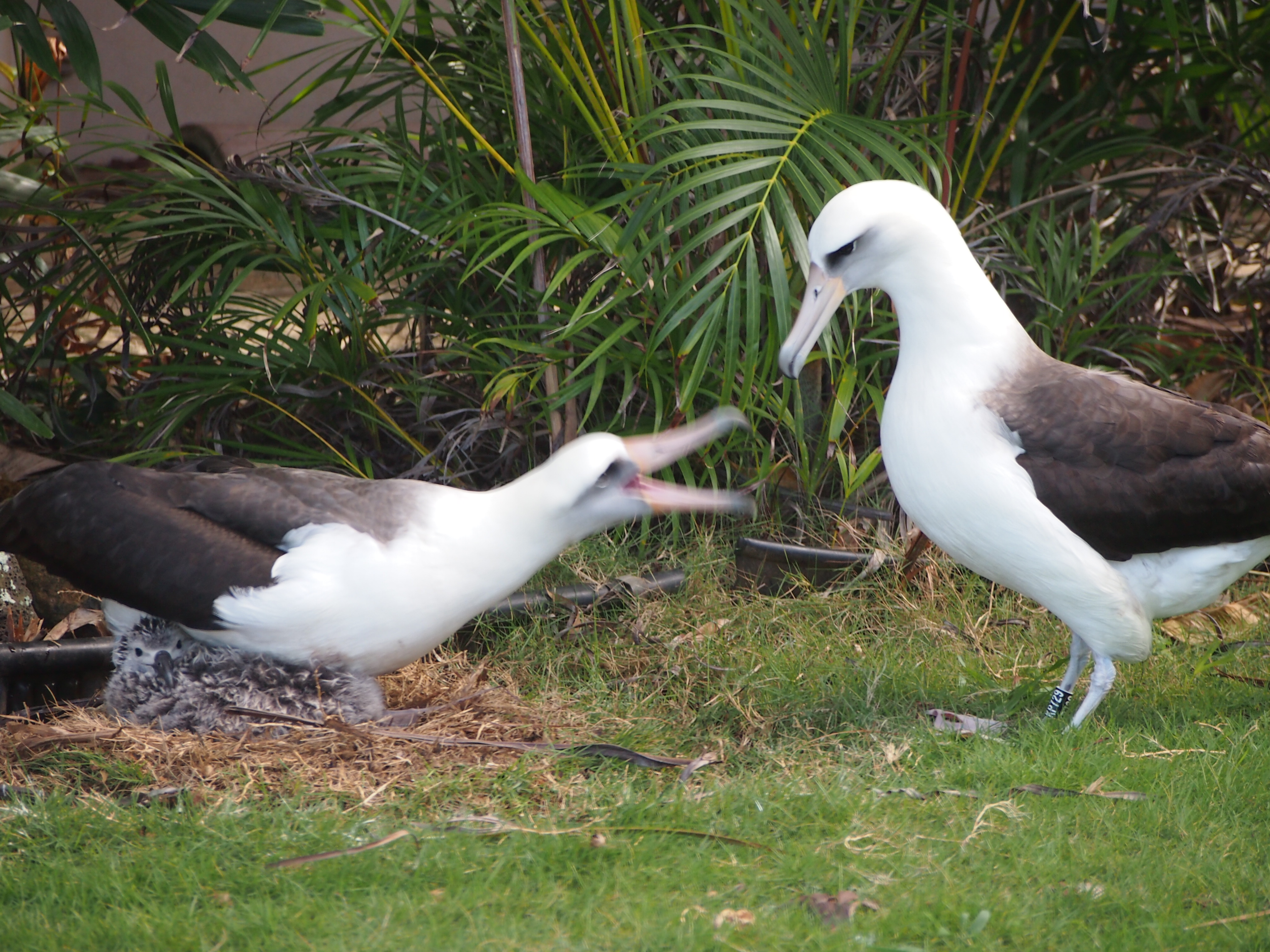
KP505 defends his chick

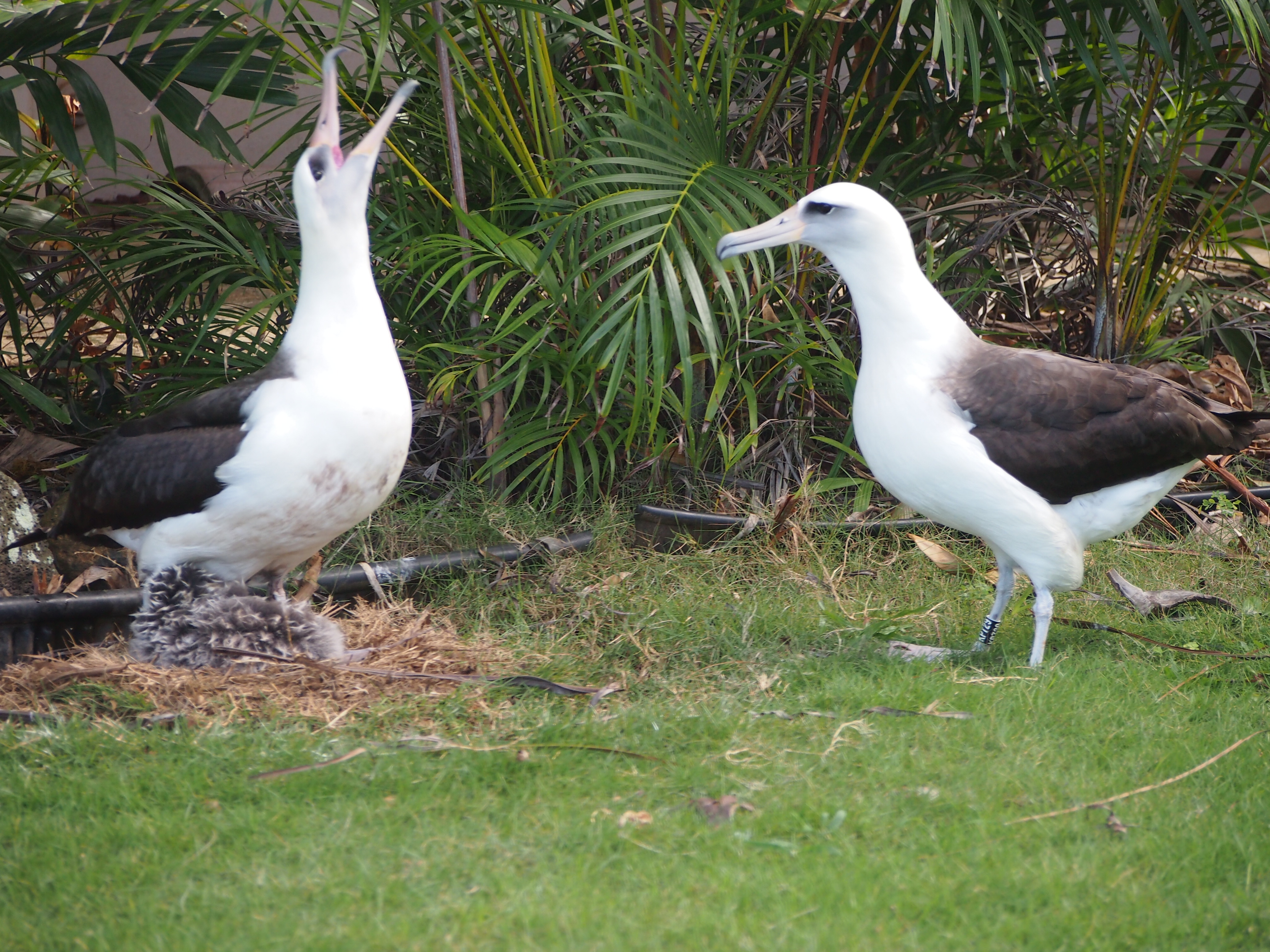
A couple of days ago the father at our first nest had an unwelcome visitor.

Scram!

Scram!

Stay away from my baby!

This is MY baby!

And when reasoning seemed to fail….

MOOOOOOOOOO!

SHRIEK!!

The visitor was KP729, the female he left for his current mate.  She eventually sat down about four feet away from the nest, and he stopped displaying at her.  He left her two years ago and she has not found another mate, although I sometimes see her displaying with other birds.  She often visits other albatrosses at their nests.  She was a good parent when she was nesting with KP505, I hope she finds another good mate.

I would like to point out that KP505 is not a bad guy, he’s an albatross.  He lives his life based on instinct, and we cannot attribute human motivations to him.  I admit, I may joke about his choice to disobey the “albatrosses mate for life” rule that they are all supposed to abide by, but I respect the fact that he follows his own albatross path, not one that we humans have determined they must all follow.

I would also like to add that two of his children are currently raising chicks, less than a block away from his nest!

Posted in Uncategorized | 3 Comments

My nesters, KP466 and K407

This year I had a female/female couple nesting in my garden.  Unfortunately. the egg was infertile.  Eventually it somehow ended up out of the nest and broken, and was therefore abandoned.

Last year this couple was nesting across the street from me, and when their infertile egg broke they started sitting together in my garden, gently grooming each other, sometimes displaying, sometimes just sleeping near each other.  They spent over a week there.  I was not surprised, therefore, when they chose to nest there this season.  Now they have been sitting in my neighbors’ yard for the last few days, leaving occasionally, but always returning to the same spot.  I am very happy for my neighbors and I hope Kp466 and K407 are able to raise a chick next season.

In the last 9 years, they have faithfully incubated 6 bad eggs, raised 2 chicks successfully, and raised one chick who died just before reaching fledging age.  They were both devoted parents and deserve to have a healthy chick to take care of.

Here is a moment from one of their displays that I filmed in my yard:

Posted in Uncategorized | 2 Comments

The Changing of the Guard

The first chick hatched on Jaunary 21st while the mother, KP792, was on the nest.  I filmed then on January 25th and put it on my last blog entry.  The next day, KP505, the father, took over parental duties.

On January 29th I saw both parents at the nest.  I grabbed my camera and ran over.  KP505 was still on the chick, very reluctant to leave.  I filmed about 3 1/2 minutes of the interaction.  I was going to edit it, but I thought people would enjoy seeing the whole thing.  Dad is on the right, standing over the chick, Mom is trying to gently nudge her way onto the nest.  At first Dad is reluctant, but gradually he comes to the conclusion that it is time for him to go.  After he gets off, Mom gets on the chick as quickly as possible, lest he change his mind, perhaps.  Then they both groom each other gently, the behavior typical of nesting couples.

The garrulous birds you hear in the background are common mynahs.

Afterwards, Dad wandered around lifting up and dropping bits of vegetation, returned to the nest and groomed his mate, then wandered around the yard a bit, leaving about 15 minutes after ceding his spot on the nest.  He will be back in a few days with lots of delicious seafood to regurgitate for his chick.

Yum!

Posted in Uncategorized | 4 Comments

Chick flick

On January 25th, I filmed KP792 with her chick.  You will see her talking to the chick.  In a crowded nesting area like Midway, chicks and parents need to be able to recognize each other’s voices.  In a place like Princeville where the nests are so spread out, this may not be so important;  but instinct is instinct.

I think if you could hear the chick underneath his mother, you would be hearing the albatross equivalent of, “Ouch!”  It must be a bit claustrophobic under there.  Eventually the chick will be strong enough to wriggle his way part way out, like this one:

KP493 and his chick

KP493 and his chick

Posted in Uncategorized | 2 Comments

Welcome to the world!

Our first Princeville chick hatched a couple of days ago after 3 days of pipping.  Pipping seemed to be going very slowly, then suddenly two days ago he was all the way out, looking like a little drowned rat.  This is a nest I can actually see from my house with binoculars; yesterday I saw him standing up in all his fluffy adorableness.  I really wanted to film him or take a photo, but any time a person comes within 30 feet of the nest, Mom sits on him.  She is, of course, a good parent.  The chicks are at their most vulnerable at this age and they need parents who will keep an eye out for all possible dangers.

So now I am hoping to film Dad attempting to take over parental duties.  This is one of my favorite albatross behaviors.  When they are incubating the eggs, the transfer of nest duty is usually smooth.  Often the couple will exhibit some of the gentle grooming I see when they first meet in November.  However, the first time a parent comes back to the nest to find that the egg has been replaced by a tiny new chick, this little one now becomes the focal point of all of their behavior.  A fight over possession of the nest will often ensue.

“Get off, it’s my turn!”

“No!  Go away!”

It starts out with a gentle nudge, but often escalates into more of a frantic shove.  Sometimes the displaced parent can hardly bear to leave, and will run back to the nest to make sure that the chick is still O.K., possibly attempting to start the shoving match all over again.  Eventually, though, the albatross who was on the egg when the chick hatched will take off to find food for the little one.

For the first 2 to 4 weeks, there will always be a parent with the chick.  I looked at 6 nests from last year, and the average amount of time the parents spent at the nest after their chicks hatched was about 20 days.   During incubation the parents take long shifts on the egg, anywhere from 2 to 4 weeks, but once the chick hatches they switch much more frequently.  Then they start leaving the chick alone for a day, gradually extending that length of time.  At first the parents will sit close to the chicks, but over time they start sitting further and further away.  The chicks get used to being alone.

Eventually the parents will be spending most of their time getting food for their growing chicks.  Towards the end of the season, I count it as a stroke of luck if I see a parent.  They may return at night, and they spend just enough time at the nest to feed their chicks.  It is a difficult job.

But as long as people still care about these birds, it is not a thankless job.  We can all show our appreciation by keeping predators, the most common being the domesticated dog, away from the albatrosses.  Most of the albatrosses that were killed on Kaua’i were attacked by someone’s pet dog.  A dog that ignores the motionless albatrosses that are sitting in nests may still chase one that is walking or running, acting more bird-like.

Please help by obeying the leash law and by supporting its enforcement.

Posted in Uncategorized | 3 Comments

Status of the Princeville albatross eggs

I thought that everyone would want to know how the albatrosses here are doing.

All of the Princeville eggs were candled by Dr. Lindsay Young and Dr. Eric VanderWerf of  Pacific Rim Conservation on the evening of December 19th.  “It was a dark and storm night…”  Some of the eggs were definitely good, some decidedly bad, and a few fell in between.

We currently have birds incubating good eggs at 18 nests.

We have 3 sitting on eggs that may or may not be good.

We have 11 sitting on bad eggs.

We have 3 nests that were abandoned.

In my last post I wrote about a nest that was abandoned by a bird who was limping.  I suggested that the injury may have made the bird too uncomfortable to continue incubation, or her survival instinct may have kicked in.  The egg was sitting alone for about 16 days, then her mate returned to the nest and has been incubating the bad egg for the last 17 days.

KP753 sitting on bad egg

KP753 sitting on bad egg

Last year, which was a very good year, 20 chicks fledged from Princeville.  The year before, only 10 made it to that point.  This year it appears that the number will be somewhere between those two:   closer to 20, I believe.

Posted in Uncategorized | Leave a comment

Abandoned nests reclaimed

People sometimes ask me why I leave abandoned eggs in the nest.  Yes, it may be a waste of an albatross’s time time to come back and sit on that cold egg again.  But it does seem to be part of the process, an important aspect of being an albatross.  More than once I have seen an albatross return to the abandoned egg and sit on it again.  Sometimes the partner will come back to renew the incubation process.

Birds with no apparent connection to an egg may use it as part of a display.  Last year I filmed two albatrosses at a nest with an abandoned egg, and included the video in the December 15, 2011 blog entry.  One of the birds was drawn to the egg,  the other was interested in both the egg and in the other albatross.

At the moment I have three nests that were abandoned but that are being visited by their builders.

In my last post about signs, I mentioned one bird who had laid her egg close to the golf cart path.  I put up signs to warn people not to stay next to KP403 because she was a first time nester and I was afraid that she might abandon the egg if people stood next to her nest too much.  She did abandon her egg.  She laid the egg on December 3rd and left it by the afternoon of December 5th.

Then her mate, KP894, returned to the nest and by December 12th she had laid an egg a few inches from KP403’s.  She sat on that egg until December 25th or 26th.

But the story does not end there.  On December 28th, I found KP403 sitting on KP894’s egg.  As of yesterday, January 2nd, she was still there.  On December 20th, KP894 briefly sat beside KP403 at the nest, but she has since left the area.

Both of these birds are first time nesters.  KP403 fledged from a nest in my neighborhood in 2003.  I remember KP894 as a chick.  In 2004, she hatched in a nest about 50 feet from where she laid her egg this year.  It is not unusual for inexperienced nesters to abandon their nest.  One couple abandoned their nest 2 years in a row but have raised two healthy chicks since then.  I wish I knew what triggered them to leave their eggs, so I could try to prevent it from happening with other albatrosses, but I honestly have no idea.

Nest number two belonged to two females who have had 2-egg nests in the past, but had just one egg this year.  KP753 sat on the egg for the first 11 days.    K672 sat on it for 3 days, then abandoned it.  Five days later, I saw K672 in the area and she was limping a bit.  I immediately thought of another nest some years ago that was deserted by a parent that was limping.  Was it uncomfortable for the bird to sit on the egg with the injured leg?  Was the instinct for her own survival stronger than the instinct to incubate the egg?  I have also seen a bird with a leg injury who remained nesting, and that bird could hardly stand up.  This is the kind of question we simply cannot answer with our human minds.  We are too far removed from the world of instinct.

I also had two females who each built a separate nest a few feet away from each other and laid an egg.  One is a PMRF bird, P061, the other is KP784, who used to nest with another bird who did not return last year.  When P061 left her egg, KP784 abandoned her nest and went and sat on P061’s egg.  This is a very unusual occurrence, a female abandoning her own egg to move to her partner’s nest and sit on that one.  To make this even more interesting, when I checked these nests yesterday, I found that KP784 had left, but P061 was not sitting on that egg, she was sitting on the egg KP784 had abandoned 25 days earlier when she went to sit on P061’s egg.  It must have been very cold.  Please someone, tell me why she did that.
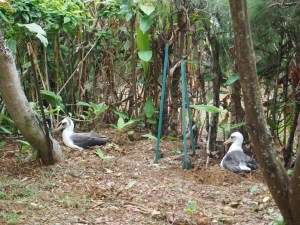
P061 and KP784 at their nests

P061 and KP784 at their nests

Instinct governs their lives, but there are also personality traits that must cause some of the differences in behavior.  The more I observe them, the more variations I see as they cope with their albatross world, which is really where they live, and with the human world surrounding them, which they usually treat as a minor annoyance.  One of my goals in writing this blog is to help people to see that for us to impose ourselves on the albatross world is much less satisfying than moving back a ways and just observing a bit of the avian one.

Posted in Uncategorized | 1 Comment

Signs – part 1

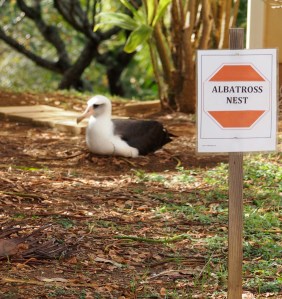
On the north shore of Kaua’i, the Laysan albatrosses nest on the Kilauea Point National Wildlife Refuge, which is federal property.   This is a safe, fenced in area with plenty of ocean bluffs with breezes to help the chicks when they fledge, and it will always be left open for them, nobody will ever build on it.  The albatrosses, however,  also nest on private property, and in Princeville they nest on people’s lawns and on golf courses.  Many of the residents and visitors know a lot about albatrosses, but some people do not know what the birds need for safe nesting and visiting.  Sometimes I have to put up signs to help everyone to understand.

As an example, there was one female this year who laid her egg next to the cart path on the golf course.  In this photo you can see how close she was to the cement path, and she was close to where golfers usually park their carts when they finish at one of the seaside holes.

KP403 on her egg

KP403 on her egg

Golfers could not avoid driving by her nest, but I was hoping to convince them not to stop right next to her.  She was a first time parent and her female mate was not around when she laid the egg, so she was already a bit edgy.

Sign for nest 27

Sign for nest 27

Those of you who read my blog last season may remember the chick who illustrated the proper response to this sign, which I put on a private property so nobody would walk into the backyard.  Sometimes I think that people forget that these are people’s yards, not a park.

I'll humor the humans....

I’ll humor the humans….

This year, one couple built their nest just past the end of a driveway at a vacation rental house.  I was afraid that someone might arrive at night and drive past the concrete and into the nest.

KP774 at nest

KP774 at nest

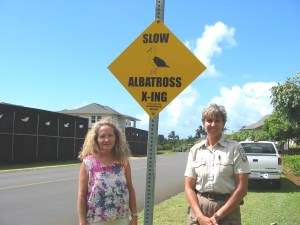
I had to include this photo.  My sister took on the job of getting funding to put up signs to warn drivers to slow down in areas where albatrosses may be walking.  Last year, a driver who was speeding hit an albatross that was crossing our main road, Ka Haku, and the bird had to be euthanized.

The wildlife biologist at the Kilauea Point National Wildlife Refuge, Brenda Zaun, encouraged Cindy to apply to the Kilauea Point Natural History Association for funding.  This is a good group that has donated money before to projects to help seabirds.  They approved the request and that is why we have these signs.

Cindy Granholm and Brenda Zaun

Cindy Granholm and Brenda Zaun

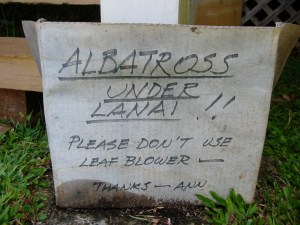
One of my friends used to get a pair of albatross females that often nested under her lanai.  She put this sign up for the gardeners.

Sign behind Ann's house

Sign behind Ann’s house

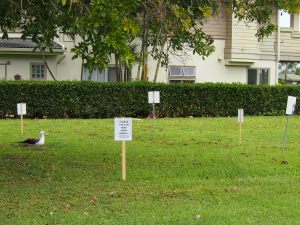
At the site shown below, we put up enough signs around a nest so the gardeners would know not to get too close.  I should say that the gardeners that have worked in Princeville for years understand that they should not mow too close to the birds, so we do not need these signs at every nest site.

Signs surround a nest

Signs surround a nest

I make new signs every season, specialized to handle new situations that require them.  I will be sharing more of them in weeks to come.

Posted in Uncategorized | 3 Comments

KP300 tries again

I could not tell you whether some of the albatrosses choose nest sites that have an abundance of building materials available or whether that is of any concern to them at all.  It just seems to work out that a number of them will build their nests in spots that are sparsely provisioned with suitable vegetation while others will find areas that have copious amounts of the stuff.

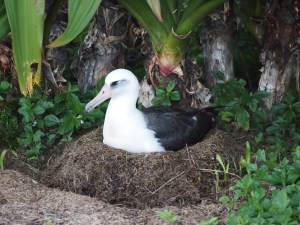
Here is one of my favorite nests from this year:

KP300 on nest 20

KP300 on nest 20

There is a poignant story that goes with this bird, who was banded as a chick in an empty lot on Punahele Road in 2002.  She nested for the first time with blueKP045 in the 2009-2010 season., not far from where the current nest is located.  BlueKP045 took over nesting duties after a few days and sat on that egg for 39 days.  That is a very long time and it certainly indicates that he or she was a good parent.  KP300 relieved him, and on the 36th day of her incubation shift, the chick hatched.

Both of these incubation times were very long, but generally the male or the female who arrives after her mate’s egg has been laid will take the first, longest shift.  That is often about 3 weeks.  The incubation times after this first long one are generally shorter, so 36 days was a long time for KP300 to incubate the egg.

KP300 sat on the chick for 6 days, then stood over him for 2 more.  The next day I got a call from a resident, reporting that the parent had left the nest during the evening and that the chick appeared to be dead.  I went right over there; the dead chick was very cold.

When a chick first hatches, the parent on the nest can feed him a warm fish oil regurgitated from the stomach to sustain him until the other parent returns with food.  Having sat on the nest for 36 days, KP300 may have been unable to give the chick enough to keep him well-nourished.  The nights were very cool, so losing the warmth of the adult may have been a double blow for the little one.  I never saw blueKP045 again, and when a bird disappears while nesting and never comes back, I assume he has died at sea.  That season I saw KP300 twice after that, both times at the site of her nest.  The following season she displayed with a variety of birds, no one in particular.  When an albatross loses a mate, it always takes them at least one season to find a suitable replacement, sometimes more.  They can live to be at least in their 60s, so this is an important decision, one not made in haste.

Last year I saw her with whiteA093 on 8 different occasions, and the behavior I observed each time was “quiet contact,” the signal of an exclusive relationship.   I should say that 8 times is a lot, and even observing every day I may miss some of the interactions so the number could have been higher.  This is why I observe every day, because if I checked every week or so I would miss way too much of their stories and would have a spotty record of their activities.  I might just see a few isolated incidents that would skew my view of their actions.  I would not get an adequate overall picture, and that would drive me crazy.

After they spent so much time with each other last season, it was not a surprise that these two chose to nest together this year.

I wish for them a healthy chick, and a long life of nesting together.

Posted in Uncategorized | 1 Comment

The numbers continue to climb

So far in Princeville I have seen 91 albatrosses and 15 nests.  I know that I have not seen all of the birds who have returned.  Even checking every day, I am going to miss some.  The long time mates will often return, mate, and leave so quickly that I might not see either one of them until they come back about a week later to nest.

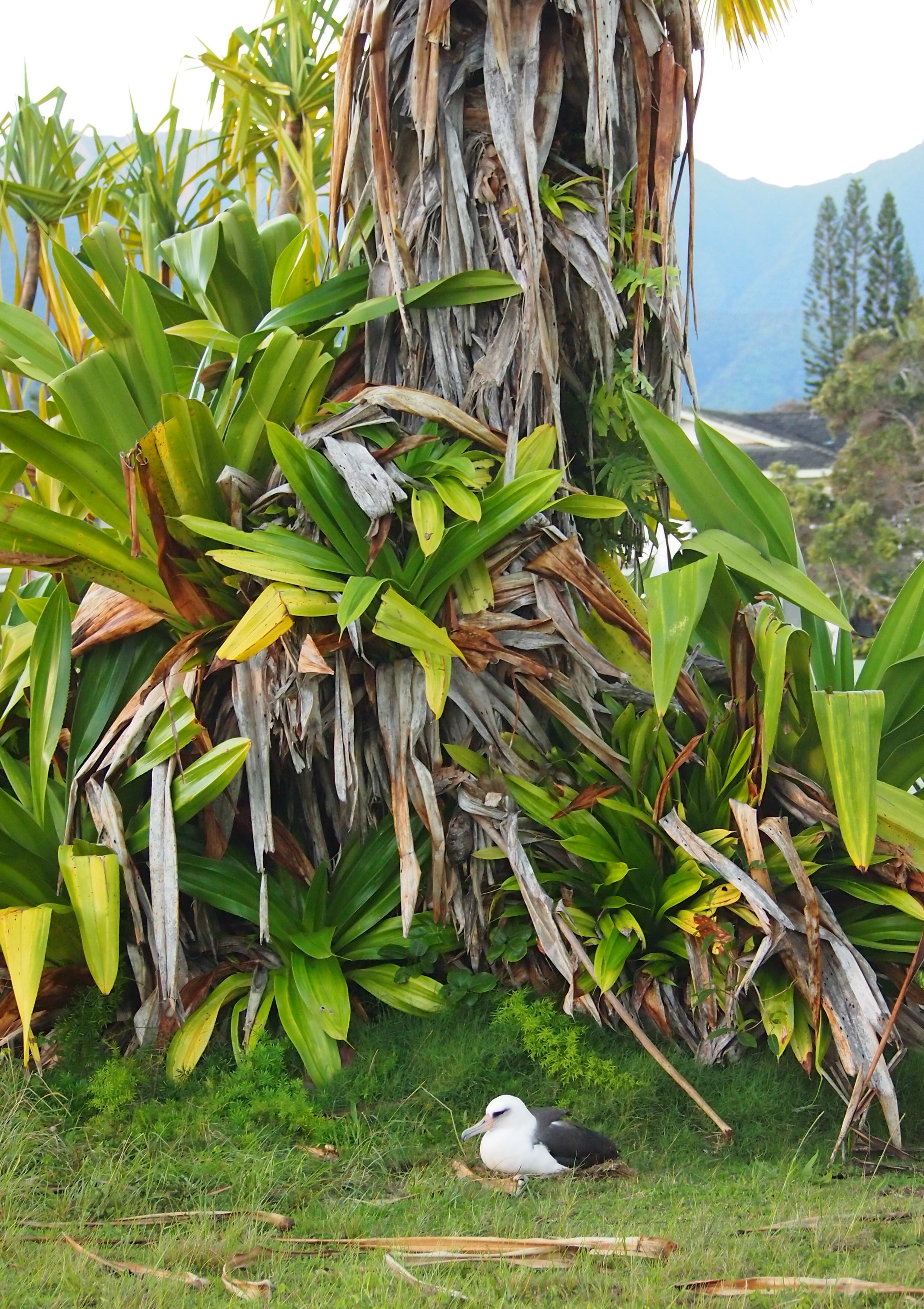
We have nests in a variety of locations:  at the end of a driveway, in bushes, in back yards, next to a front door, in gardens, on or near golf courses, and two in the paths of big storm drains.  There will be more to come.  We usually start out with twice as many nests as we end up with.  Some may be abandoned, especially by first-time parents or by females with no mates, some will have bad eggs, the two eggs near the storm drains could be swept out of the nests.  Albatrosses show extremely high nest site fidelity, they will not follow the egg or chick if it is out pushed out of the nest.  I have been called to nests to put eggs back that were unintentionally kicked out by a parent cleaning up the area.  They will continue to sit in the nest, squirming around and looking uncomfortable; they will not leave to sit on or to try to retrieve the lost egg.

People ask me if I ever try to discourage birds from nesting in a particular spot.  I am pretty dedicated, but not so much that I would camp out to make sure they didn’t sneak back to their favorite site when there were no interfering humans around.  I did try to walk a bird off a golf course fairway to a safer nesting area with lots of nice, long, grass to use for nest building, but she was just waiting for me to leave so she could run back.  There is no reasoning with these birds.

One of my new nesters this year is the bird who was banded as a chick in June of 2002 on Tern Island in French Frigate Shoals in the Northwest Hawaiian Islands.  Tern Island is a flat runway with little vegetation.  Look at where this bird is now, in the middle of a golf course:

From Tern Island to the golf course

From Tern Island to the golf course

Posted in Uncategorized | 5 Comments