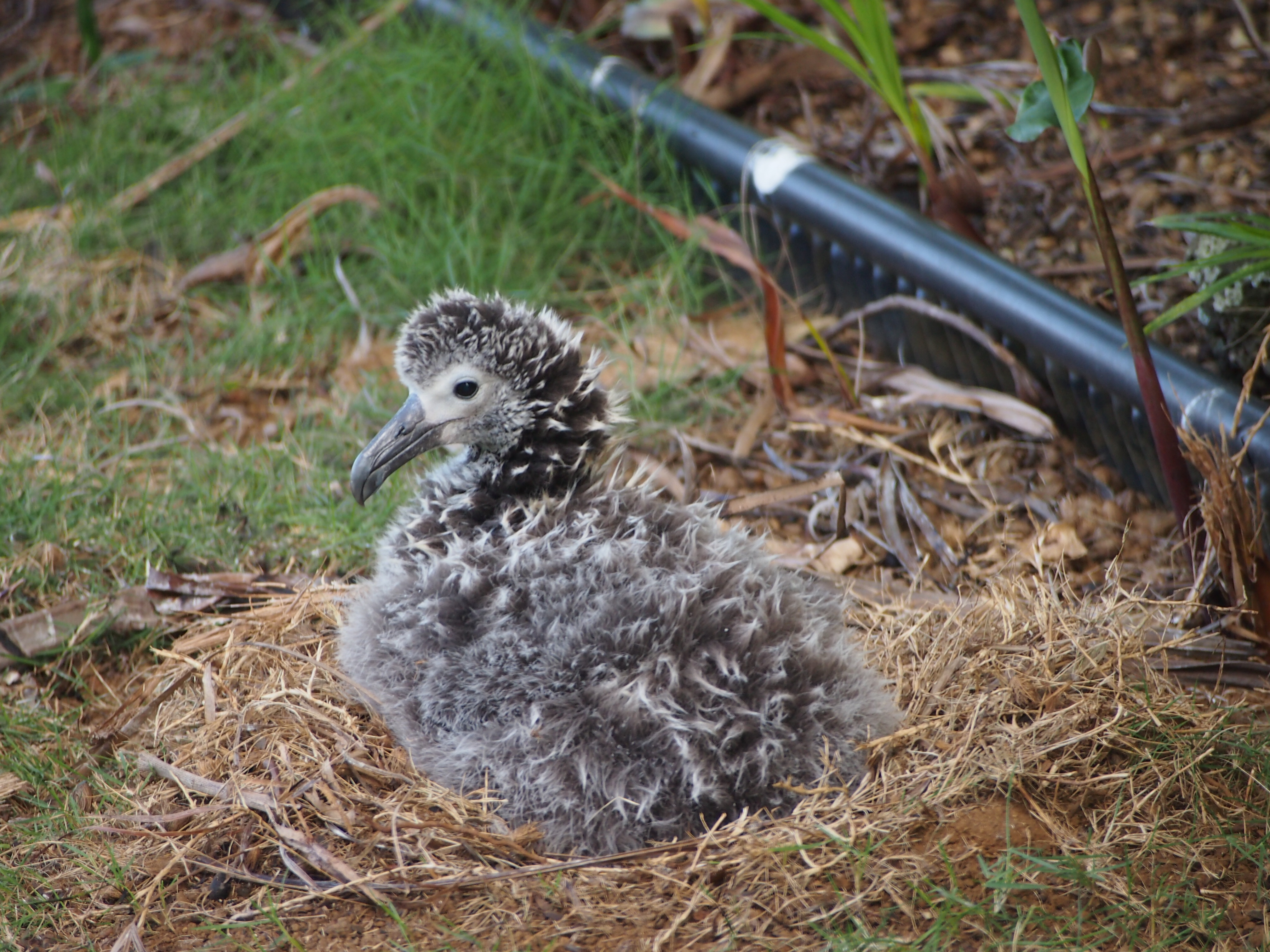
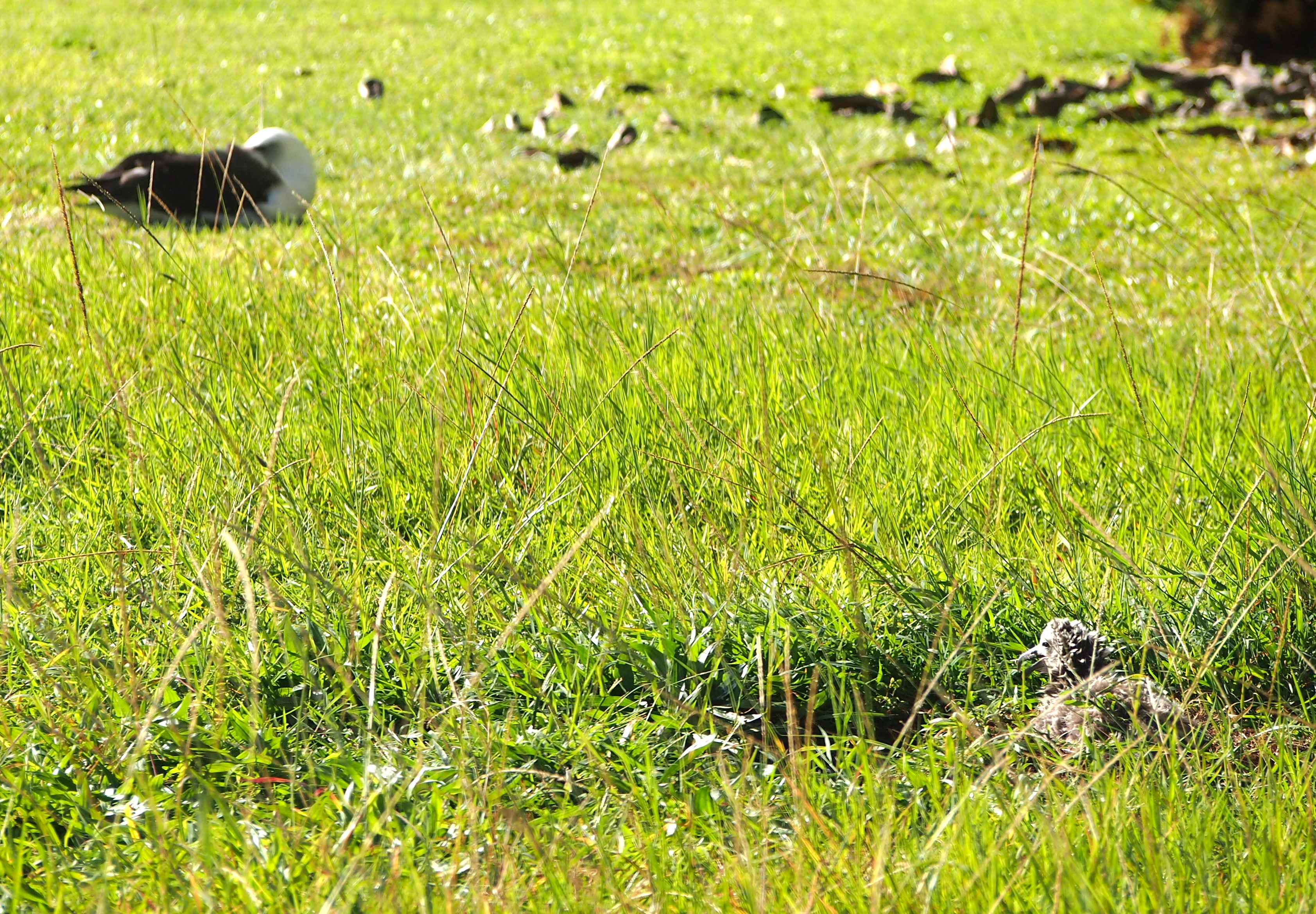
A Sunshine display

The golf courses are particularly popular with non-nesters, and sometimes I find the chicks there surrounded by adult albatrosses.  The adults often fly around the golf course looking for other birds, which are easy to spot on the green lawns.  Sunshine is in the most visible nesting area on one of the courses and there have been times when as many as 15 adults were keeping this chick company.  Sunshine is used to watching the adults displaying, often just inches away.

Brian Murphy, who named Sunshine and who lives close to the nest, asked me if I had ever seen a chick display; I said no.  Mostly the chicks watch the adults and act annoyed when the dancing and clabbering and mooing get too close.  Then I watched this video that Brian took of Sunshine and a parent.  The parent had recently fed the chick.  I do not know if this is a weird way of asking for more, or if Sunshine was getting a jumpstart on adult activities, but everyone who loves albatrosses should watch this behavior.  I find the  reaction of the parent to be just as entertaining at the dance moves Sunshine executes, especially the head bobbing in time to Sunshine’s moves.  It reminds me of someone watching a tennis match.  Those of you who are familiar with the courtship display will recognize the classic bill-under-the-armpit-followed-by-the-beak-in-the-air accompanied by the vocalization called a “sky moo.”  I have seen chicks do the sky moo before, but never as part of a display.  The chicks generally do not make the “moo” sound, but the body movement is the same.  The clabbering is also a part of a display, and I do not recall ever watching a chick doing this rapid bill clacking before.

Enjoy the show!

Posted in Uncategorized | 2 Comments

Portrait of an albatross dad

In February I posted a video of a very young chick being fed.  The one in the film below is Sammy, who is much older and is rapidly approaching giant sized.  He is being fed by his father,  KP730.

Some of the chicks make begging noises that are much louder than Sammy’s squeaky little vocalizations.  The tapping on the parent’s bill seems to be more likely to inspire the feeding process than the talking is.  A chick who is not strong enough to do this would probably not be able to stand and accept the regurgitated food.

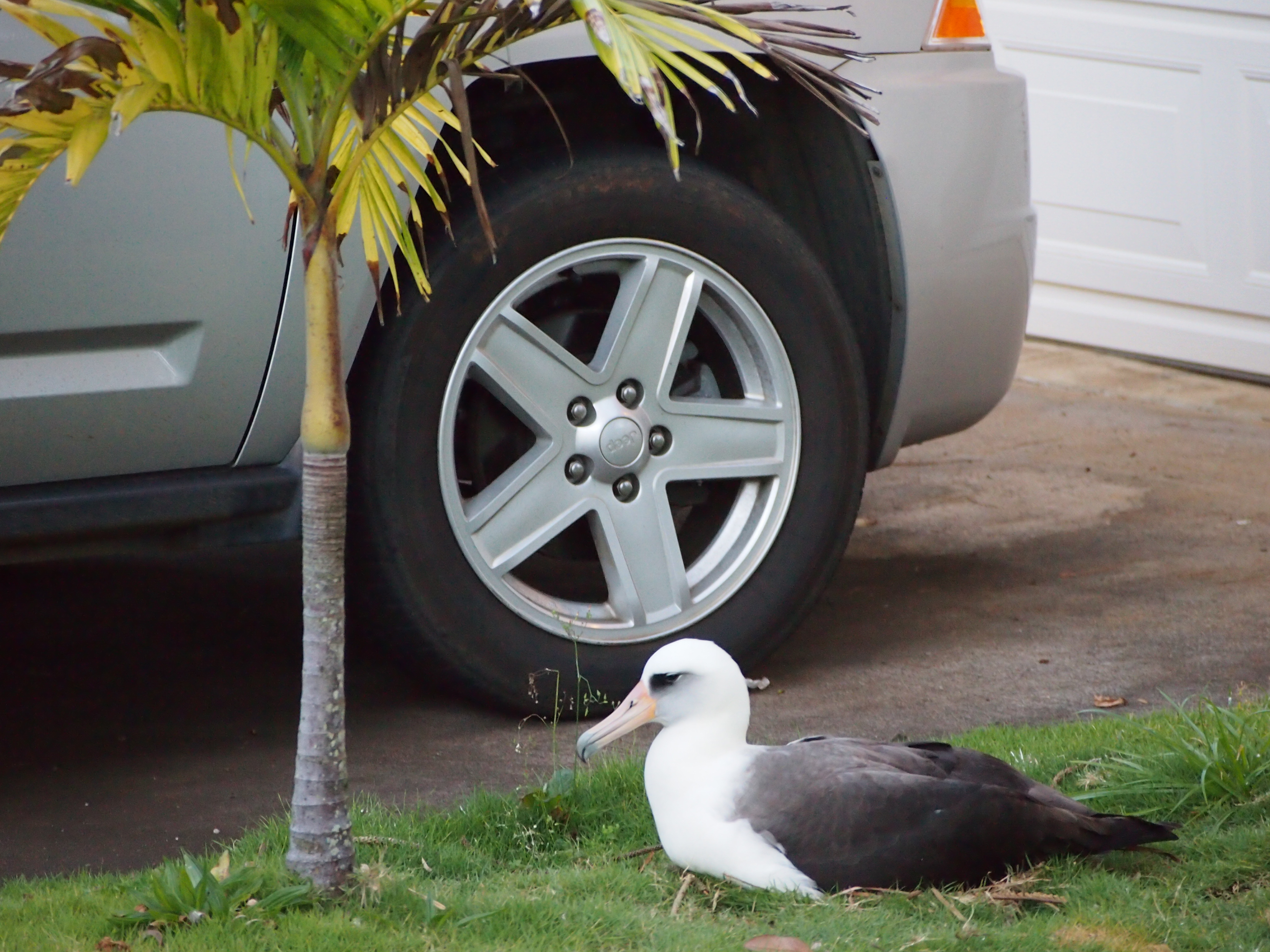
At one time KP730 was called “Tennie” by my neighbor after we saw him attempting to hatch a tennis ball.  Here is a photo of him as he was getting ready to sit on it.  I believe he was speaking to the chick inside.

photo by C Brookman

photo by C Brookman

I wish there were a word like maternal that would also cover the albatross fathers, paternal just doesn’t have quite the same meaning, and parental sounds oddly impersonal.  They spend just as much time as the mothers with the chicks, sometimes even more.  They take the first and longest incubation shift, and they fight the moms for the right to sit on the newly hatched chicks.  They work hard to keep the burgeoning chicks in food.

So here’s to you, KP730, and to all of the other albatross fathers.  The chicks would never survive to adulthood without the hours you spend sitting on the egg in hot sun and pounding rain, flying near and far to search for food, bringing it back and patiently dispensing it, clacking vigorously at all perceived threats, and sometimes just sitting at a distance, so the chick can have the security of seeing you but will start learning to live alone for the next few years.

Stay well, find lots of squid, and raise many more healthy chicks in years to come!

Posted in Uncategorized | Leave a comment

An assortment of albatrosses

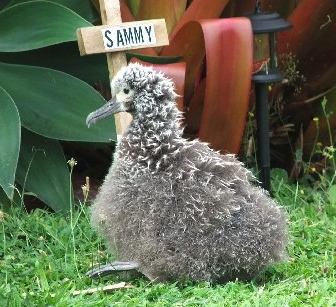
In Princeville we have trained all of the albatross chicks to sit by signs with their names on them to make it easier to see what names homeowners have given to the chicks living in their yards.

photo by C Brookman

photo by C Brookman

Actually, the chick had waddled out into the yard and just happened to plop by the sign made by the homeowner.

———————————————————————————————————-

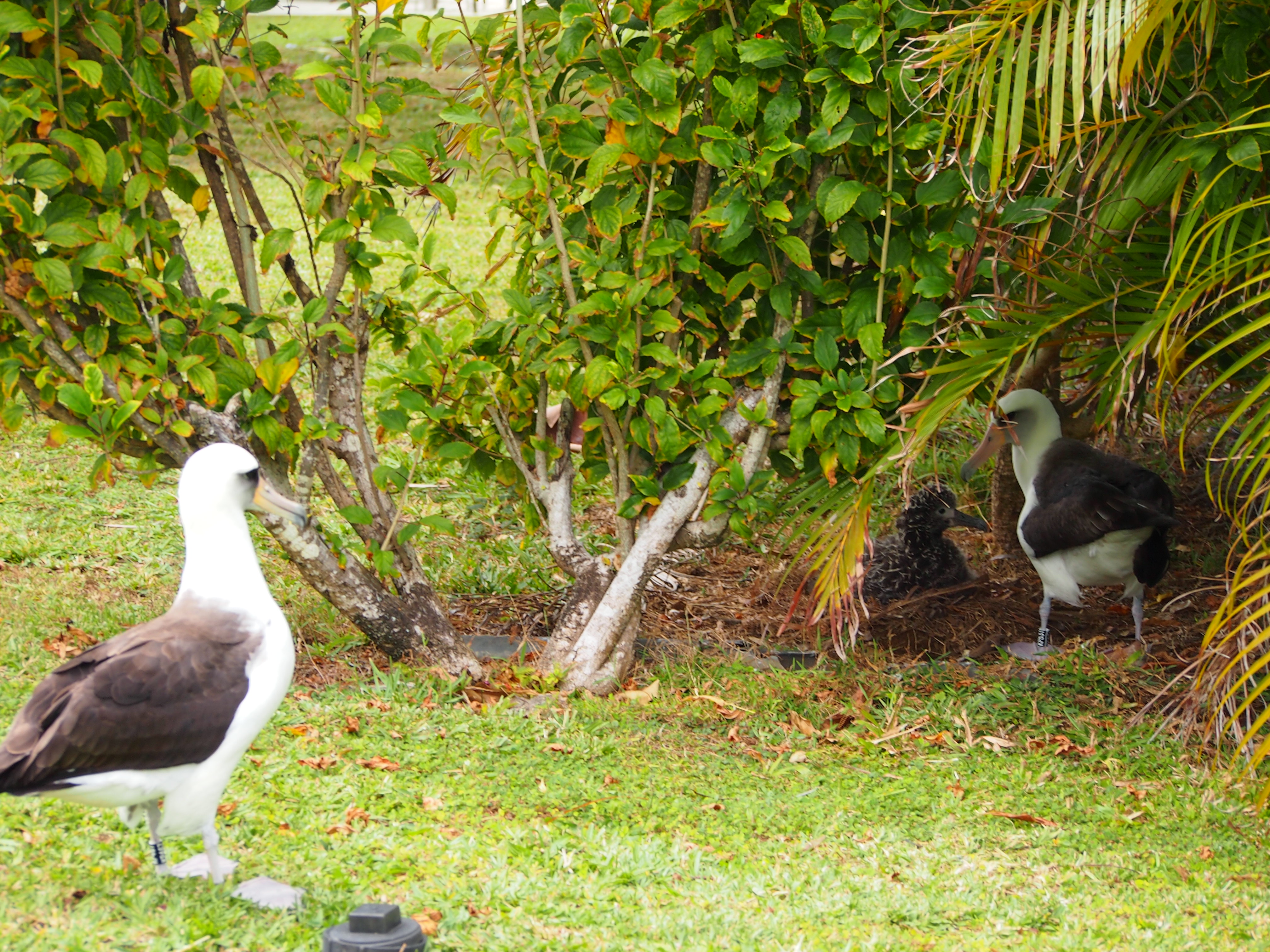
The albatross on the left is a female, KP467.  The adult standing next to his chick is her former mate, KP531.  Last year I told their story.  They were a couple since at least 2004.  Two years ago, they abandoned their egg early in the season.  KP531 kept returning to the area and met another female, K112, and they raised a chick together last year.  KP467 has not found a new mate yet.  It is very human to try to read her thoughts as she watches her former mate, but we are so far removed from their world that I would caution everyone to just enjoy watching them without trying to read their albatross minds.

467 and 531

467 and 531

———————————————————————————————————-

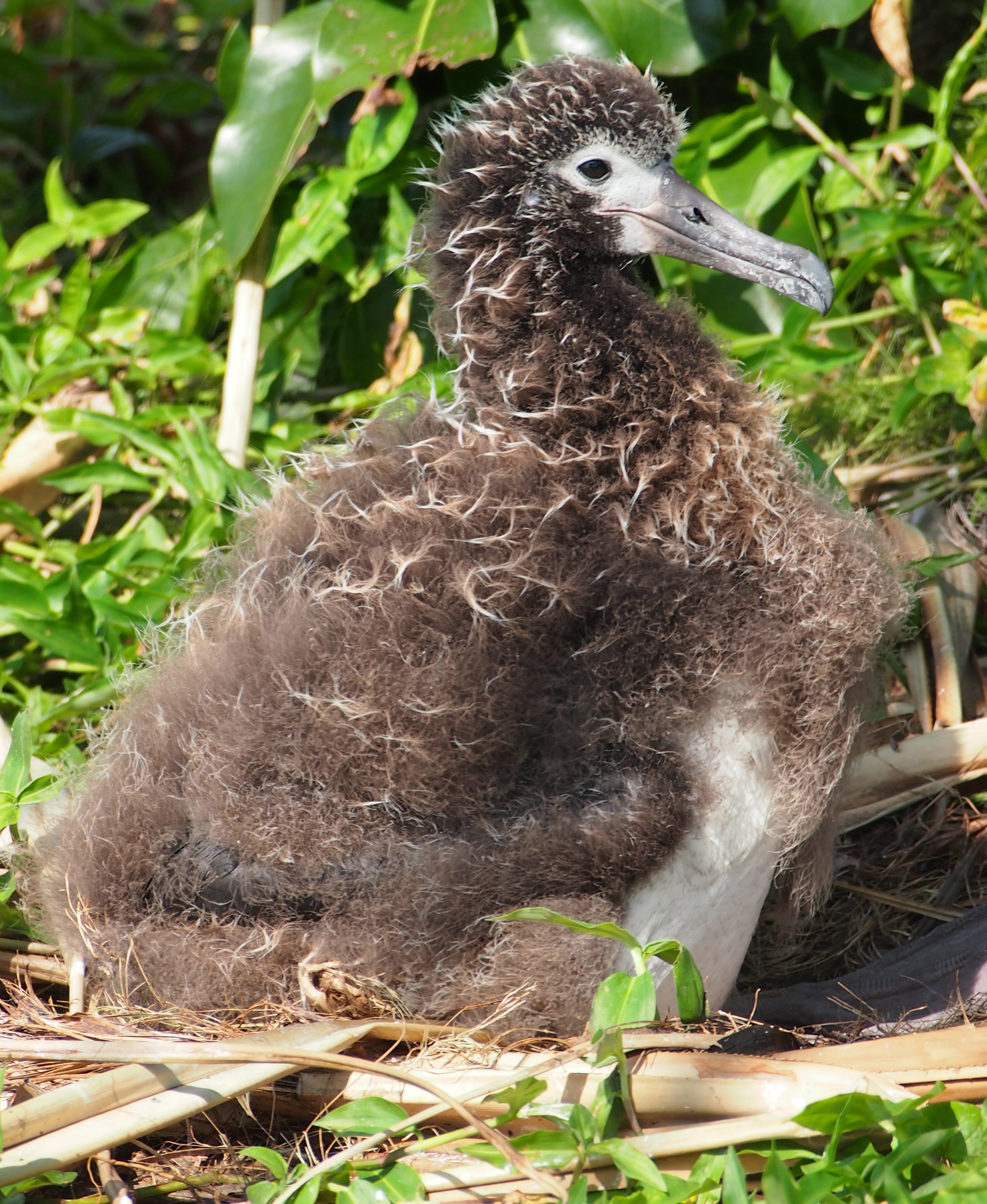
The chick in this photo is starting to get his white adult feathers.  Those feathers appear first on the stomach and start developing from the bottom up.

Chick is getting his adult feathers

Chick is getting his adult feathers

By the time the chick is ready to fledge, the important flight feathers have to be fully developed.  However, the chicks usually have some baby fuzz left on their heads.

Feeling the wind beneath his wings

Feeling the wind beneath his wings

———————————————————————————————————-

So far, I have seen 1oo non-nesters in Princeville.  That is 11 more than I saw by this time last year.  Later on I will do a breakdown of who these non-nesters are.

Posted in Uncategorized | Leave a comment

Abandoning a nest

I am especially fond of the ones I call the old-timers, the albatrosses I have watched since I first started collecting data eight years ago.  Among these are KP338 and KP643, who nested this season across the street from me.  For as long as I have been collecting data, these two have been a couple.  They are both females.

KP338 was banded as a chick in 1998 in Princeville.   Nothing is known about KP643’s background.  She was banded as an adult in the 2004-2005 season.  When an adult is banded we assume that bird to be 3 years old, the youngest age at which a fledgling will return to land.  Wisdom, the 62-year old Laysan albatross currently nesting on Midway, was banded as an adult, so she is very likely even older than her estimated age.  It pains me to see unbanded adult birds.  Is this unbanded one the bird you saw in the same area yesterday?  Is that unbanded one the same bird that was displaying with one of the banded ones last week?  In Kaua’i, the albatrosses travel between colonies, so I do not even know if other observers have seen any of these birds.  This data can never be recovered.

KP338 nested with KP643 for the first time in the 2005-2006 season.  They each laid an egg and the one they chose to incubate was infertile.  They were given an egg from a nest at the Pacific Missile Range Facility and raised a healthy chick.

In 2006-2007 they did not nest.  However, KP338 was in the neighborhood on 14 days, spread out from December 9th until February 18th.  KP643 spent 19 days on land; the first day was December 21st and the last was March 14th.  During that time, they displayed together three times.  Twice they sat together engaged in quiet grooming, the behavior typical of mated couples.  Of course I may have missed some of their meetings, since I do not observe them 24 hours a day.  If I observed them once a week or less, I would have been lucky to see any of these get-togethers, since there were five spread out over more than two months.

In 2007-2008, they raised another couple’s chick successfully.  The mother of the chick had incubated the egg and stayed with the chick when he hatched, but left after she had spent 45  days at the nest.  The chick was very young to be left alone.  The father never returned.

In 2008-2009 their chick failed to thrive, and eventually died.

In 2009-2010 and in 2010-2011 they left the eggs fairly early in incubation.  In 2011-2012 they each built a separate nest and laid a separate egg.  Unfortunately, the nests were in different yards, and each bird stayed on her own unviable egg.

This season they each laid an egg near each other, but both sat on one egg and the other was abandoned.  They built the nest next to my neighbors’ driveway.   Unfortunately, when Lindsay and Eric candled the egg in December they found it to be unviable.  The egg swap with the PMRF did not happen this year, so the couple was left with their bad egg.

KP643 sitting on egg

KP643 sitting on egg

These two faithfully took turns incubating their egg.  Then KP338 began leaving it alone, sitting nearby and waiting for her mate to return.  KP643 did come back and then she continued the futile incubation.  At one point I saw her standing and talking to the egg.  When the chicks start to hatch, they talk back and forth with the parent on the egg.  For the albatrosses in a crowded area like Midway, this will help the two to identify each other.  In this case there was not a chick in the egg to respond to her.

She left the nest on March 17th, but even after that she sat briefly on the egg.  My neighbors, Louise and Steve, who shared their yard with these two albatrosses, watched out over them and went out of their way to keep the surrounding area quiet and safe for them.  Louise assembled a film showing them changing nest duties.  You can see it on her blog:

Sometimes albatrosses abandon their nests.  Some first-time nesters do.  Perhaps they do not have the patience required to stay for days on end in one spot,  sitting through all types of weather from heavy storms to hot sun.  For some birds that seems to take practice getting used to.  Sometimes even experienced nesters leave the nest.   None of these albatrosses are being neglectful, or uncaring, or any other negative adjective we can think of.  They are being albatrosses, no more, no less.  They operate on instinct, which we have little understanding of.

The instincts of these two albatrosses led them to stay with their egg far longer than the requisite time for hatching a viable egg.  Most eggs hatch around the 65th day after the egg is laid.  Last year, every egg hatched on day 64,65 or 66. This couple shared incubation duties for 104 days.

Could I possibly use “abandon” to describe these two finally leaving their egg?

It seems a shabby word to select to acknowledge the end of the hours each one spent at the nest, keeping the egg warm and safe, waiting for her partner to return.

Posted in Uncategorized | 2 Comments

But officer, it was self-defense!

The chick at one nest finally had enough of the non-nesters tromping around his nest and occasionally pecking at him.

Touché!

photo by Brian Murphy

photo by Brian Murphy

Posted in Uncategorized | 2 Comments

Survival of the fittest chicks

It must be a milestone in a chick’s life when Mom and Dad stop sitting on him.  Some of the parents continue to try to cover them even when the chicks have clearly outgrown the space that is available underneath the adult.  I have watched chicks try to buck them off, but most eventually give up and just resign themselves to being flattened.

P027 squishing her chick

P027 squishing her chick

Closeup of squished chick

Closeup of squished chick

Posted in Uncategorized | Leave a comment

the albatrosses who do not come back

Every year some of the nesters from the previous year do not return to Princeville.  If albatrosses who have never nested do not return, it is possible that they relocated to one of the other colonies on the north shore of Kaua’i to look for a mate there.  However, if I do not see one who had a nest mate the previous year, I am less optimistic about what happened to that bird.  They are programmed to return to nest again, that instinct is very strong.

Occasionally I will write about one of these albatrosses I remember from past seasons.

KP298

KP298 hatched in my neighborhood in 2002, and returned for the first time in 2005.  For the first two years, I only saw him in my neighborhood.  Then in 2008 he started spending time on the golf course where he would eventually nest.

Blu200 was banded as an adult; I have no idea how old she is.  In 2009 blu200 was all over the place, in all of the areas that I check, but started to spend all of her time at the golf course.  KP298 started out that season spending time in my neighborhood, but ended up on the golf course near blu200.  The last two days I saw them both in March of 2009, they were displaying together and engaging in quiet contact.  Undoubtedly they were together more often than that.  Even checking every day I miss a lot.

They nested together in 09-10 and 11-12.  Last year, strong winds blew over the tree that was next to their nest.  The chick was in the right spot and was uninjured.

Chick of 298, blu200

Chick of 298, blu200

Blu200 came back this season in November, when the nesters from the previous season met up with their mates.  She stayed in the area where she had nested with KP298, but he never returned.  In the last week of December she started going to other areas in Princeville; since then I have only seen her on the part of the golf course where her nest was located.  I have seen her displaying with other birds there, but not with one in particular.  She still has time to find a mate if she is looking for one.  I have discovered that some albatrosses take longer than others to give up on the old life and get on with the new one.

And frankly, finding a mate who will faithfully accept weeks of incubation duties, spend many hours at sea searching for food for a chick, and return each season to nest again or just to renew the bond with his mate—-that is a job worth spending some time on.

Posted in Uncategorized | Leave a comment

Dinner is served

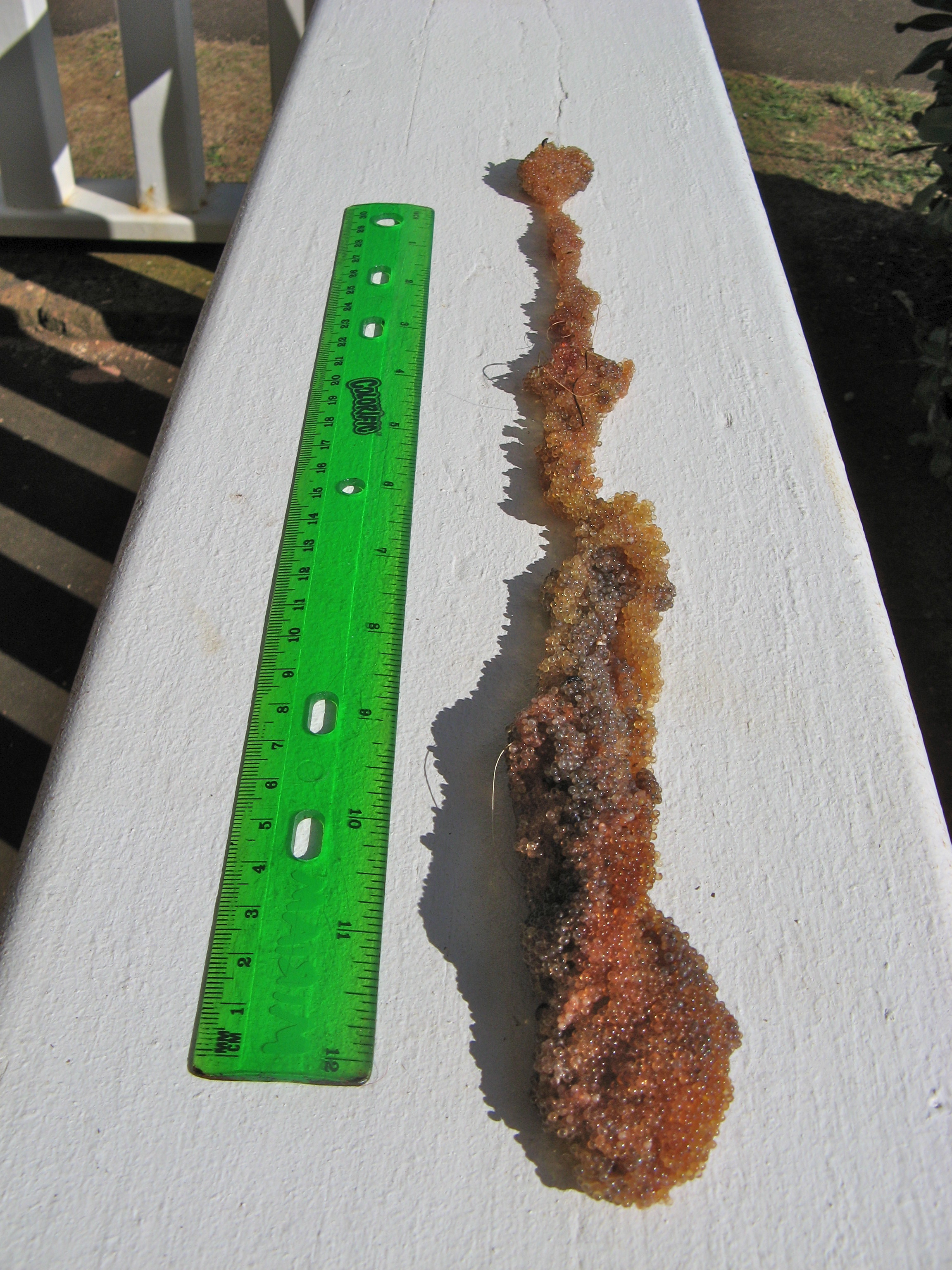
An albatross chick must peck on the parent’s bill to stimulate feeding.  The parent will regurgitate a delicious meal made up of food that was picked up on the last flight out to sea, mixed with stomach oil, an energy-rich substance formed in the stomach from ingested food.  The checks get their water from this mixture.  One favorite food item is flying fish eggs.  Flying fish tend to lay their eggs near seaweed or other floating objects, which unfortunately includes increasing amounts of plastic.  The eggs have long filaments that wrap around these things.  A parent may pick up plastic that is attached to the eggs, then regurgitate it for the chick.  A young chick cannot vomit for the first few months, then he can throw up a “bolus,” a mass of indigestible objects.  The bolus usually contains squid beaks, but may also have bottle caps, fishing line, plastic cigarette lighters, even a toothbrush.  The chicks whose stomachs are not too full of plastic will be able to hold enough food in their stomachs for survival, until they are old enough to expel the bolus.  Sometimes a chick is fed so much plastic that it fills the stomach, so there is no room for food.  The chick can die of dehydration.  In addition, sharp objects may puncture the chick’s digestive tract.  Huge masses of plastic float on the Pacific Ocean and are a threat to the welfare of these albatrosses.

My sister and I once came upon a chick who was making a strange noise, and the parent was sitting near the nest vocalizing.  There was a bit of plastic line coming out of the chick’s mouth.  He was choking on something.  I pulled a tiny bit on the end of the line, and it was not stuck on anything; the danger in pulling it out would be if there was a hook tied to it.  I was able to pull it all out.  It was over a foot of fishing line that was covered in flying fish eggs.  The parent had fed it to the chick, who was unable to regurgitate it and was choking.  It was pure luck that made us walk by that nest then.

flying fish eggs on fishing line

flying fish eggs on fishing line

closeup of flying fish eggs

closeup of flying fish eggs

In spite of all of these dangers, the great majority of the chicks will survive and fledge.  So I will close this post with a little film of a chick on the golf course enjoying his dinner.  Bon appétit, little guy!

Posted in Uncategorized | 2 Comments

Updates on non-nesters and on chicks

The albatrosses in Princeville are branching out.  Yesterday I counted 7 who were hanging out at local condominiums, displaying or just sitting around.  Clearly, they are doing this to make my life more difficult.  I now have to check their additional habitats and I also have to reassure people that it is normal for the birds to stay here for a few days in a row.  The albatrosses often spend the night in Princeville.  The couple who nested in my garden spent 10 nights in a row in my neighbors’ yard.  Ask my neighbor, she started sleeping on the sofa because the birds were often noisy in the evening, and they chose a spot underneath her bedroom window for their evening displays.  This does not mean that the birds never leave.  They may leave at night, or early in the morning, or some other time when there is nobody around to see them go and return.

When other albatrosses fly overhead, the ones on land will usually stand and vocalize to get the flyer to join them.  Last January I filmed one such display:

Albie Talk

We now have 18 chicks.  Every egg that Lindsay Young and Eric VanerWerf classified as a viable egg during candling has hatched.  To learn about the candling process check out

http://www.acap.aq/index.php/en/news/news-archive/24-2011-news-archive/820-sixth-year-for-the-laysan-albatross-egg-swap-on-kauai-hawaii-deemed-a-success

The parents are starting to leave the chicks alone to spend more time finding food for them.  Our oldest chick has been alone at the nest for 3 days.

chick at Nest 1

chick at Nest 1

The parents get their chicks used to being alone by moving away from them inch by inch, then they will often leave them for a few hours.  There is a lot of variation in parenting techniques.  Yesterday I found a father sitting about 30 feet from his chick.  The whole time I was there, the chick’s eyes were glued on Dad.

KP400, watched by chick

KP400, watched by chick

So as we see more and more of the albatrosses who are looking for nesting partners, we will see less and less of the ones who nested this year.  I will have to start putting up my signs that reassure observers that the chicks have not been deserted by their parents.  This devotion to their young ones is definitely programmed into the albatrosses, abandonment is simply not a choice for them.

Posted in Uncategorized | 1 Comment

the lure of an albatross chick

A few days ago I watched a five-year old male albatross who was trying desperately to touch a 3-day old chick.

Before I started to observe them, I would not have expected to see birds doing this, this is a behavior typical of primates.   I have seen parent albatrosses actually try to hurt the chicks of other birds, but non-related albatrosses will sometimes groom the little ones and even sit with them when their parents are not around.  Sometimes, I think, it may be a way of showing other albatrosses that they know how to handle chicks.  That is strictly a guess, maybe they just genuinely enjoy sitting with the chicks, who knows?

Sometimes the adult albatrosses get a bit rough with the chicks and the grooming becomes over-zealous, so the parents usually try to discourage their company.

Watch this video twice.  The first time, concentrate on the two adults.  The one on the right is a 5-year old, Maluhia, and the parent is K454, a bird who has not nested before in Princeville.  Maluhia is a young bird who is still trying to get his act together.  He thinks that fake-grooming the parent will give him access to the chick, but the older bird is wise to him.  It doesn’t take much to make Maluhia leave, just one quick jab, one that didn’t even connect with the target.  At the end of the tape you will hear Maluhia make a sound that is called a “sky moo.”  Sometimes albatrosses make a sky moo as part of the courtship display, sometimes it sounds like “Woe is me!”

Then replay this tape and watch the chick.  Remember, the chick is just 3 days old.  At about 15 seconds into the video, the chick does the albatross equivalent of taking a swing at Maluhia, the quick beak jab.  After that, when Maluhia gets too close, the chick assumes what I call “the defensive posture.”  When the parents start to leave their young ones alone so they can feed their burgeoning appetites, the chicks need to learn to protect themselves from other albatrosses.  Eyes are a vulnerable spot, and the chicks will move their heads to the side and then down, protecting them from harm.

Remember, albatrosses evolved without the presence of domestic dogs and cats, so turning the head to the side will not offer much protection from those predators.  Please keep your pets away from these birds!

Posted in Uncategorized | 2 Comments