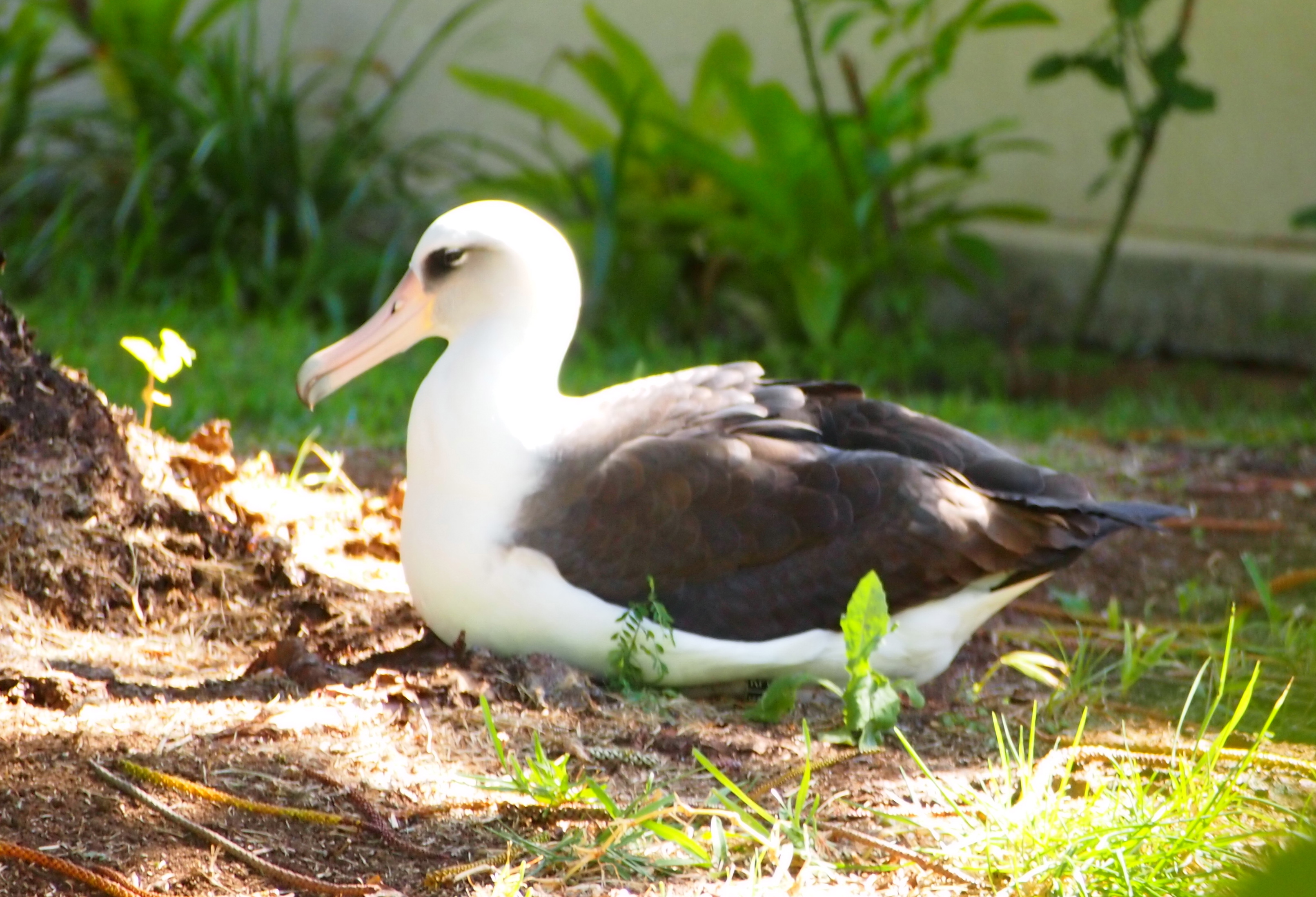
The birds keep coming

I have already seen 62 albatrosses and 3 eggs in Princeville, scattered around two residential areas and the golf course.  Most of these birds are the ones who have nested before.  There are a few non-nesters that last year exhibited the “quiet contact” behavior typical of couples, sitting close to each other and gently grooming the mate.  Those couples may also nest this year.

Finding a mate takes time and effort.  Sometimes when a bird’s mate does not return, the one who is left does not find or perhaps even look for a replacement for a year or two.  Other times, they start searching the same season as the mate’s disappearance.  Sometimes they disappear from Princeville, and I always wonder if they have relocated to another spot on the North Shore because they could not find a suitable mate here.  It may not be easy to find a new one.  I have said this before, if I ever learn how to speak albatross, the first thing I will ask them is “How do you choose a mate?”  This is a mystery to an ignorant human.

A few of them are still waiting for their mates to return.  Some have already been together and have  left for the “pre-egg laying exodus.”  After they have met here, all of the couples leave for a week to 10 days before returning to get down to the business of laying an egg (or eggs, in the case of a female/female couple) and beginning the cycle of incubation and chick feeding.  Even checking every day I may miss seeing some of the couples reunite, I may not see them until they come back to nest.  If I checked less regularly, I would miss a ton of interesting albatross stories.

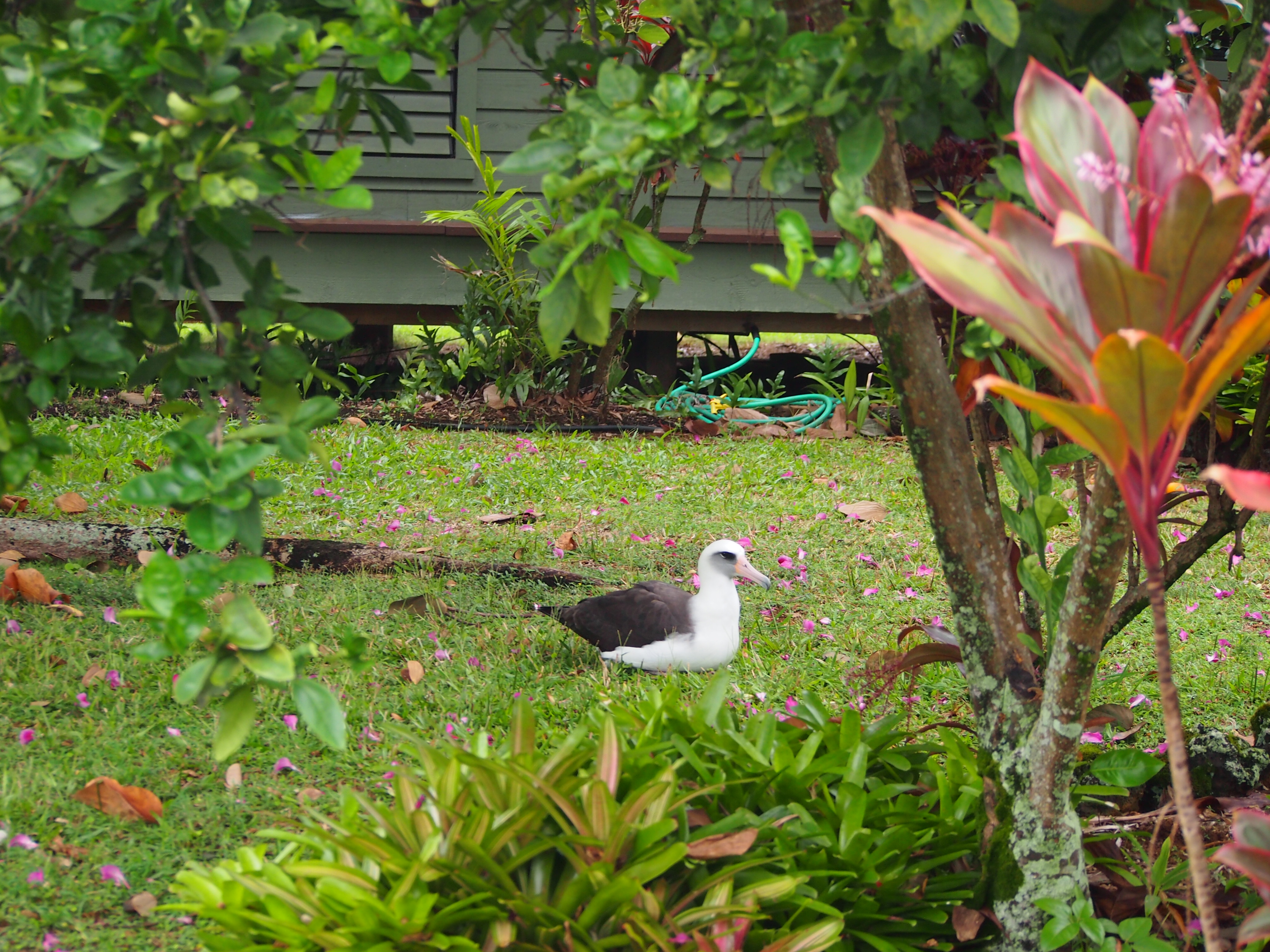
Oh, and I should add that last year I had seen 51 albatrosses and no eggs by November 23rd.  Princeville is doing very well as an area for safe nesting, thanks to the concern and care of the people who live here and of all the visitors who cannot believe that they can walk down a street and see a wild seabird sitting on someone’s lawn.  I picked the house I live in because it is in the middle of a nesting area, and I have had nests on my property 4 times, and watched two chicks being raised.  Sitting in my living room, I am listening to an albatross calling to another bird flying overhead, hoping that one is his missing mate.  About half a block away, I hear the exuberant display of two or more birds.  At night the albatross across the street claps his bill together for no apparent reason, at least not one that a non-albatross can understand.  Over the years I have watched traffic come to a halt more than once because a chick has decided to try out his wings on my street.

We have been given a glimpse into the private lives of beings that were here long before Homo sapiens.  We must honor this miracle by protecting them from harm and by respecting their right to live normal albatross lives.  We admire them from afar and realize that the observer who can watch these animals without intruding into their lives is the one most likely to be treated to an unexpected behavior, a tiny golden moment of unguarded birdiness.
Posted in Uncategorized | 1 Comment

Albatrosses continue to return

As of November 16th, I have seen 22 albatrosses in Princeville.  There are 4 couples, 11 birds who nested before and are waiting for their mates to return, one unbanded bird, one bird who does not have a mate, and KP618, whose mate disappeared during incubation last year.

On November 15th one of the females who nested in my garden last year returned.  She has been waiting in my yard since then.  When this couple has a failed nest, they usually pick the place where they will be nesting the following season and meet there day after day.  Last season they chose my neighbor’s yard, and I expect to see them there when the second one returns.

K407 waiting for KP466

K407 waiting for KP466

KP531 is the male who left his mate for another a couple of years ago.  The rejected female has already left Princeville with a new mate, and I expect them to have the first nest here when they return.

One bird, KP505, is a grandfather.  He and two of his children nested here last season and all three chicks fledged.  He was originally banded in as an adult in 1989 at the Pacific Missile Range Facility.  We assume that adults are at least three when banded, so he is at least 27 years old.

Another bird who returned to my neighborhood is KP639.  He was banded in Princeville in 1989, and was nesting then at one of the first nests in Princville.  Nesters are at least 5 years old, so he is at least 29.  He was reunited with his long-time mate, KP676, who was banded at the Kilauea Point National Wildlife Refuge as an adult in 1988.  There is a record of her nesting in Princeville in 91-92.  She and KP639 have been nesting together since I started observing in 05-06.  Last year they didn’t have an egg, but they were both back when the nesters returned in November.  I last saw her in February, he returned after that and I saw him last in mid-April.  It is interesting that she preferred life on the open seas over living in a yard in Princeville, while her mate spent 22 days here after she had left for the season.

Every day more albatrosses will be arriving.  I always look forward to seeing familiar band numbers, and I am always sad when someone does not return.

Posted in Uncategorized | 1 Comment

Two more albatrosses

On Sunday, November 10th, KP618 and KP467 were still sitting in separate areas, a behavior that would be highly unusual if they were a couple with plans of nesting together.

Everything changed yesterday.

KP424 arrived.  He nested in Princeville in the 1993-1994 season.  His age is unknown, but I have never heard of an albatross younger than 5 nesting; using 1993 as a baseline, he is at least 25 years old.  Every year since I started collecting data in 2005, KP424 has nested in the Kilauea Point National Wildlife Refuge.  Every year he has always returned to Princeville and stayed here for 2 to 10 days before flying to the refuge to nest with his partner.  He never interacted much with the locals, he just sat on one particular lawn and watched the other albatrosses.

Last year, he did not return to the refuge, and neither did his partner.  I just counted the number of times I observed him here:  fifty!  He was a busy boy, too, participating in 11 displays and 5 quiet contacts.  Most of those displays involved KP467, the female who arrived on Saturday, and all of the quiet contact sessions were with her.  I would say that is a good indication that they were both anticipating getting together this season.

All day yesterday, KP424 and Kp467 were together, and most of that time they were sitting close to each other in mutual grooming sessions.  KP618 was sitting about 10 to 15 feet away from them.  Today he is still here, but the other two have left.  If I were a betting person, I would give you odds that this couple will come back in about a week or so, she will lay an egg, and they will raise a chick together.

Is it possible that the father of the egg is actually KP618, that he and KP467 mated before KP424 returned?  Absolutely!  But I do not think that KP424 will be thinking this.  He will be acting on instinct, which will tell him to take over incubation duties when KP467 leaves after laying her egg.

It is interesting that so far this season I have seen a female who was rejected by her mate and has not nested for a couple of years, and two males whose mates disappeared last year.  I did not mention another neighborhood albatross that I saw yesterday, K233.  He and his mate have raised two chicks together.  Last year I saw them both for the first time on November 23rd.  I saw him a few times after that, but she did not come back for over 3 weeks.  They did not nest.  I last saw her on January 16th.  He came back a few times after that, but I did not see her again.  I looked at my chart for another year and their behavior patterns were actually quite similar, so I will not try to predict whether or not she is coming back this year.

This photo shows him sitting not far from where they have nested before, near the palm tree in the back to the right.

K233 has returned

K233 has returned

I will keep an eye out for his partner, who has a purple leg band with a number following the letter “O,” which indicates that she was banded on Oahu.

I will also be watching KP618 to see if he is spending his time looking for a new mate.  It takes some albatrosses longer than others.  They do have unique personalities, that is one fact about albatross behavior that I can attest to.  So can anyone who has read this blog for any length of time.

Posted in Uncategorized | Leave a comment

The plot thickens….

Observing animals in the field is only a part of the process of data collection.  If that is all I did, I would not be doing my job.  In the days before personal computers, the next step would be to transfer key observations into a central journal.  Anyone who has read any of the classic books by wildlife biologists about life in the field knows that when they returned to camp, no matter how exhausting their day had been, they had to transfer some of the data to the journal.   Usually social interactions were recorded, and other types of behaviors that the person in charge considered to be important: exact locations of the animals, the foods they were eating, vocalizations, interactions with other animals, whatever was deemed to be especially significant.  The journal made it easier to find the information the researchers were most interested in.  Now computers serve as journals, as repositories for field observations.  Older data that was recorded in journals is now being entered online.  Jane Goodall’s journals are currently being transferred to a computer database which can then be accessed by scientists all over the world.

With laptop computers the job of recording the most important data is much easier.    I record all of my data for each season in an Excel chart.  Rather than flipping through all of my observation notebooks (about 9 small notebooks per season of daily observations, and I am now going into my 9th year) I can find what I’m looking for online in a few minutes.

I was wondering why KP618 had returned to Princeville on November 4th, a week before I had ever seen an albatross return to Princeville.  I remembered that KP618 was not one of the birds that I often see at the very beginning of the season.  I checked my charts and found that the earliest he had ever come back was November 21st.  Why would he come so early?

Then I saw that the last time I had seen his mate last season was December 16th.  After she left, KP618 incubated their egg for a total of 44 days.  That is an unusually long time for an albatross to sit on an egg.  He finally abandoned the nest.  Two days later he was back on the egg, then he was gone by the next day.  I saw him a few times during the following week but I never saw him interact with any other albatrosses, he just hung out near his nest.

When an experienced nester fails to return during incubation, I always assume that he or she has died.  Nesters may abandon an egg, but they will always come back during the season to renew the bond with their mates.  So now I am guessing that KP618 realized that his mate will not return, and that he came back this early to find a new mate.

Saturday morning I watched a second albatross fly over my neighborhood and land near KP618.  KP467, a female, immediately displayed with KP618, who had vocalized at her as she circled overhead.  In my post dated November 22, 2011 I told the story of how KP467 was dumped by her long-time mate.  She has not found another mate since then, although I have seen her displaying with other albatrosses.  I never saw her displaying with KP618 last year, but they were together Saturday morning.

They were still sitting together that afternoon, occasionally grooming each other.  That is a behavior you see with the couples who nest together.  I record it as “quiet contact,” but I think of it as being “married couple behavior.”

By 3:30, they were sitting quite a distance apart; they were still in different areas as of yesterday.  Were they still a couple?  Usually, an albatross who has lost his mate the previous season will take more time to find a new mate, at least one season, sometimes even several years.  And usually birds who will be raising a chick together will stay together until one or both of them leaves for a week to 10 days before coming back to start nesting.

Today the soap opera became more interesting.  But you will have to wait for my next post to read about it.

One of the reasons I love to observe these birds is that they surprise me all the time.  Occasionally they lull me into feeling secure that my vast experience observing albatrosses will guarantee the infallibility of any predictions I may make about their behavior.

Oh, what fools these non-albatrosses be!

Posted in Uncategorized | 2 Comments

The first albatross returns to Princeville

Every year I start checking for albatrosses around November 7th, a few days before I think they will actually begin to arrive in Princeville.  The earliest I have ever seen one is November 11th.  Yesterday afternoon while walking my dog in my neighborhood I heard the familiar bill clacking of an albatross warning the non-albatrosses to stay away.

It was KP618, who hatched 9 years ago in the yard where he is sitting now.  His father disappeared and his mother relocated to the golf course, where she has raised chicks with another female since 2008.  Every year they have a fertile egg.  I think it would be so interesting to do DNA testing of these birds to see who is related to whom.  There might be some surprises there.

KP618 first nested at the young age of 5, and over the years he and his mate have successfully raised 3 chicks.

Welcome home, KP618.  I hope your mate returns very soon, and I look forward to watching you both raise a fat, healthy chick this season.

KP618 resting after his long flight

KP618 resting after his long flight

Posted in Uncategorized | 6 Comments

Fledging from Princeville

Imagine that you are an albatross chick on an island in Midway.  Unless you go in circles, if you walk in any direction you will end up at the ocean.  Fledging is a matter of lifting off from the beach into an ocean breeze, heading out over the sea, and avoiding dangers like the big sharks that wait for descending chicks.  If you have survived chickhood to the point of fledging, you will at least know where to go.

What if your nest is in someone’s back yard about 200 feet above the ocean?  What if you can’t even see the ocean from your nest?  How do you know where to fledge from?  Until I started to observe these albatrosses, I assumed that they would somehow smell the ocean and make their way to an appropriate takeoff point.  I now believe that fledging from Princeville is often more complicated than that.  Fledglings have ended up in garages, under houses, by the highway, walking across the busiest road in Princeville, and in a little park surrounded by houses, among other places.

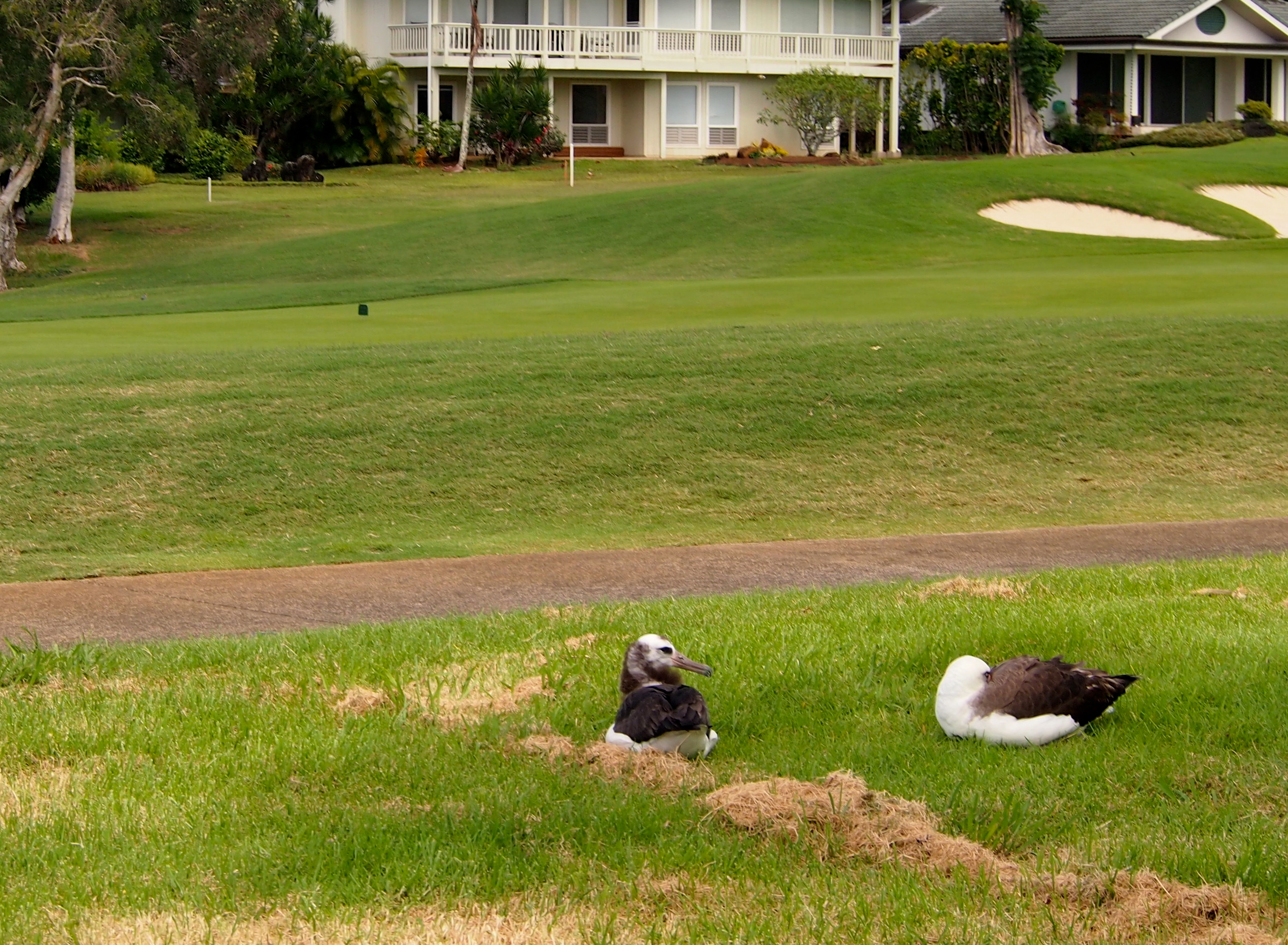
There are some spots that are perfect for fledging.  Despite the possibility of being clobbered by an errant golf ball, the chicks on the golf course have an easy path for a takeoff.  The breezes off the ocean blow down the fairways, and chicks need to head into the wind to fly.  The maintenance staff keeps shrubbery at the ocean bluff very low, so there are no obstacles to get in the way of a departing chick.  I wrote about the golf course chick who had decided to move away from his nest and into fairway 6.  I checked on him one afternoon and he was gone by the following morning.  I used to watch him make little practice runs from the side of the fairway, which angles down towards the center, then walk back to the side and try again.  He probably just kept going on one of those practice flights, right out over the ocean.

On the other hand, a chick who has grown up in someone’s back yard may have more difficulty making his way to an ocean bluff.  The wind blowing into his yard may not be coming from the ocean, so he starts his journey in the wrong direction.  Or there may be no wind to guide him; he will walk.   One year a chick made his way to the bluff but instead of taking off, he climbed down it to a beach below.  It took him all day to do it, scrabbling down through vegetation that covered a cliff that was nearly vertical in places, and he fledged from sea level like the Midway birds, not long after he first hit the sand.  The part-time resident who watched him take his first flight was so astounded that she forgot to take a photograph of it.

Even chicks next to the golf course may fly into winds that are not off of the ocean.  One year a chick within sight of the ocean ended up in the parking lot of the Sandpiper Condos, nowhere near the ocean.  Fortunately a USFWS volunteer found him before he wandered out onto a surrounding road.  Adult albatrosses can run down a street flapping their wings and manage to take off;  I have never seen or heard of a chick who could do that.

As of today, we have had 11 fledgings, with 7 chicks left.  I have not seen one of them leave.  Most of them just disappeared, so I don’t even know their stories.  I will be sharing some of the incidents surrounding their departures, and two of my neighbors were able to see chicks fledge and to take photos of them.  If anyone reading this saw one fledge in  Princeville, please let me know, I would love to hear about it.

I know there are people who do actually get enough of hearing about albatrosses, but I am not one of them.  I belong to an elite group of albatrossophiles.  Our numbers are growing, judging from the increasing number of visitors we get here and at the Kilauea Point NationalWildlife Refuge every year, and from all of the residents who watch out for our local birds.  We don’t have any meetings  or conferences or secret handshakes, but we are the best friends an albatross could have.  We are willing to stand in the background and admire them from afar because we take pleasure in watching them ignore us while they reward us by acting naturally, and we will stand up for them when anyone invades their parallel plane of existence.  The only thank you we need is a glimpse of behavior that is only visible to patient observers,  a view into a world that is ancient and alien, yet familiar and totally addictive.

Posted in Uncategorized | 2 Comments

More about Fairway Chick

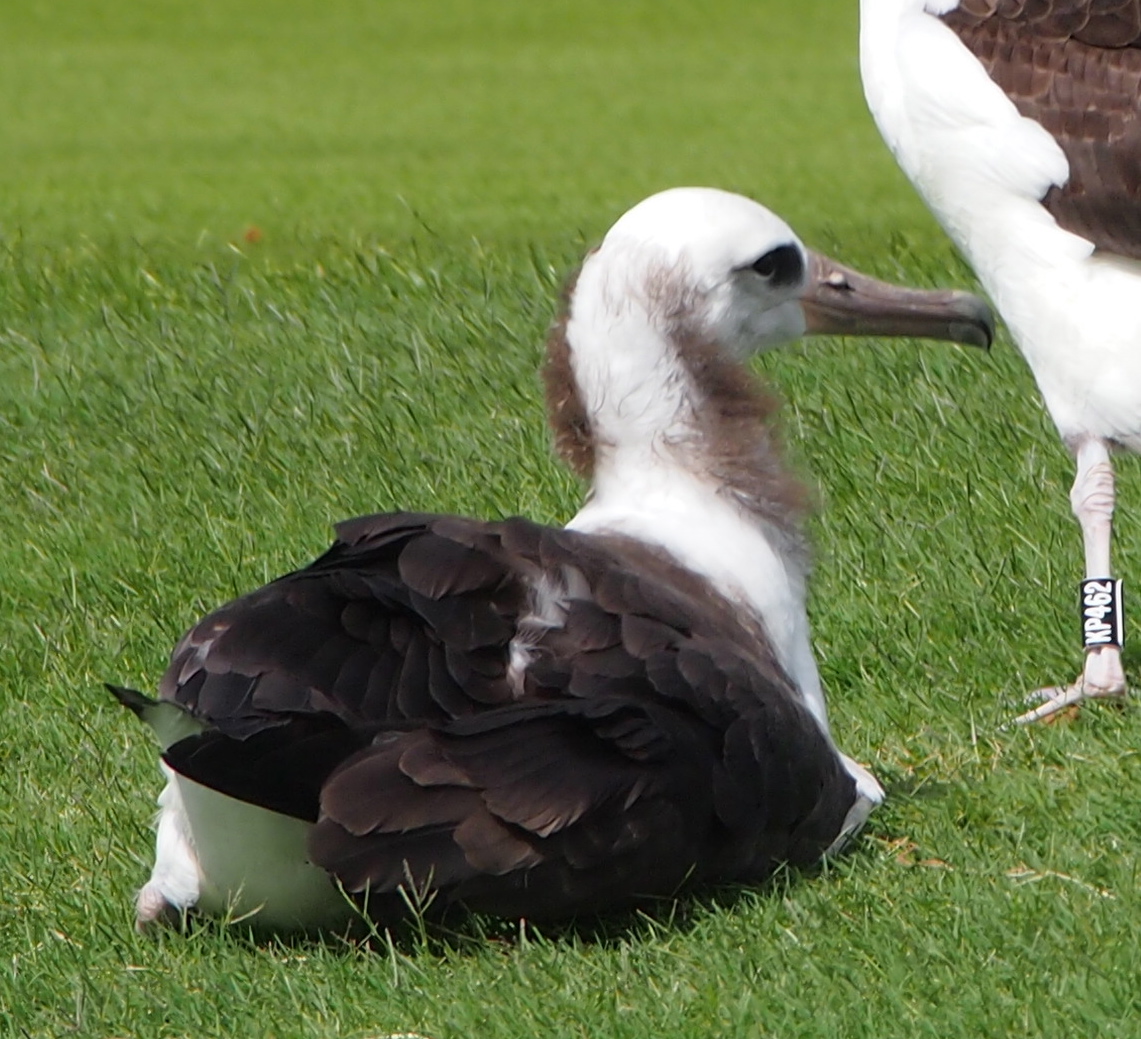
For two days in a row I saw the Fairway Chick sitting with Mom in the center of the golf course away from the fairways.  The third day, he convinced her to walk across the golf cart path to join him on the side of the fairway.  His mother left shortly after I took this photo, and the chick proceeded to make a short practice flight into the middle of the fairway, which is downhill.  He then walked back up the hill and tried again.  The winds off of the ocean are very inviting to an albatross and make fledging very natural for the chicks close to the bluffs.

Fairway Chick and Mom

Fairway Chick and Mom

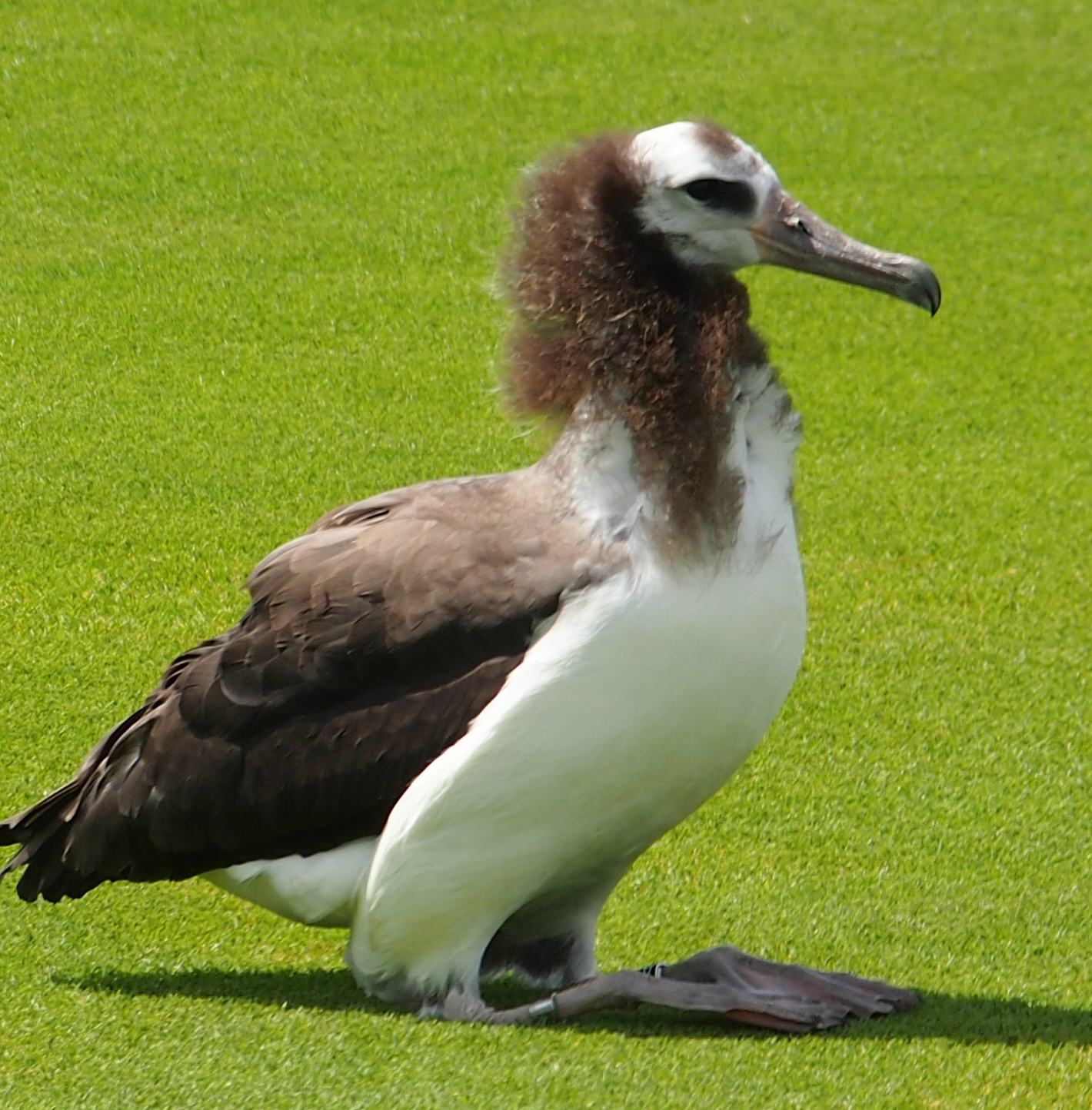
Some of the chicks still have lots of downy feathers.  Here is a sequence of photos of the Fairway Chick to show you how he is losing his.  It may be that some were lost when his mother groomed him.

June 9:

June 9, 2013

June 9, 2013

June 11:

June 11, 2013

June 11, 2013

June 16:

June 16, 2013

June 16, 2013

Posted in Uncategorized | Leave a comment

Fairway chick moves

In my last post I wrote about the chick who has made the golf fairway his hangout spot.  He is always there, and while I can get him to move temporarily, the minute I start to walk away he is waddling back out to the fairway .  But today when I checked on him he was sitting in the safer area in the middle of the course.

fairway chick back in nest area

fairway chick back in nest area

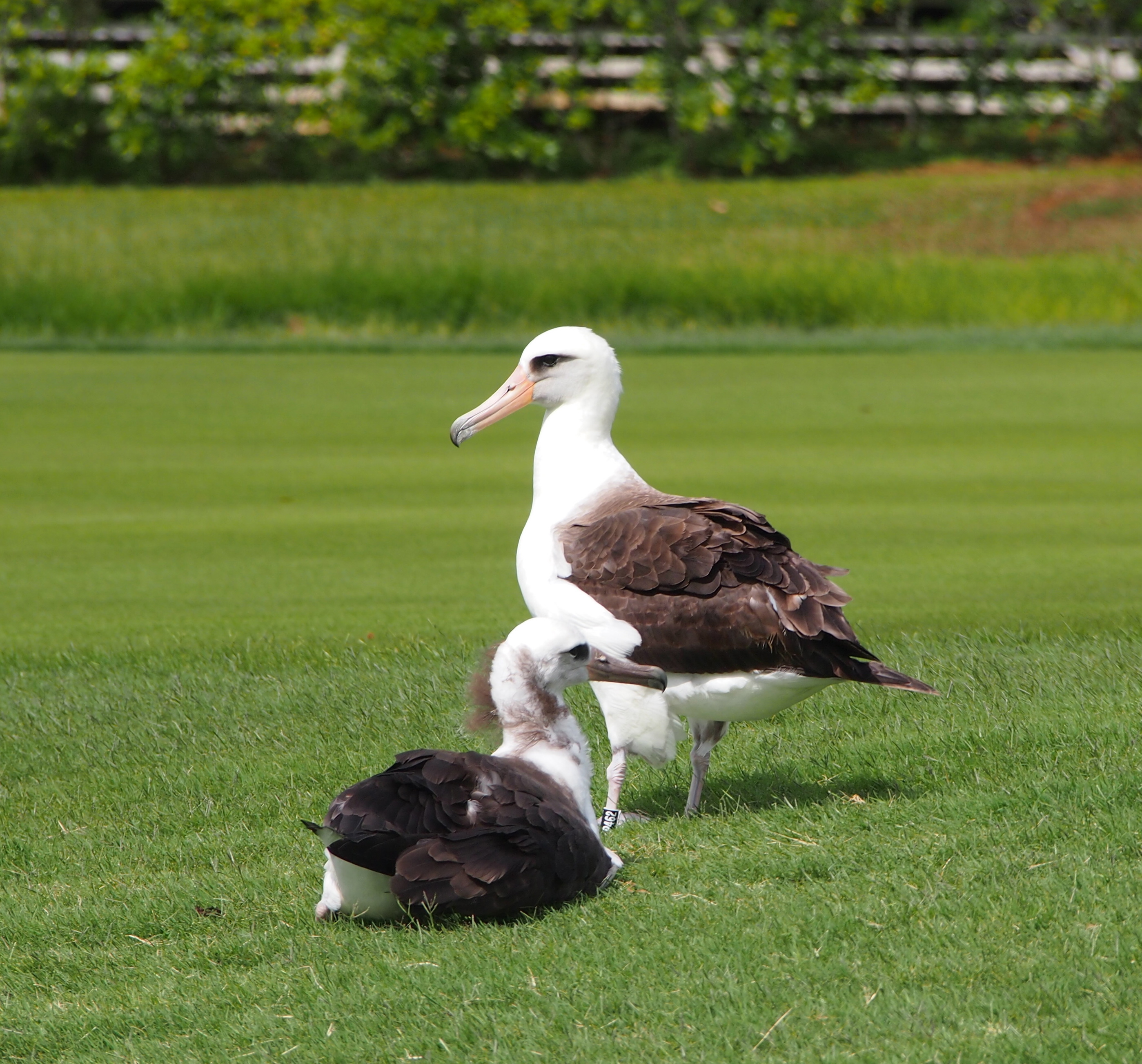
When parents return to feed their chicks, they seem to prefer to be close to the site of the original nest.  When this chick’s mother came back, she made the chick walk all the way across the fairway to join her in the center of the golf course.

That is, if he wanted to be fed.

P462 and chick

KP462 and chick

Will the chick return to the fairway when Mom leaves?

Stay tuned.

Posted in Uncategorized | 1 Comment

Three albatross observations

Observation 1:  Identifying a parent

When I saw this adult albatross I knew I was seeing a parent.  Check out the head feathers:

Closeup of KP524

Closeup of KP524

At this time of year, you can pick out the parents by this pattern of head molt. Albatrosses have to take time off from chick rearing for molting, they certainly cannot lose flight feathers when they have to spend so much time finding food for their chicks. But they can afford to lose the head feathers.

I never see non-nesters with head feathers that look like this.  Why?

———————————————————————————————————-

Observation 2:  Albatross adults hanging out with the chicks

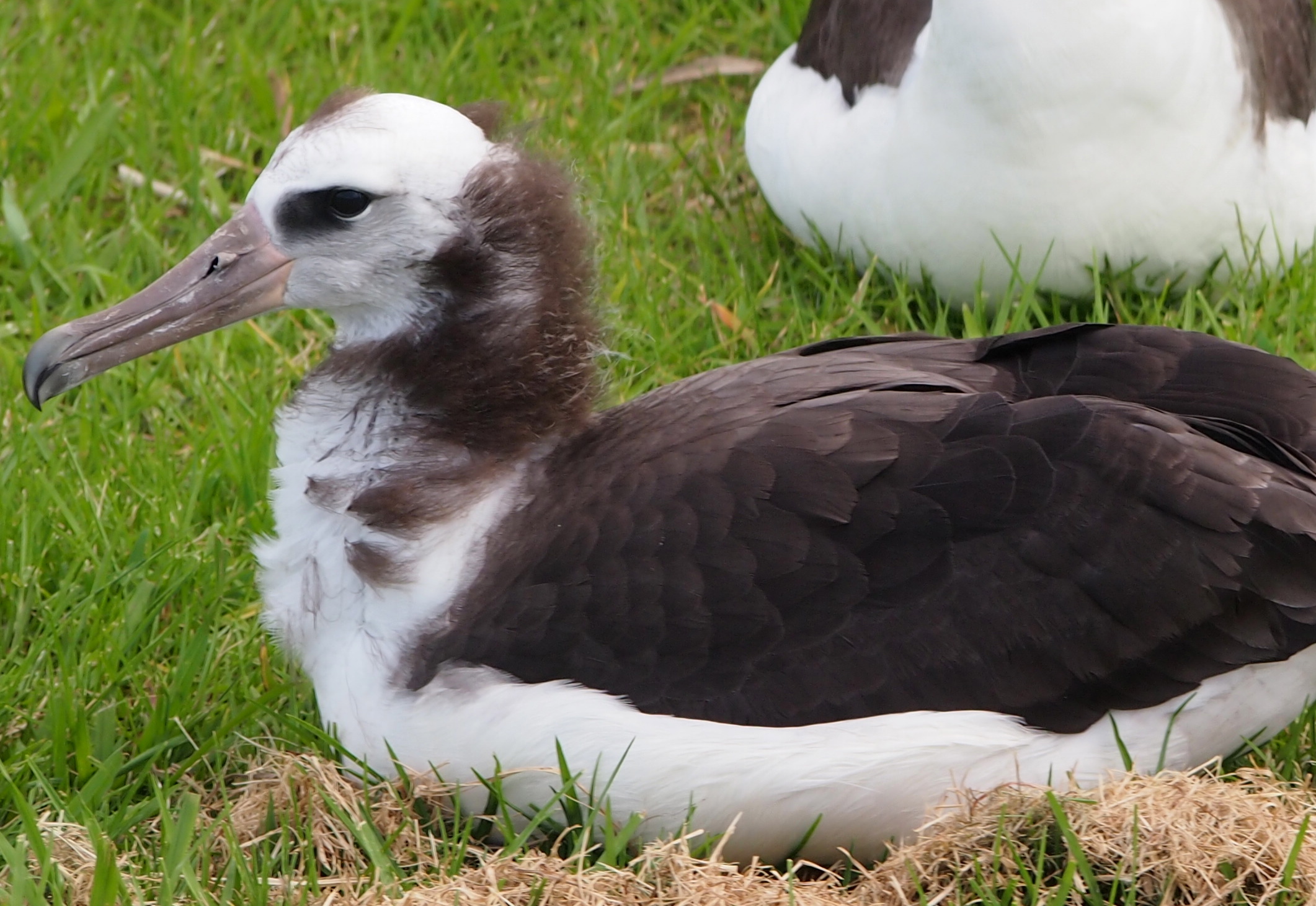
I rarely see parents this time of year, they spend so little time on land.  But I do see adult albatrosses spending time with the chicks.  This couple may nest here next season.  One is a 6-year old named Kaulele, who fledged from a nest located not too far away from where the chick in this photo is sitting.  Kalulele has been spending quality time with the other adult, who was banded on Oahu.  Whenever I see them together they are somewhere near this chick, who does not seem to mind their company.

Chick 11 and adults

Chick 11 and adults

Another chick is frequently accompanied by a bird that was banded at the Pacific Missile Range Facility, P293.  I often find them sitting near each other, sometimes so close that they are touching.

———————————————————————————————————-

Observation 3:  My problem child

fairway chick

fairway chick

He had a wonderful home away from golf balls, in the middle of the golf course.  Then he decided that my life was way too easy, so he settled in on the fairway.  He will not be moved.  I am hoping that he is the first chick to fledge, the sooner the better.

I will bid him a fond adieu, and hope that he does not decide to nest on his favorite fairway when he returns.

Posted in Uncategorized | 4 Comments

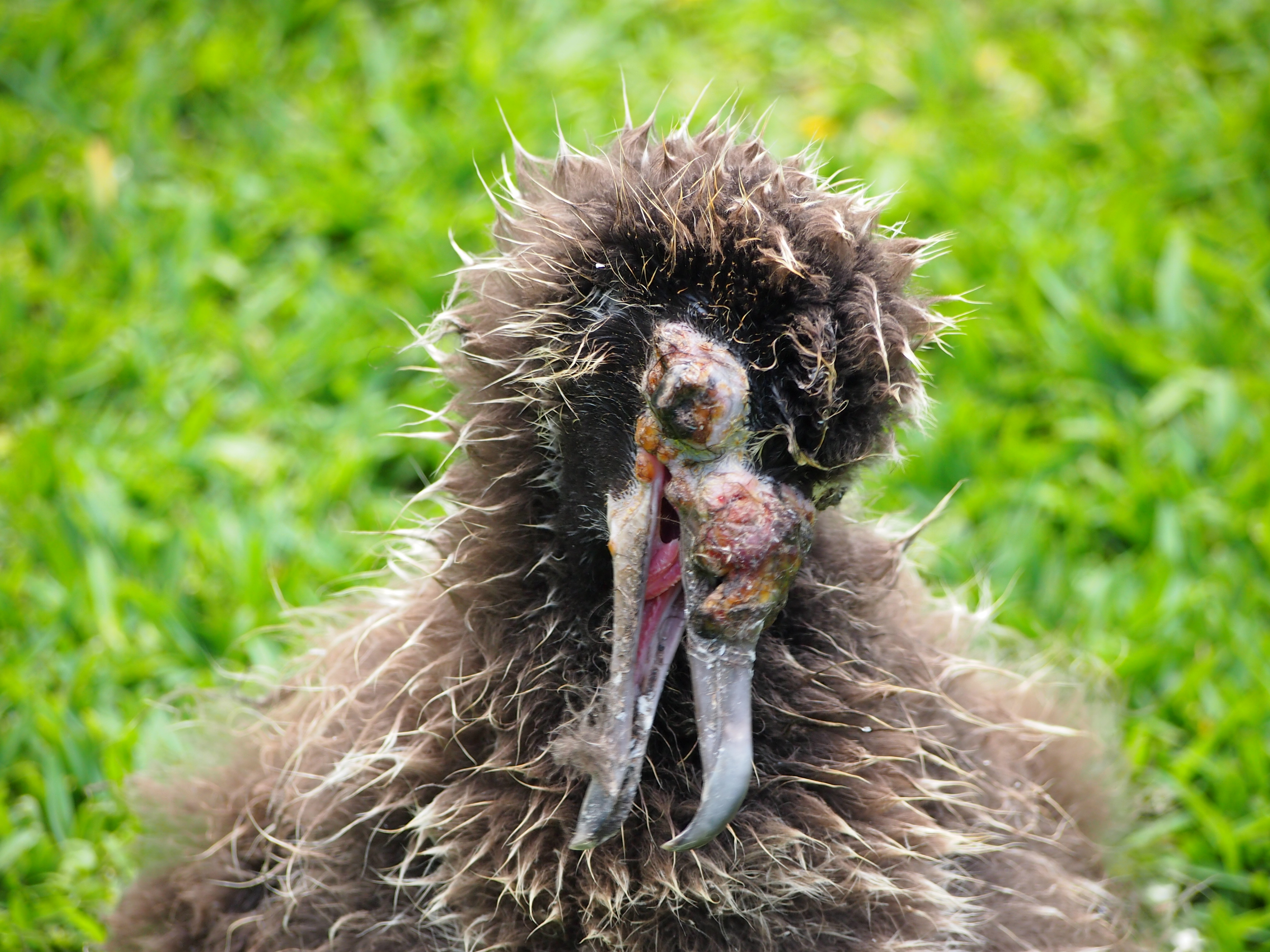
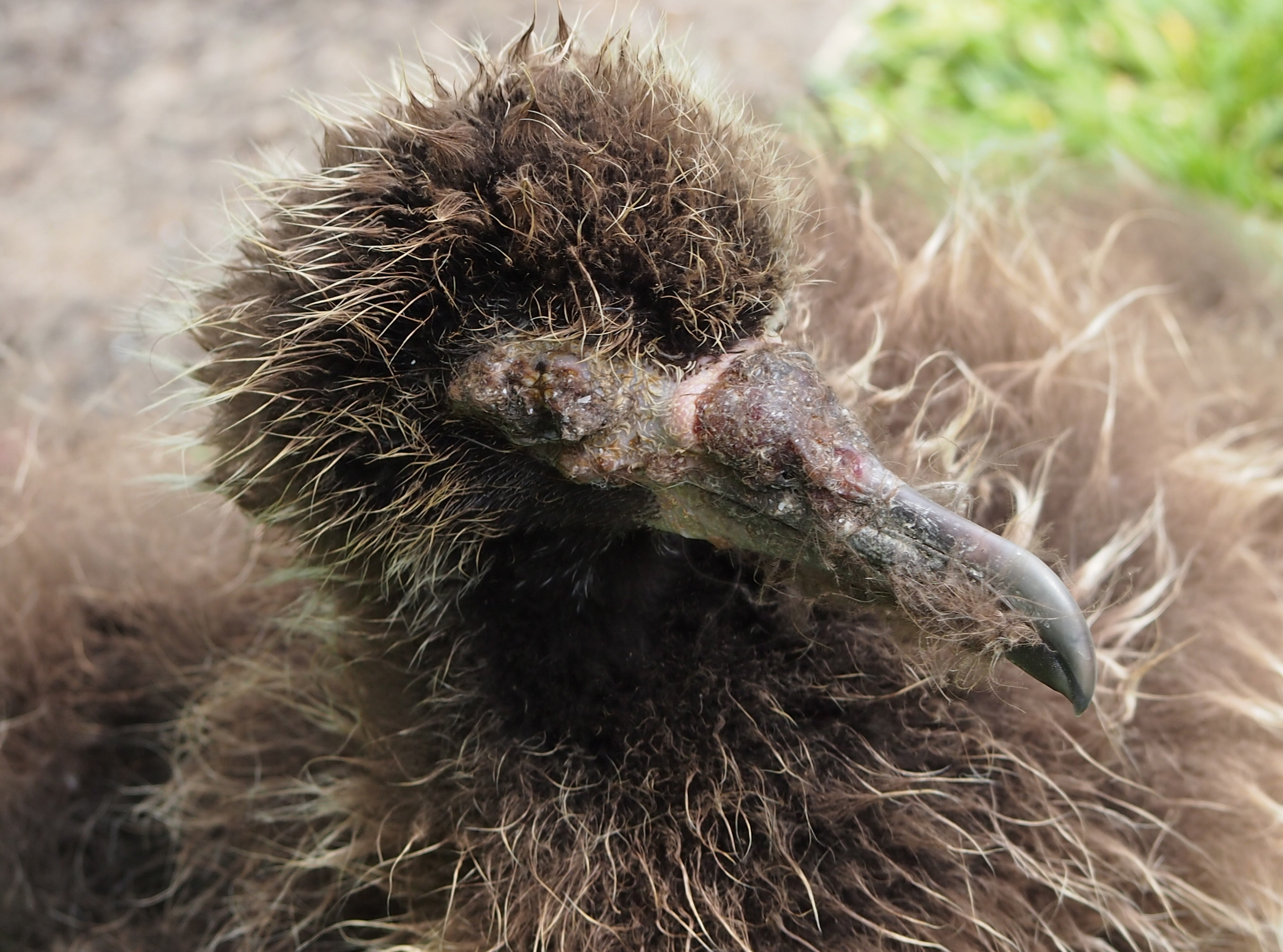
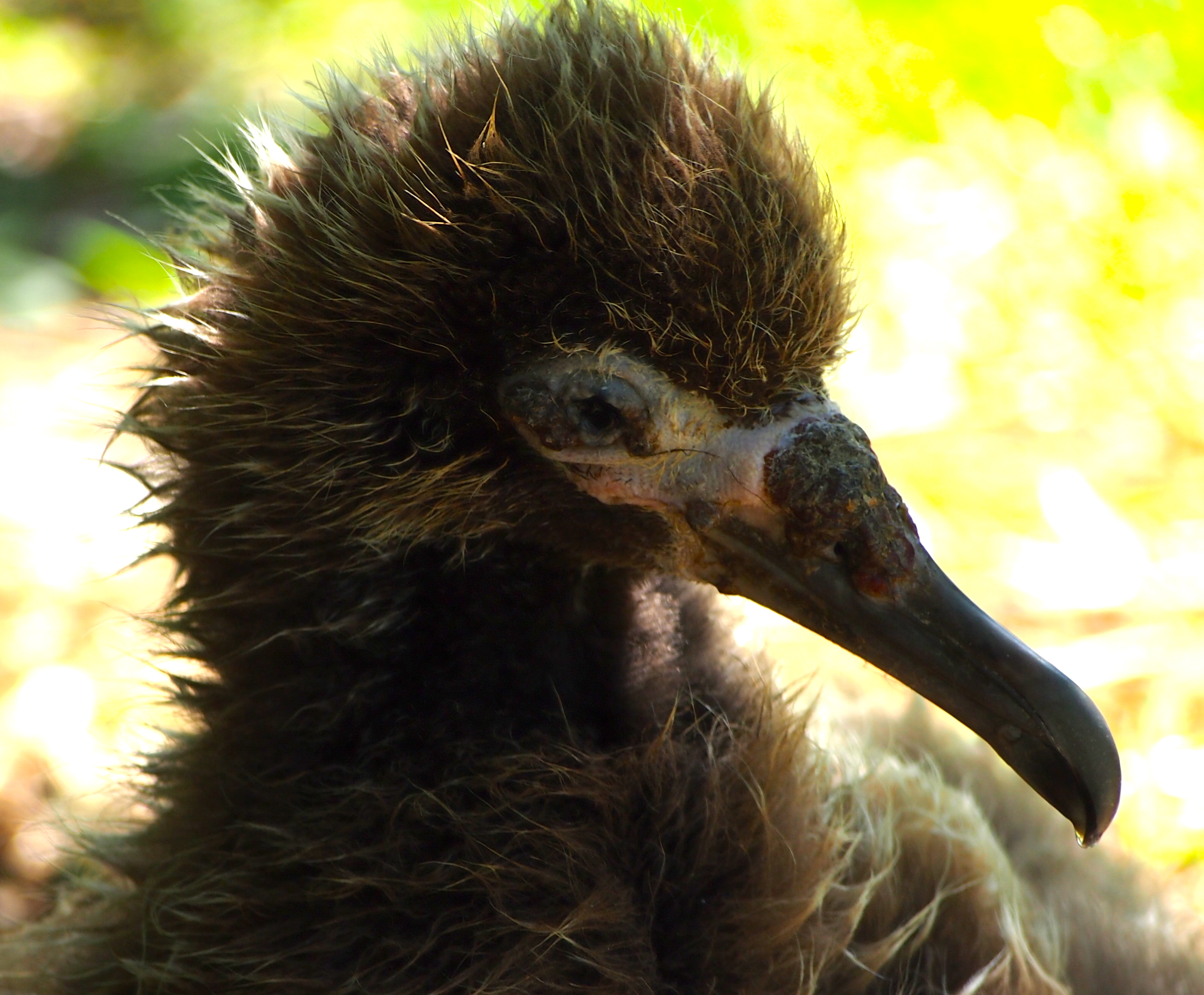
Avian pox

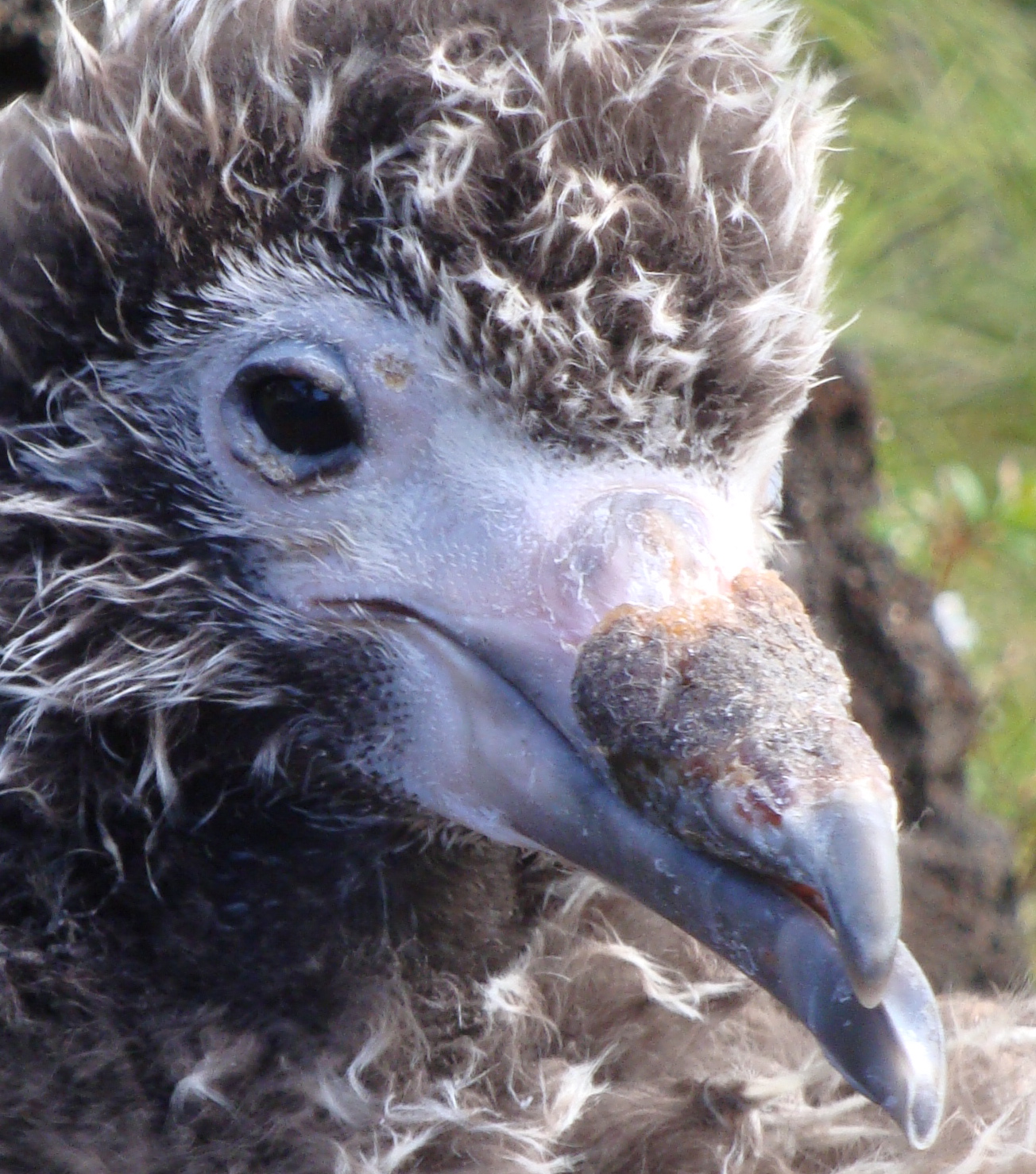
There is one mosquito-borne disease that may afflict albatross chicks.  The symptoms are crusty growths on bare areas, typically the face, bill, legs and feet.  This is avian pox.  If a chick contracts the disease when he is very young and still has a lot of growing to do, the formations on the bill may result in permanent deformity.  Mosquitoes are most prevalent in rainy years, and they survive best in areas that do not get much of a breeze.  Chicks in nest areas surrounded by vegetation are the most likely to get bitten.  The chicks on ocean bluffs with sea breezes blowing most of the time are less likely to get avian pox.

Several years ago I noticed the pox on this chick when he was about 20 days old.  As his bill grew and the pox lesions covered his bill, the top bill grew to the side so the ends did not meet.  The parents continued to feed him, so he was able to grow and eventually fledge, but the malformation may have resulted in an inability to grab and hold on to food successfully.  It could also have resulted in dehydration, since moisture was lost from the inside of his mouth.

Chick with malformed bill

Chick with malformed bill

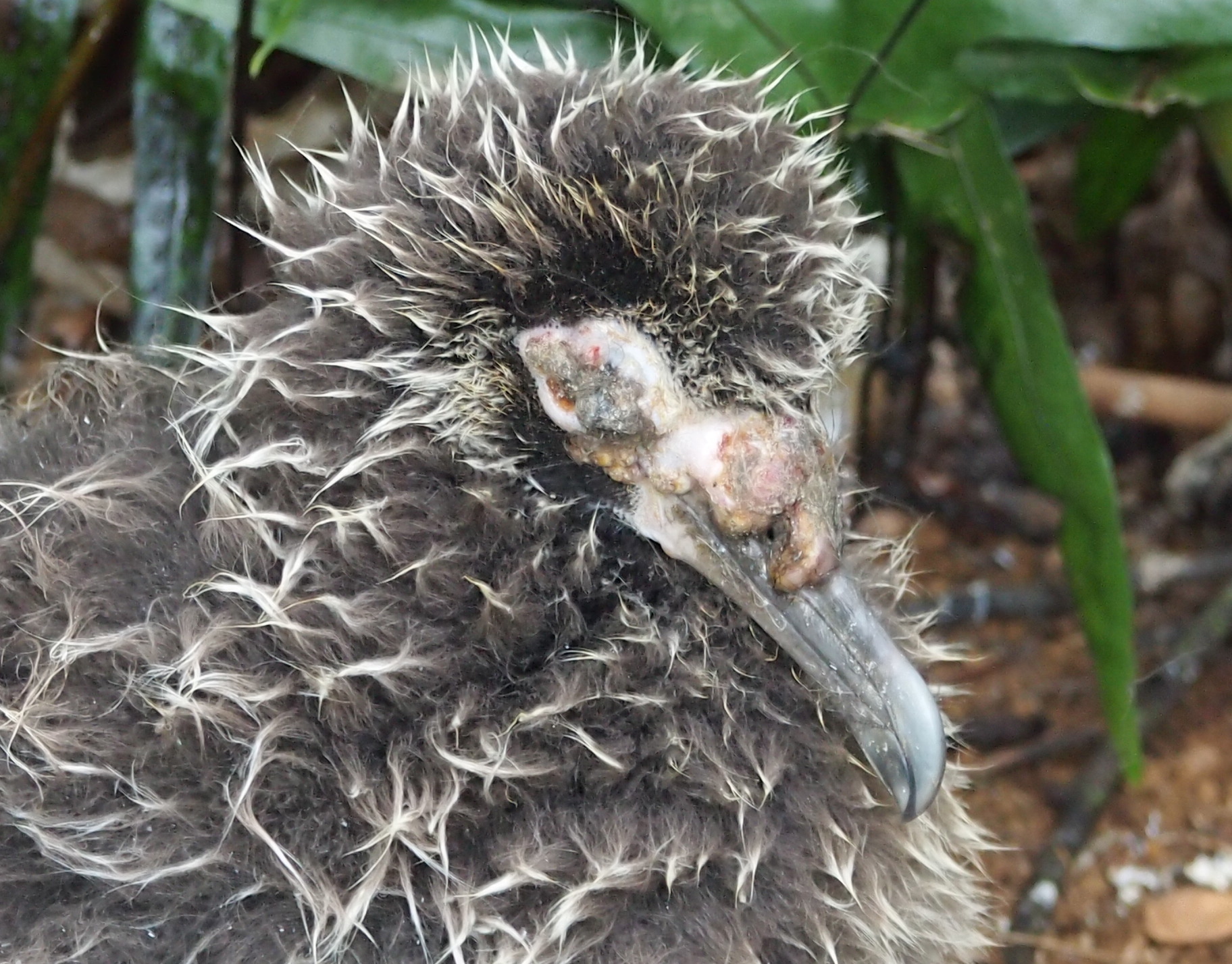
Out of 18 chicks this year, I have seen 4 with very small lesions at the top of their bills, one with a scab on his eyelid and a small lesion at the top of the bill, and one who was severely affected.  Fortunately, the pox did not affect the growth of his bill.

These photos show the progression of avian pox on this chick:

March 31:

March 31, 2013

March 31, 2013

April 3:

April 3, 2013

April 3, 2013

For a few days, the chick was holding his head in an odd position.  Sometimes he would spin in a circle keeping his head at this unusual angle.  I had never seen this behavior before and I was beginning to think that he would not recover from his affliction.

April 7:

April 7, 2013

April 7, 2013

A few days after the next photo was taken, the chick wandered far away from the nest.  Both parents were sitting near the original nest site and could not see the chick.  The chick did not call to them because his eyes were covered by crusty growths and he appeared to be blind and did not know that they had arrived.  The next day he moved even further away, probably rolling down a hill, and ended up in a greenbelt between houses.  In both cases, if he had been left there the parents might have assumed that he was gone and would not have returned to feed him again.  That would have meant a slow death for the chick.  On both days he was returned to the nest area where his parents could feed him.

April 12

April 12, 2013

From about mid-March on, I rarely see a parent with a chick.  They have to spend so much time looking for food, they show up just long enough to feed the chick and leave. However, at some point during the two days the chick wandered away and also the following day, I saw one or both parents with this chick.  I watched one feeding that was fascinating.  I could not film it because the parent was very jumpy, so I used binoculars and stayed far away. The observer’s equivalent of a doctor’s rule of  “First, do no harm,”  is “First, do not scare a bird away.”  The worst thing that I could do is to scare off a valuable meal for any chick, and especially for one who is physically impaired.

The chick was sitting in front of the mother but could not see her.  Normally, the chick begs to be fed by vocalizing and by tapping the parent’s bill with his own.  The parent will not feed the chick without this behavior.  In this case, the chick could not even see his mother.  He knew she was near him, so he was swinging his head wildly from side to side. The mother seemed to understand his predicament and would occasionally bend down so the chick could not avoid coming into contact with her bill.  Once the chick knew where her bill was, the feeding process could then proceed.

As I said, one or both parents were with the chick every time I checked the nest for three days in a row.  I think they may have groomed some of the old crusty formations off of his eyes, because after they left he could see well enough to stay within sight of his nest.

April 17, 2013

April 17, 2013

April 27, 2013

April

April 27, 2013

Every time I check him now the scabs are smaller.

May 14, 2013

May 25, 2013

It is important for people to realize that even a chick with such horrendous disfigurement can recover from this disease.  In 2004 a chick with avian pox was taken from his nest by someone visiting the Ka’ena Point albatross colony on Oahu.  This person brought him to Sea Life Park, which would not take him because the people there understood that avian pox could spread to other seabirds in the park.  The chick was ultimately euthanized at the Hawaii Humane Society.  He may well have survived if he had simply been left in his nest.

________________________________________________________________

I can recommend two good articles about avian pox in Laysan albatrosses.  Both can be found at http://www.pacificrimconservation.com.  This is the website of Pacific Rim Conservation, a private company which conducts research and advises on wildlife management in Hawaii.  Dr. Lindsay Young, one of the co-owners, supervises the two Laysan albatross colonies on Oahu, and is someone I can always go to with my “Did you ever see….” questions about albatrosses.

Young, L. C., and E. A. VanderWerf. 2008. Prevalence of avian pox virus and effect on the fledging success of Laysan Albatross. Journal of Field Ornithology 79:93–98.

VanderWerf, E.A., K.A. Swindle, and L.C. Young. 2005. Pox virus in Laysan Albatross at Ka`ena Point, O`ahu: How can we help? `Elepaio 65:1-7.

Posted in Uncategorized | 4 Comments