Tater’s first displays

This is part 4 of a series of posts about Tater, an albatross who hatched on my lawn and recently returned to Princeville after spending 6 years at sea.  During that time he did not  spend any time on land, so he had to relearn how to walk.  He also started to attempt interactions with other albatrosses, the very first step in finding a mate.  We know that Tater is a male because he was part of a research project that involved DNA sex testing of all of the chicks and many adults on the north shore of Kaua’i from 2006-2008.  I am hoping that someday he will nest in my yard, but as long as he is living in Princeville I will be happy.

——————————————————————————————————–

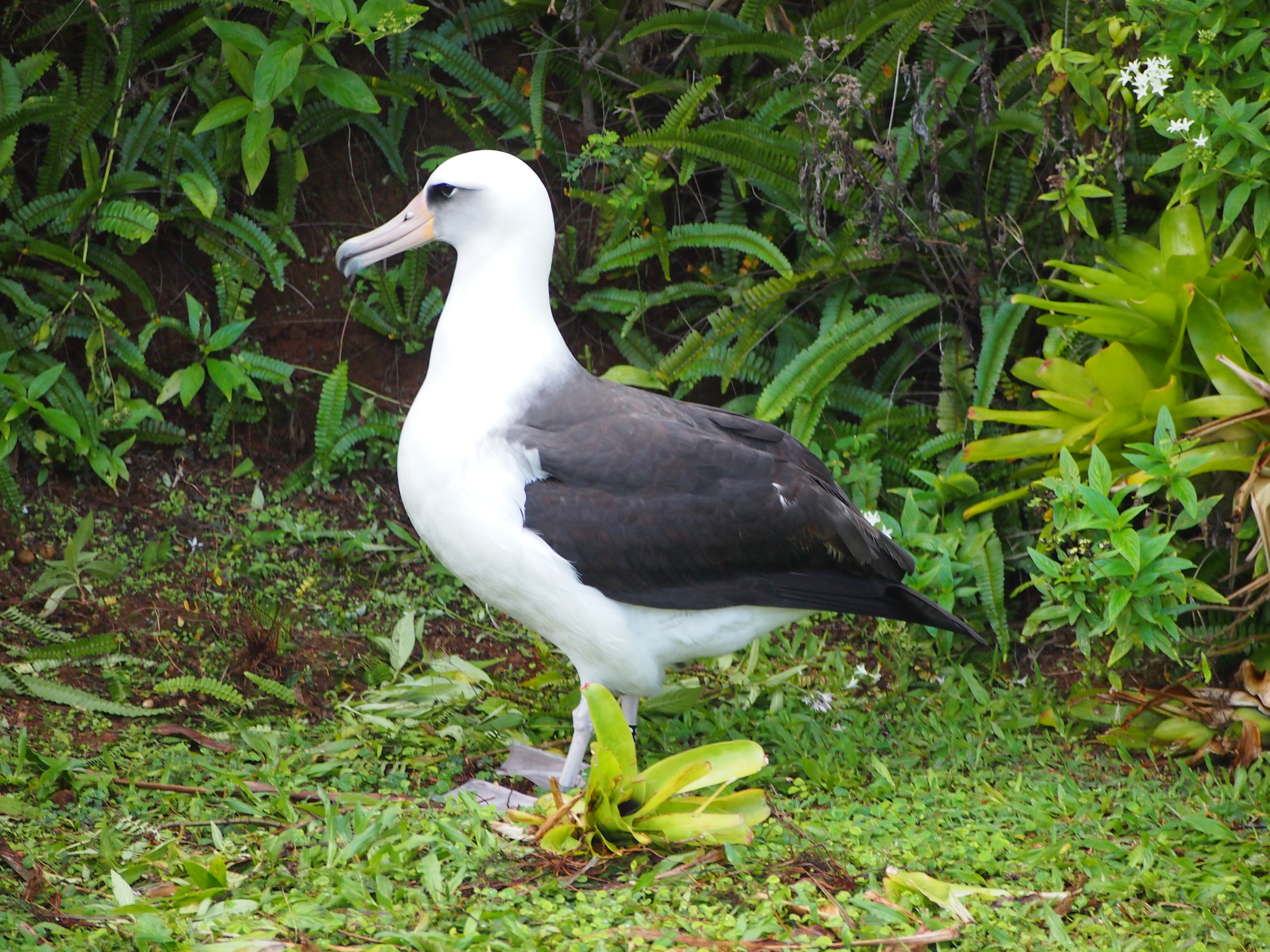
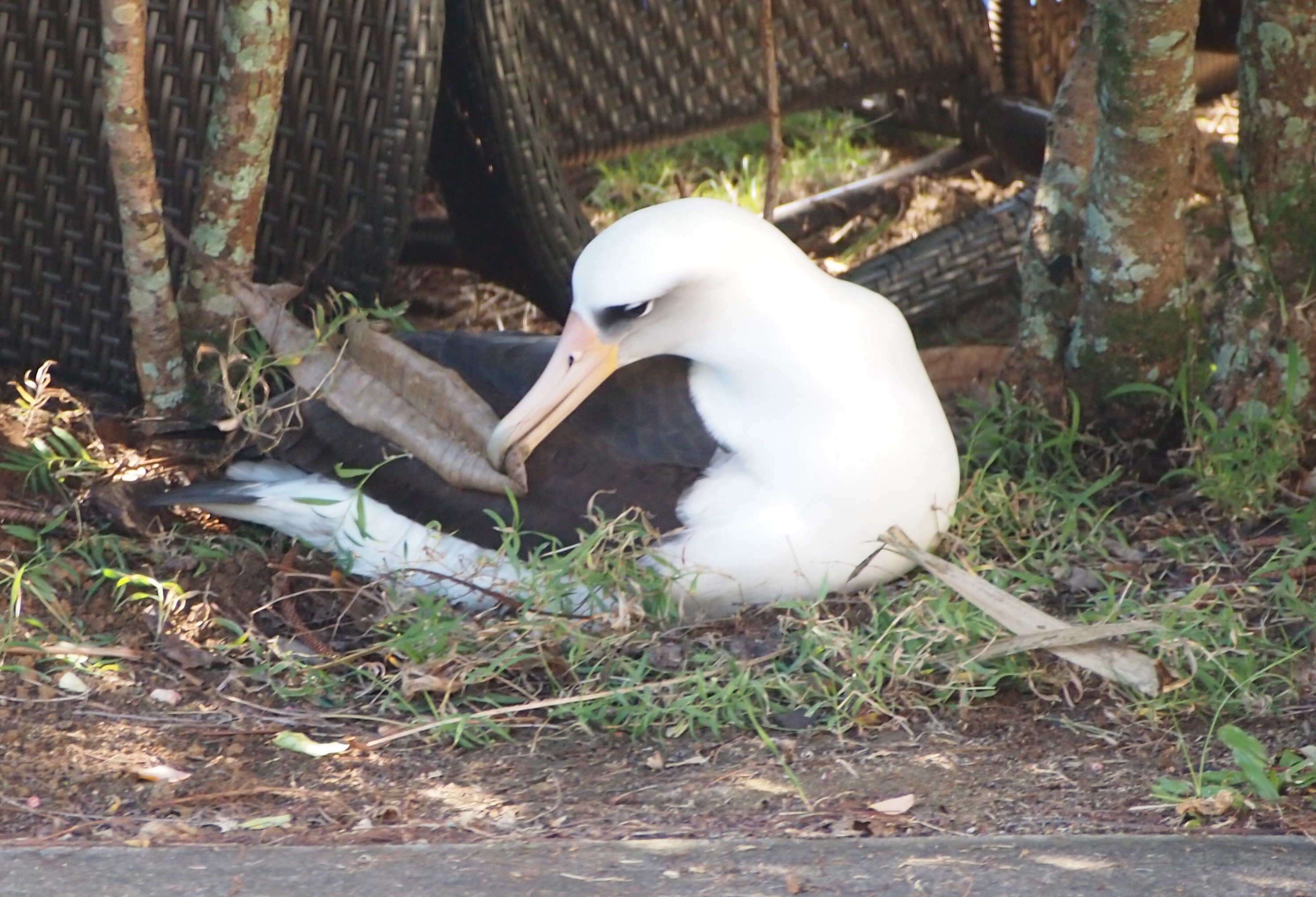
Obviously, young Tater never had a chance to try a display with other albatrosses when he was out at sea for 6 years.  He was pretty tired when this bird landed near him but he did not want to lose an opportunity to meet and greet one of his own kind.  So he attempted an albatross sit-down display.  This does not impress the ladies, as you can see from his partner’s lack of a  response.  If it is true that the albatrosses check out the physical fitness of their  partners by the variety of movements and vocalizations they display,  Tater’s act will need some work.

He puts more effort into this interaction, even standing up, sort of, but things start going wrong when he stumbles into the other bird.  Like his first partner, this one seems to have no clue that he is trying to display with her.  Tater had learned something about albatross socialization from the birds he observed across the golf cart path, and he attempted a modified version of a beak-duel greeting, which is something they typically do when they first meet each other.  With experienced birds, the duel involves actual bill contact.  This one is more the albatross equivalent of the air kissing women do when they do not want to mess up their lipstick.  His partner valiantly tries to touch bills, but when the other bird is doing so much head bobbing it may be better to look away to avoid getting seasick.

I have seen Tater once since January 20th.  Through my years of observing them I have learned that an albatross may come to Princeville for just a day or two his first year back. I know that  I am lucky to see one of these birds, even though I check the areas where they gather every day.  I rarely get to see one who is still having the problems navigating on land that Tater displayed in my video.   To be able to share these moments with the albatross who spent his first 5 months on my lawn puts this experience somewhere at the top of my list of the reasons why I plow through a variety of frustrations and keep on spending so many moments with these birds.

I wish Tater and all the other Princeville albatrosses long and happy lives.

If you would like to watch the whole video, please check it out on YouTube.  Get the popcorn ready, the film is about 20 minutes long.  It’s definitely meant for the unrepentant albatotrossophile.


Posted in Uncategorized | Leave a comment

Tater tries a long-distance display

This post is more about Tater, the albatross I wrote about in my previous two posts.

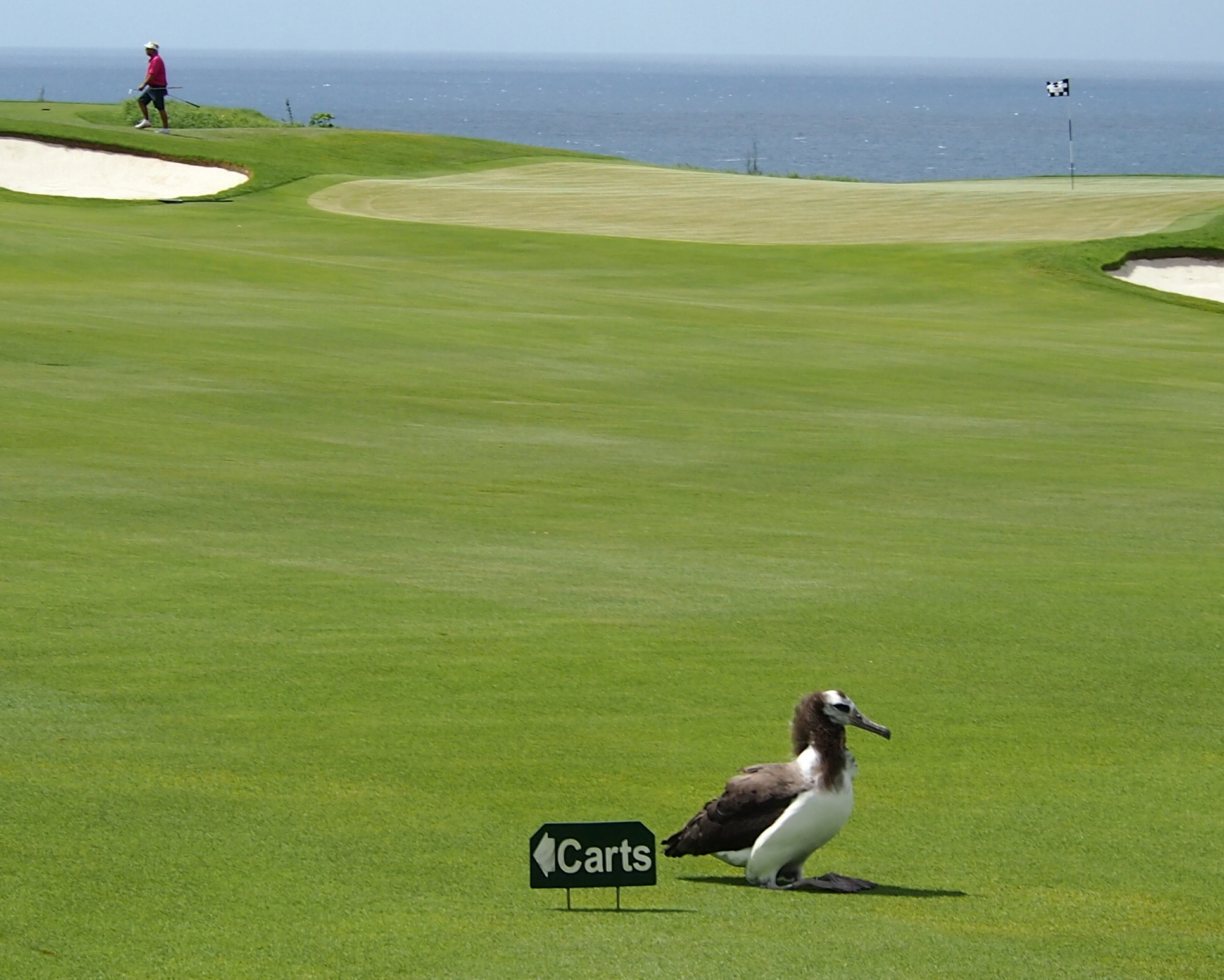
The albatrosses that were to my right, across the golf cart path from Tater,were displaying, which Tater could not help but notice.  Rather than attempt the long, precarious walk across the cement path to be with them, he joined in from afar, trying to mimic their vocalizations.

He loved the “sky moo,” but the other vocalizations proved to be more difficult.  Forget about the fancy footwork; just walking was hard enough.

Posted in Uncategorized | Leave a comment

Tater learns how to walk and talk

There are days when I just don’t feel like walking around the golf courses checking on various nesting albatrosses and the birds who like to hang out near them.  Sitting on the sofa and reading one of my trillion books sounds like a fitting reward for all of the hours I have spent with these birds.  But that little voice in the back of my head tells me that I really need to check on that nest in the area where albatrosses have never nested before, or to look out for the bird who abandoned her egg and is now sitting on another bird’s nest.  Something tells me to just do it and it becomes impossible to ignore the call to duty.  And every now and then, the albatrosses reward me in a spectacular fashion.

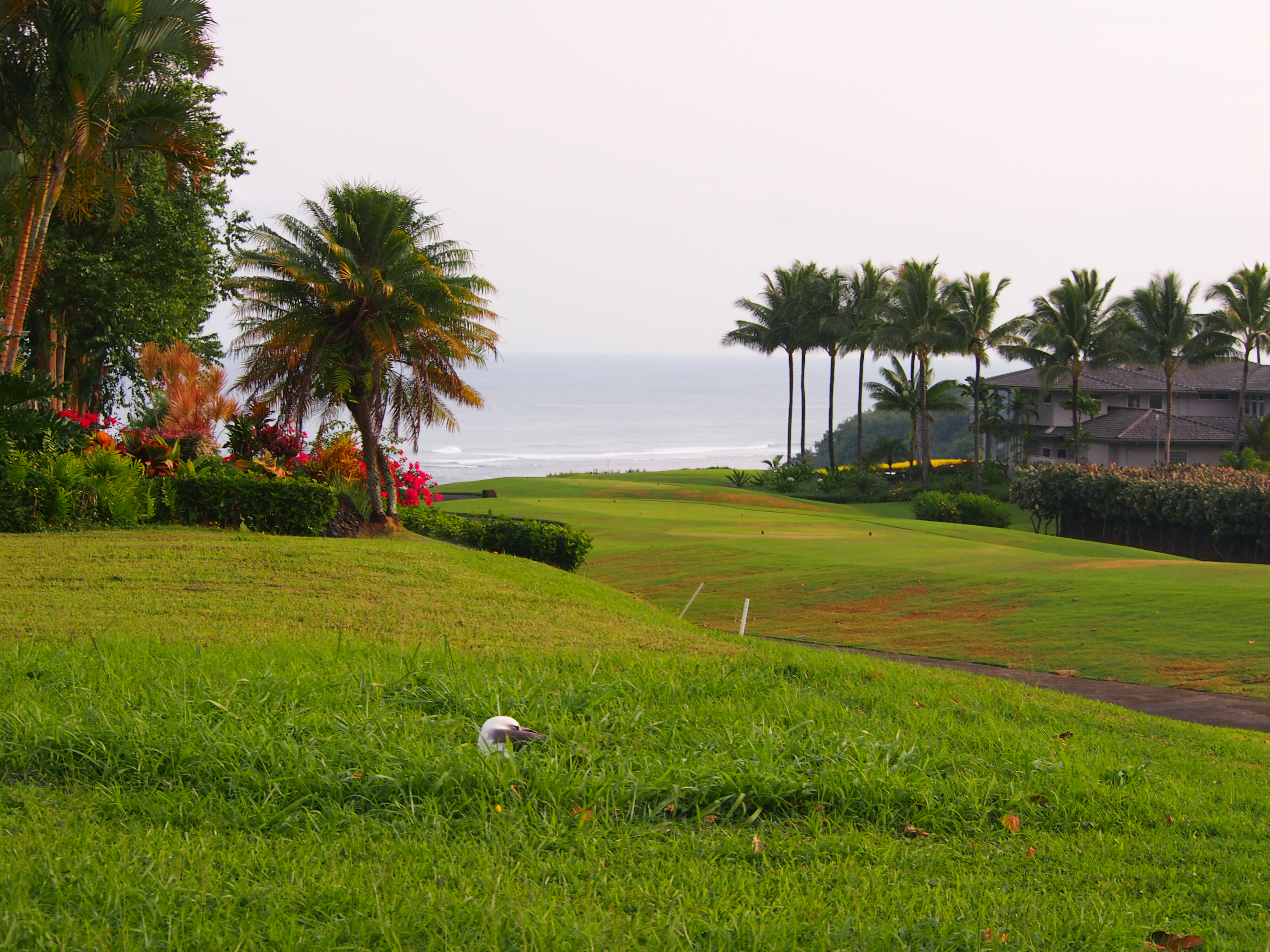
On this day, January 20th, I had just arrived at the last place I check on the golf course.  I saw a bird sitting on a fairway overlooking the ocean.  Often it is where I see the bird I call Mrs. Pastry Bird, named for the Danish pastry that once appeared next to her nest.  She lived the trauma of being stuck next to someone’s fenced off pool for an indeterminate period of time, unable to fly out, and when I carried her out from there she immediately took off and did not return for about 6 weeks.

When I next saw her she was near her mate but was not sitting very close to him the way birds who have nested together usually do.  The trauma of being stuck in a fenced in area clearly had a lasting effect on this albatross.  That is one reason why it would be wrong to encourage these birds to nest anywhere that is not on an open bluff overlooking the ocean.  They are not naturally in areas where they  must fly over a tall fence, with no view of the sea.  People who love albatrosses do not want them to be in unsafe areas like that, they are not lawn ornaments.  They may decide on their own to nest someplace that is not the safest spot for them, but for us to actually solicit their presence in potentially dangerous areas is selfish and short-sighted.

Mr. Pastry Bird did not understand his long-time mate’s unexpected coolness towards him.  He relocated to the golf course, found a new mate, and raised a chick with her the following year.   Mrs. Pastry Bird found him and won him back the year after that.  They raised another chick together.  He did not return to Princeville last year and Mrs. Pastry Bird often sits near the spot where they raised their last chick.  I have a special place in my heart for her, she has been through rough times.

So I assumed the bird was her, and walked over to check the auxiliary number.

The bird did not want to stand up.  Usually if I approach one from the rear it makes them nervous and they will stand long enough for me to see the band number.  I do not even have to get very close to them as a rule.  I was afraid she might be injured, so I did get close.

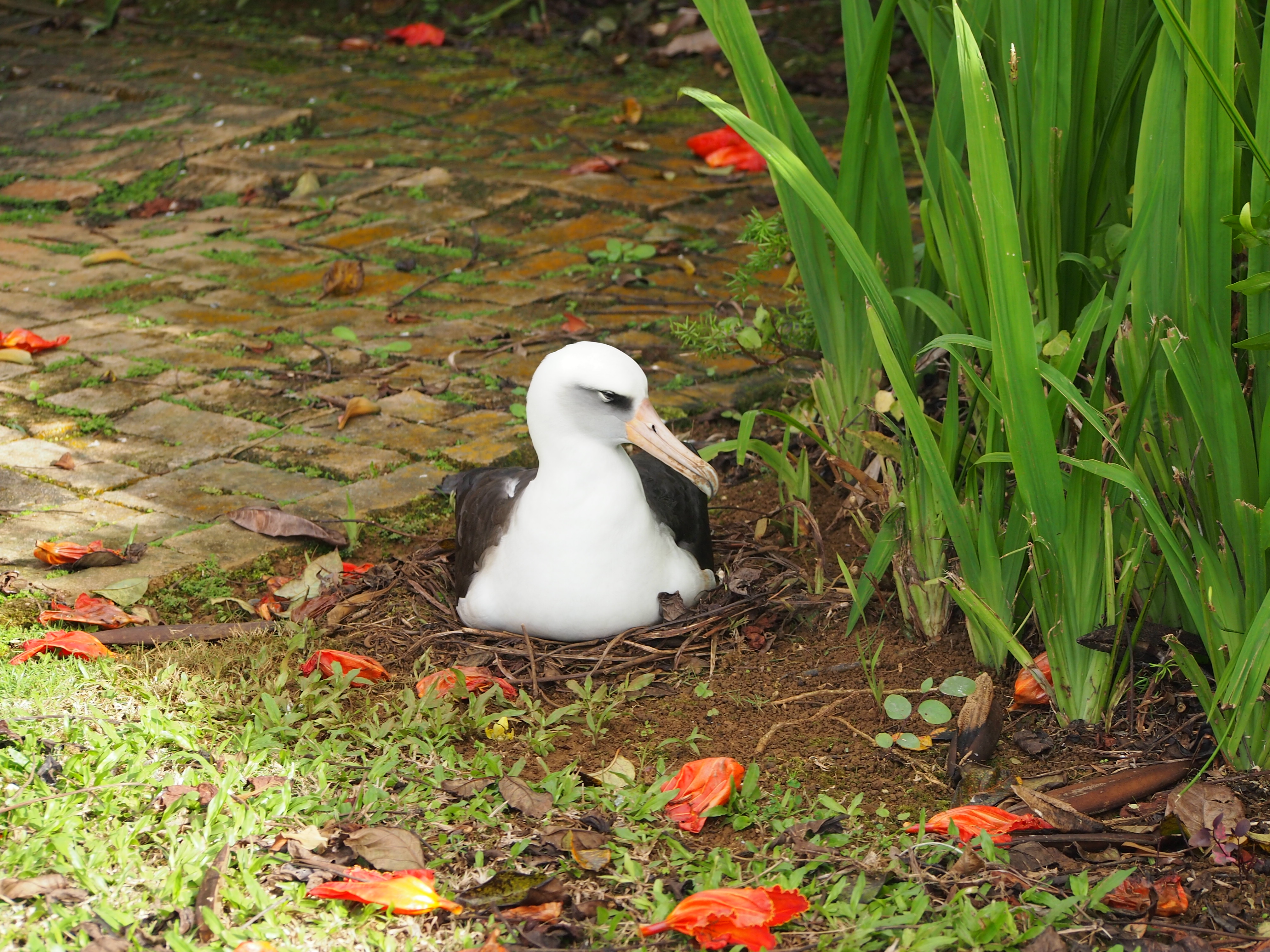
She stood up briefly, and—-it was not Mrs. Pastry bird.  It was K555, Tater!

I moved away from him quickly and moved to the grass across the golf cart path from where he was sitting.  If I could have made myself invisible, I would have, anything so he would not notice me and alter his behavior.  Good observers want to be able to watch the animal acting normally.  The bad ones want the animal to notice them so the animal alters his behavior to reflect the presence of the human.  Some people call it being one with the animal.  I call it worshipping at the altar of the grandiose ego.  It reflects a total lack of concern for and interest in the animal.

As I watched him I realized that he was far too busy trying to learn how to walk on land to worry about me.  He could hear two albatrosses to my right.  He wanted to vocalize with them, but did not know quite what to say.

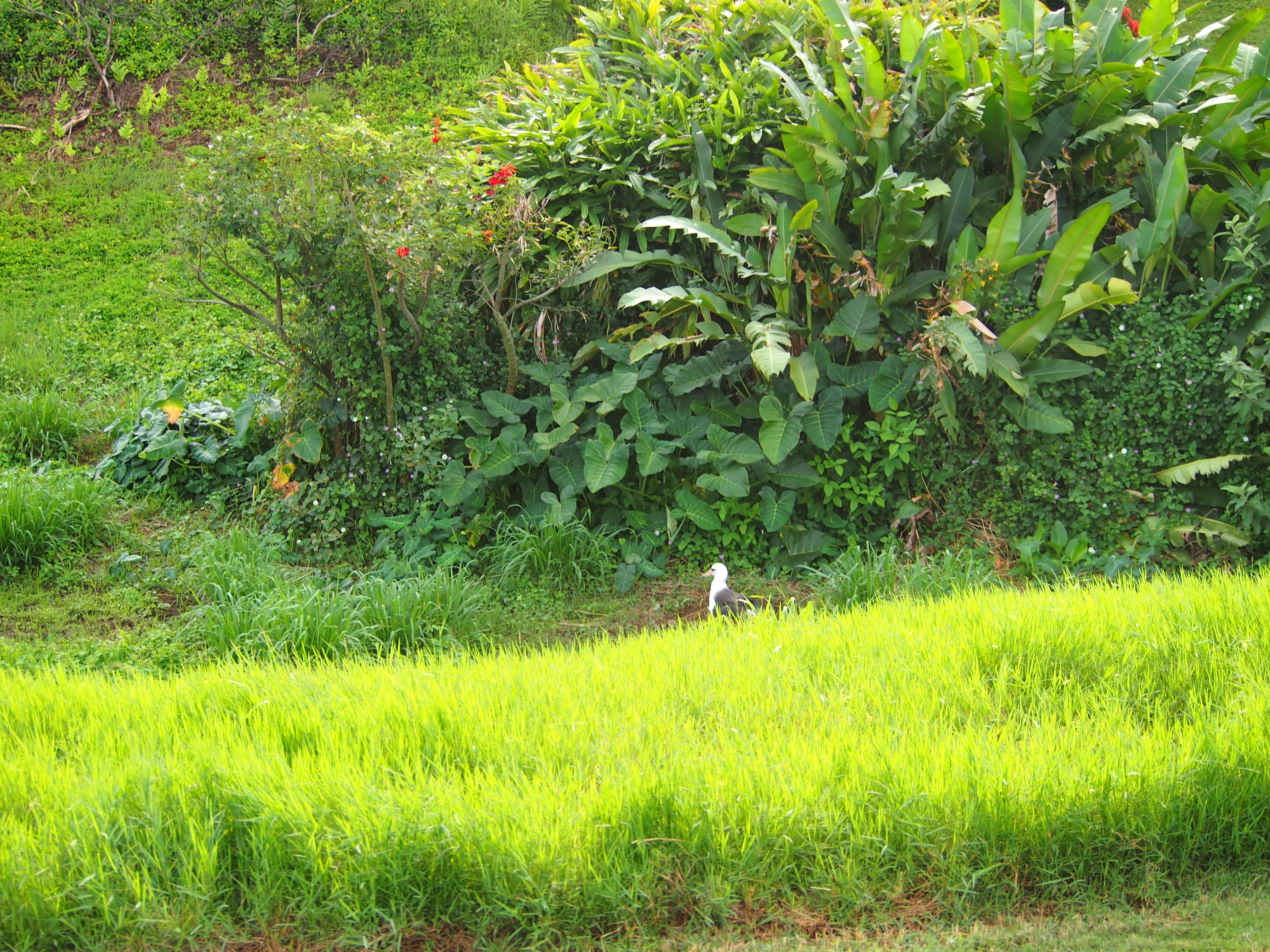
The albatrosses across the path from him started displaying with each other.  He decided to leave his comfortable fairway and cross the scary concrete golf cart path to join the other birds.  He was a bit intimidated by the other two and he walked back to his resting spot on the fairway.  It is clear that walking on and off the cement is a learned experience, not an instinct that is wired into his albatross brain.

If you are not falling in love with this bird by now there is something seriously wrong with you.

Posted in Uncategorized | Leave a comment

Ladies and gentlemen, meet Tater

The next 4 blog entries are all about a six-year old albatross that I was fortunate enough to see on his first hours back since fledging.  Everyone with even a little knowledge about albatrosses knows that when a chick fledges he will not be coming back to land for at least 3 years.  I have found that they usually come back when they are 4 to 5 years old.  I keep lists of all of the chicks from Princeville from 200o-2001 until the present, and whenever I see one for the first time during a season I check off a box for that year.  By the time I see one for the first time, the bird has usually re-learned living on land.  Even checking every day I have not seen very many who have just returned, and I have never before filmed one.

I had to break the film into segments shorter than 2 minutes each because inserting them into the blog takes such a long time.  So in the last installment, I have included a link to the entire 20 minute film.

———————————————————————————————————

From January 31 until June 28th of 2008, my back yard was home to a particularly endearing albatross chick that my sister named Tater.   Since Cindy was closest to the nest and had to listen to the monotonous clacking of one female for many evenings, she earned the right to pick a name, more than those of us who slept in clack-free peace.  The chick had two mothers who had successfully raised an older brother in my yard the year before.  In both  years the moms each laid an egg and ended up incubating an infertile one.

Brenda Zaun of USFWS and John Burger of the Pacific Missile Range Facility cooperated to replace unviable eggs on the north shore of Kauai with good ones from the navy base, where the albatrosses are unwelcome residents.  The navy had always been afraid that one of the birds could collide with an aircraft.  It is a fact of albatross behavior that a bird will return to the area where he was raised.  So the eggs were gathered and kept in incubators to await placement with new parents.

People have asked me if the albatrosses ever reject the new egg.  The egg swap is done underneath a big lid from a plastic container or under a clipboard or other large object.  There is no dawdling, the exchange takes seconds.  Even when an egg is candled and must be removed from underneath the parent, as long as the bird doesn’t see what is being done they don’t seem to notice the absence of their egg.  They look uncomfortable, they stand up and rearrange how they’re sitting, but they never seem to know that the egg is gone.  One time a PMRF egg hatched en route to the north shore.  Brenda carefully removed the infertile egg from underneath the female at a nest in Princeville and replaced it with the chick.  The adoptive mom immediately started vocalizing to the chick and was clearly elated that the egg had finally hatched.

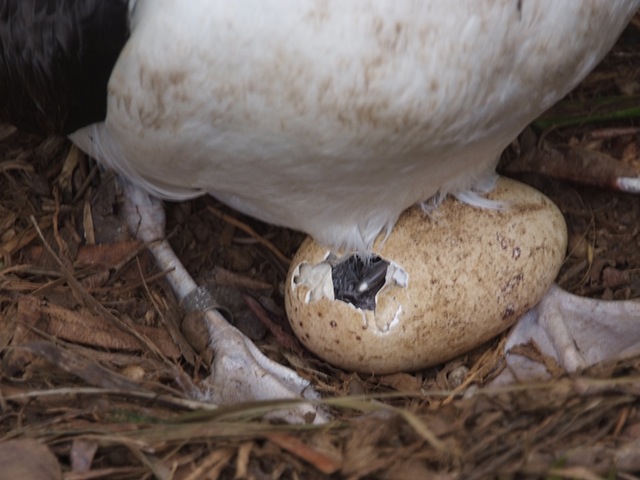
On January 28th our chick started to peck his way out of the egg, and on the fourth day of pipping he hatched.  This was my first view of Tater.

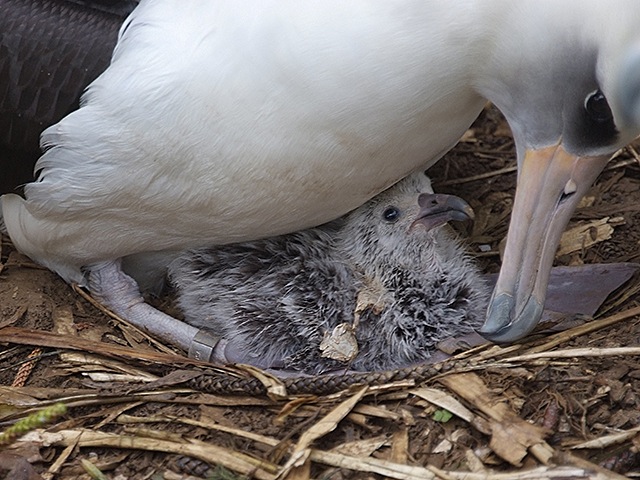
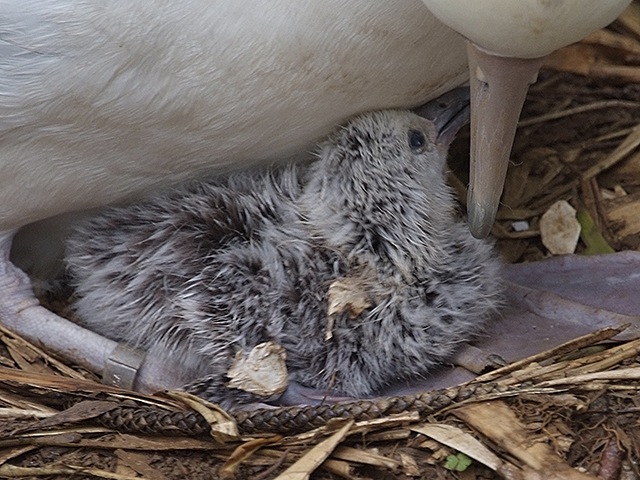
Tater and one of his moms

Tater and one of his moms

We watched him grow and learn how to be on his own, as his mothers took more and more time finding enough food to feed him.  As the non-nesters started to disappear and the time between feedings grew longer, we anticipated the day when Tater would be leaving us.

On the morning of June 28th, 2008, Tater was very agitated.  He walked across the street and I followed him.  Often when a chick is getting ready to fledge he leaves his comfort zone, the area around his nest.  When his nest is not on the bluff he may get himself in a spot that is not conducive for a chick’s first flight.  Adults can run down a street and flap their wings and take off.  A chick cannot.

Fortunately Tater seemed to know how to find a good spot.  He led me out on the bluff in front of my neighbors’ houses and ended up at the spot overlooking the ocean where many of our neighborhood birds take off and land.  As though he were an experienced flyer he ran off an ocean bluff and launched himself into the air.  It was not a very windy day, and he seemed to descend more rapidly than fledglings usually do.  I held my binoculars to my eyes for as long as I could, about 20 minutes, until my arms started to ache.  And I was afraid for him.

He kept coming down in the ocean after very short flights, then taking off again.  When there is a strong breeze to buoy them up, they seem to fly quite a long distance before coming down.  I had never seen a fledgling whose flying was so up and down.  Would he tire himself out before he could find food?  How long does it take a chick to find the first meal not brought to him by a parent?

The more I learn about albatrosses, the more I realize how little I really know about them.

Posted in Uncategorized | Leave a comment

Hatching is exhausting!

One of the female parents at this nest used to nest with a male in my neighborhood.  He did not return in 2007-2008 and she relocated to the golf course, where she met her current mate.  Both birds have been DNA tested so their sex is known.  Since they had 2 eggs their first year nesting, and since an albatross can only lay one egg at a time, we would know their sex anyway.

During the 5 years they have been together they incubated 4 fertile eggs of their own.  One of them obviously has been with a male.  This is very unusual for a female/female couple in Princeville, where the albatrosses nest over a wide area and it is less likely for a returning female to be jumped by a male.

In this photo you can see a tired little chick, exhausted after 3 days of pipping.  He’s not quite all of the way out of the shell, but I know that when I check today he will be dry and fluffy.  He has the benefit of two skilled mothers.

One of his siblings used to sit on the golf cart path and required a small fence to keep him safely in the grass.  The one last year developed a taste for fairway living; neither parent nor observer could convince him that this was not a good idea.  The golf course warned players to watch out for him.

Who knows what trouble this chick will get into when he’s a bit older?  Bring it on, little guy, we will all do our best to keep you safe.

a tired chick

a tired chick

Posted in Uncategorized | 1 Comment

Our first chicks

One of the rewards for the 3 or so hours a day I generally devote to the albatrosses is that I know the approximate day an egg will hatch.  It usually takes a chick 3 or 4 days of breaking and removing the shell before he makes his appearance.  During that time the parent will not help the chick but will talk to him and offer moral support.  The chick often responds.  It is one way they both learn to recognize each other.  That may not be a big problem in Princeville, where nests are spaced far apart.  On Midway, of course, being able to recognize your chick’s voice would be important for locating him amidst the hundreds of thousands of nests.

The first two Princeville chicks made their premiere appearances yesterday.

I am eternally grateful to Bob Waid, my friend and neighbor, for the beautiful photos.  Bob has his own blog, http://www.albatrosskauai.com, where you will find many more incredible pictures.  He lives in one of the areas most favored by albatrosses for nesting and for courtship displays.  When albatross chicks are getting ready to fledge, they become much more active, flying further and further from their nest areas.  Bob sits in a lawn chair keeping an eye on them.  He calls me when it looks like a chick is getting ready to leave.  Sometimes they choose unsafe spots to fledge from, sometimes they wander further away from the ocean bluffs.  They may need a bit of guidance to find a safe area for their first flight, a bluff with ocean breezes to fly into.  These are the hazards of not nesting at sea level on a small island like Midway where a chick can locate the ocean wherever his nest may be.

This first chick’s parents are K233 and purpleO324.  K233, the male, was banded as an adult in June of 2007.  Because he was an adult when banded, we can only assume that K233 was at least 3 years old, which would make him 10 years old.  Of course, he could be much older than that.

PurpleO324 was banded as a chick on 06/09/1989 on Whale Skate island in French Frigate Shoals.  As a result of rising sea levels, this island has disappeared.  Wow.  Shades of things to come.

She was rebanded in 2008 by Dr. Lindsay Young at Ka’ena Point on Oahu.

Enough explanation, bring on the chicks!

Here is purpleO324 with her chick on the 3rd day of pipping.  You can see his bill with the whitish “egg tooth” on the end.  The chicks use this hardened bit to help break out of the shell, then it falls off later when it is no longer needed.

The chick is working hard…..

The chick is working hard…..

And the next day….

Voila!

Voila!

The second nesting couple is KP424 and KP467.

I have written about these two before, they have both led interesting lives.  467 nested for a number of years with a mate who eventually dumped her and moved on to nesting with another female.  Both females had eggs that season, but the male chose to incubate his new mate’s egg.  467 eventually had to abandon her egg.  She met her current mate last season.  424 was banded as an adult in Princeville in June of 1994.  At some point he started nesting at the Kilauea Point National Wildlife Refuge.  But every year before returning to the refuge he would spend a few days sitting on my neighbor’s lawn.  When his mate did not return to the refuge, he relocated here.  The rest is history.

If you think you have reached your cuteness quota today, do not look at these  photos.

He still has shell stuck on his feathers!

He still has shell stuck on his feathers!

Happy Mom with chick

Happy Mom with chick

While the parents are taking turns incubating the egg they will stay away for periods of time ranging from about 2 to as many as 4 weeks.  However, when it is near the time for the chick to hatch, and most especially, once the parents have seen the chick, they will spend just a few days away.  I have even seen them return after just one day.  When they come back they often have to shove the mate off of the nest, they both want so desperately to stay with the chick.  The reason?  I guess someone could go into a scientific discussion right about now.  But I think it has more to do with this:

Closeup of cuteness

Any questions?

Posted in Uncategorized | 8 Comments

An albatross biography, KP505

This is KP505 sitting with Lanea*, the chick he raised with his mate last year.  Lanea had decided that a tree stump next door was a much better spot to rest in than the nest her parents had built and maintained for her.
Lanea and Dad

Lanea and Dad

Both KP505 and KP792 tried to get her to come back to the nest but she would literally not be moved, like most chicks who have selected a new spot to sit in.   That is why people who golfed the sixth hole on the Makai Golf Course last year were warned to watch out for a large seabird sitting in the middle of the fairway.  The chick would not move back to the nest site in the weedy center of the course.
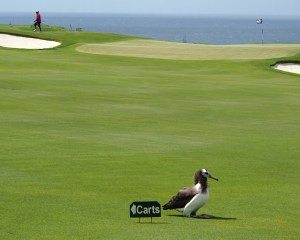
Chick on fairway 6

Chick on fairway 6

Two of KP505’s grown chicks from previous years were taking care of their own chicks while he was helping to raise Lanea, so we had three generations of albatrosses in my neighborhood last season.  One daughter from 1993 has been nesting in Princeville since 2004.  Gator hatched in 2006 and nested last year for the first time, very close to where he hatched.

Last year, KP505’s chick from the 2003-2004 season, Mystery, showed up on Midway.  I had never seen this bird since he fledged.  The only reason he caught the ranger’s eye was that he tapped on the door to his office.  Princeville birds are very polite.

I knew that KP505 was captured and banded as an adult in 1989 at the Pacific Missile Range Facility, then rebanded here in 2004. Since there is no way to determine how old an albatross is, it is assumed that one is at least 3 years old when banded as an adult.  Of course he could have been older than that.  There is one nesting on Midway who is at least 63 years old.

Since I observe the Princeville albatrosses almost every day that they are here, I have mounds of data.  I have Excel spreadsheets on which I record every day’s activities from the first adult’s appearance to the last chick’s fledging.  With the spreadsheets I can easily follow an individual bird’s time in Princeville.  So I decided to look up KP505, to see what his story is.  I already knew the basic outlines, but I wanted to see what I had missed, to color in the portrait.  After all, he is a patriarch of the albatross community here.

KP505’s mate from 2003 through the summer of 2006 did not return the following season.  KP505 returned in November and hung out in my neighborhood without really interacting with other birds until mid-December, when he displayed with KP729.  He displayed and engaged in quiet contact with both KP729 and KP792.  Quiet contact is the gentle grooming you see the nesting couples doing with each other, what my sister calls albatross canoodling.  I do not know if either of these females nested with anyone in previous years.  Since they were both banded as adults about 10 years ago I have no way of knowing their histories.

In the 2007-2008 season he came back on November 15th and nested with KP729.  Even though I was checking this area every day, I never saw KP729 until a day before she laid the egg.  Their chick hatched but when I found him he was dead.

In the 2008-2009 season, he again nested with KP729.  Yet the day he returned to Princeville, November 15th, he displayed with KP792.  Both females had nests.  I saw him copulate with KP729 but I could easily have missed seeing him mating with KP792.  He shared incubation of Kp729’s egg, and KP792 abandoned hers.  He helped raise a healthy chick that the homeowners named Obama.

KP505 was back on November 23rd of 2009, but his mate, KP729, did not return to Princeville until January 20th, much later than nesters usually come back.  I saw him display with 6 different females, and he copulated with one of them.  Most surprisingly, he never interacted with his mate during the 10 days she was here.  After she left he started to spend more time with KP792.  I saw 4 instances of quiet contact between them.  That may not sound like a lot, but it is a special behavior that indicates a close connection.  Furthermore, even though I check them almost every day I certainly miss a lot of behaviors.  If I observed them less frequently, I would see a much more fragmented life story.

On November 11, 2010, one of my neighbors observed KP505 land near KP792 and copulate with her, and they spent several hours in quiet contact.  They were gone by the next day, and KP792 was back and sitting on an egg on November 19th.  KP729 returned to Princeville on November 20th.  I first saw her standing about 12 feet from her former mate’s new nest.  She has not found a new mate since then, and she often sits on my lawn now, calling out to albatrosses flying overhead or walking around the neighborhood.  She has displayed with other birds but does not have a regular partner.

KP505 raised two chicks with KP792, Coconut in 2010-2011 and Lanea in 2012-2013.  They took the year in between off, and during that time I saw one or both of them on 34 days.  I saw 13 sessions of quiet contact, a record for my observations.  They were a very close couple. Unfortunately I have not seen KP792 this season.  KP505 arrived back on November 14th and has been here on more than 30 days so far, always in the yard where he raised two chicks with KP792.  He has even built himself a nest to sit in.  I have seen KP729 visiting him, but he does not show any interest in interacting with her.

KP505 in his nest

KP505 in his nest

Occasionally he has displayed with other albatrosses, and he always returns to this spot.  I will not attempt to psychoanalyze him.  He is a bird, after all.  I have no interest in attributing human motives to him.  Perhaps he is continuing to wait for his mate, maybe he has given up and is looking for another, or maybe he just wants to rest his weary bones.  My job as an observer is to describe what he does, not to try to describe what he thinks. There is a chance that his mate could still return, but she was always one of the first ones to come back to Princeville in November.  Sometimes when albatrosses lose a mate, they start looking for a replacement that same season.  I have seen other birds take several years to find a new one; some are still alone.  I will be watching to see it KP505 finds someone this season.

If you had told me when I first moved here that I would find birds that are as charismatic as the chimpanzees I worked with at the Los Angeles Zoo and that I would regularly plan my vacations around their schedules, I would have rolled my eyes and told you that there was no way a bird could ever affect me the way my dear old friend Toto did.  It is true that no albatross ever did a double take when he caught a glimpse of me and rewarded my mere presence with the gift of an elaborate pant hoot display.

But it is their very wildness that touches me, their reluctance to acknowledge the humans that live at the edges of their avian world.  The result of millions of  years of evolution is walking across my lawn, nesting in my garden, clacking at me when I get too close.  If I can make their sojourn in Princeville a little bit safer while sharing my growing awareness of their unique personalities with people who still find delight in the natural world, then I will have earned my keep as an albatross observer.


——————————————————————————————————–

* I really do not like to refer to albatrosses as “it.”  So even though I do not know the sex of Lanea, I use “she” since this chick was named after the homeowners’ delightful young granddaughter.

Posted in Uncategorized | 6 Comments

Larry and Dora

Someone asked me if I name the albatrosses.  Last year I saw at least 188 albatrosses in Princeville.  I say “at least” because I really do not know how many unbanded ones I saw.  The albatrosses fly between the 4 general areas where they hang out and nest in Princeville.  Often I see the same bird in 2 or even 3 different places in one day.  On one day I saw 5 unbanded birds in one spot.  I saw a total of 183 banded birds from November through July, so I will assume that I saw at least 188.  It just doesn’t make sense to name all of them.  It is easier to know them by the band number, which is what I record in my field notebook and in my Excel worksheet for each year.  Occasionally a homeowner with birds nesting in their yard will start referring to one by a name and that is fine with me.

It has always been my policy to allow the homeowners who have nests on their property to name any of the chicks that fledge from there.  I keep track of those names, and I love being able to tell someone that a bird they named has returned to Princeville.  These albatrosses have interesting names like Robert Frost and Fluffy.  Fluffy is a male who was named by a child whose room overlooked the yard where the parents nested.  Fluffy has raised two chicks of his own and that child is now in college.

Let me say a word on behalf of everyone who has had a nest in their yard.  It is not always easy for them.   Some of the adult birds are clackers.  When I first had a nest in my yard, I thought someone was bothering one of the parents because it sounded like she was constantly snapping at something.  But that was not the problem; the bird just liked to clack, to snap her jaws together and make a loud sound.  I have observed them clacking while grooming themselves and to chase interlopers away, but they also appear to clack for no reason that a human can see.  Sometimes at night an albatross will go on for some time making this noise.  I do not know why some are clackers, some are not, but I do know that the noise can wake people up in the middle of the night.

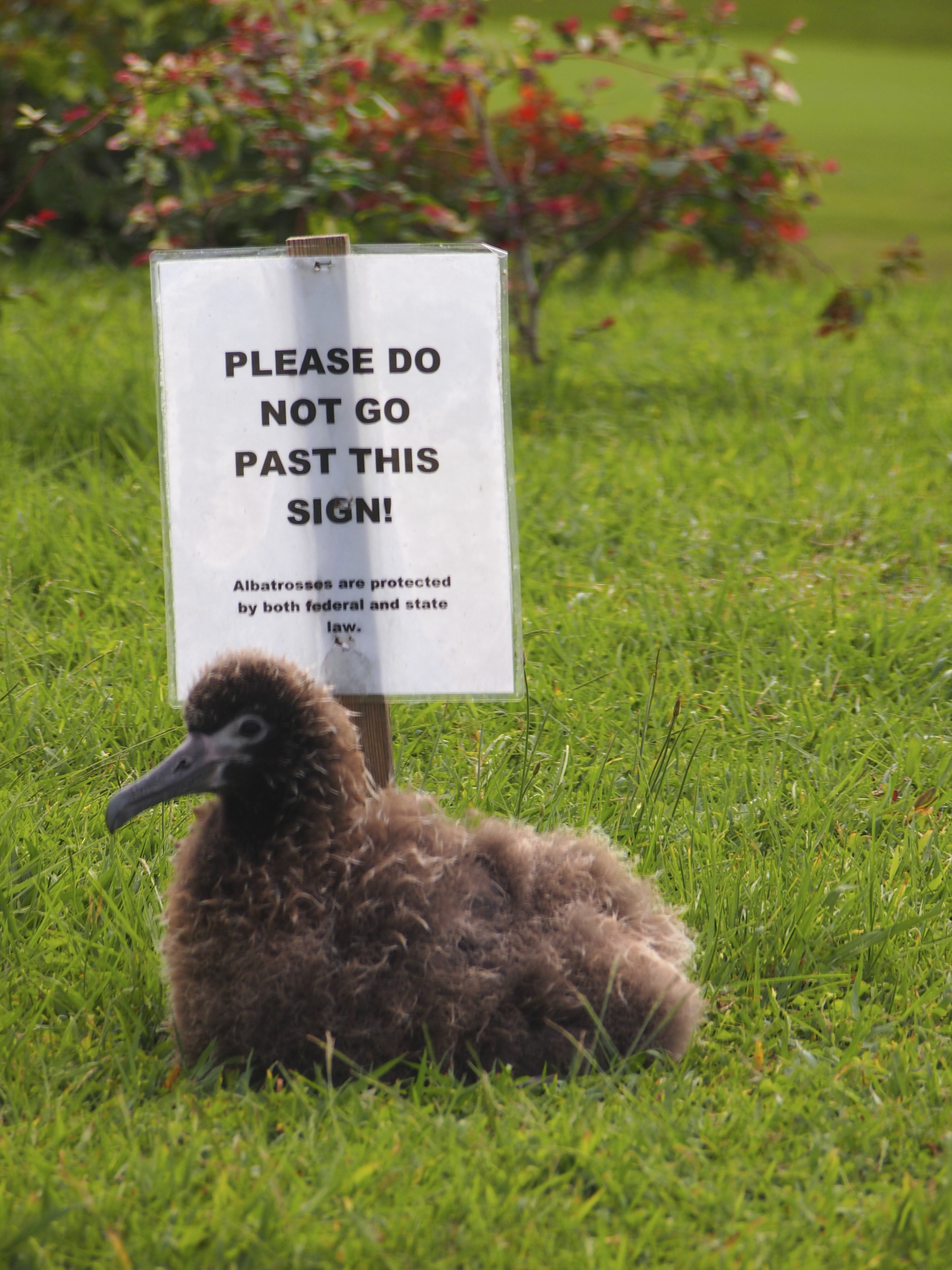
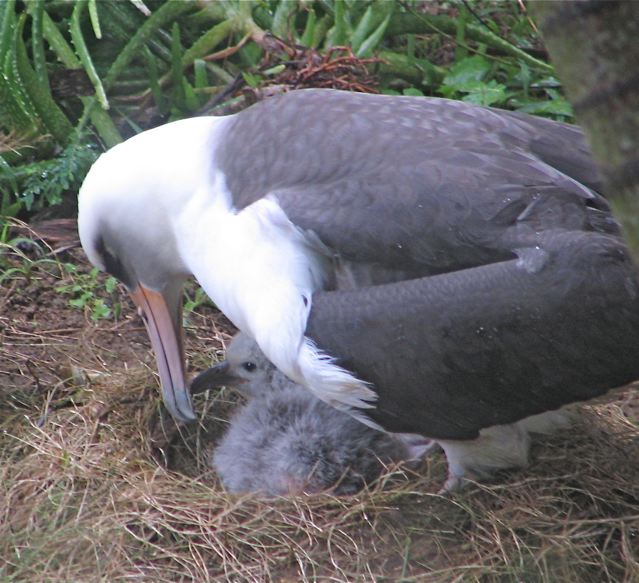
Even worse are the people who seem to think that the homeowners’ yards are public parks.  One couple was awakened by someone shining a light in the bushes next to their bedroom to see a chick.  People have found strangers standing in their backyards at all hours, taking close-up photos of nesting birds.  This behavior is the reason for this sign, which this albatross chick took to heart.

Albatrosses can read!

Albatrosses can read!

Two females at one nest managed to come up with a fertile egg in the 2006-2007 season in Princeville.  The result was Larry.  He was named by my neighbors who kept an eye on the nest from the time the egg was laid until Larry fledged; he was seen between 6:45 and 7 A.M. on July 14th and was gone by 7:30 A.M.  Sometimes albatross chicks whose nests are not within sight of an ocean bluff fly in the wrong direction when they get the urge to fledge, and if there is no breeze they will even try to walk somewhere.  One once landed on top of a cliff, which required me to climb up after him, carry him under my arm and use the other hand to grab on to strong bushes.  When we got down to the ground, the ungrateful chick bit me.  They have ended up in garages, under houses, and stuck in thick vegetation.  Fortunately, most Princeville residents obey the leash laws.  Imagine what would happen if the chicks fledged in areas where there are dogs running around next door to their nest sites.

We looked around for Larry to make sure he did not end up someplace that he could not fledge from, but we didn’t find him.  He was probably winging his way over the Pacific Ocean by then.

Larry first came back to Princeville when he was four.  For the next 3 years I never saw him anywhere but in my neighborhood.  He spent time displaying with different birds, but the only times I saw him engaged in the “quiet contact” I record for nesting couples it was with KP889, named Dora by the homeowners at the property where her parents had their nest.  Her father, by the way, raised a chick last year at the same time that two of his children were raising chicks in the neighborhood.  We have 3 generations in my neighborhood!

This year Larry and Dora got together November 26th, then Dora left and did not return until December 1st.  On December 2nd, Larry was sitting on an egg.  There was no nest and the egg was way too close to the street.  By the next day the egg was abandoned.  Larry would periodically return to sit on the egg, but he would always leave it again.  Then I did not see him for about a week.  He came back to wait for Dora to return.  He  spent many hours sitting not far from where the egg was located.  In the photo below you can see him standing in a bunch of leaves that he pulled off of nearby plants.

Larry redecorates

Larry redecorates

It is not uncommon for first-time nesters to abandon the nest.  Some of them seem to get it right from the beginning, others need more time.  Larry seems to be in the second group.

Maintaining a relationship with a mate is an important activity for these birds, worthy of the extra time spent on land waiting to be reunited.  It takes much less of their time than searching for a new mate.  After 12 days Dora returned, and they renewed their bond.  Dora was sitting on those leaves that Larry had shredded.  They were quietly grooming each other, the “quiet contact” I referred to previously.

Larry and Dora

Larry and Dora

I expect them to try again next year.  Chances are that they will raise a chick next time. I wish I knew why some first time nesters seem to know exactly what to do while others have to fumble around a bit.  

These birds keep their mysteries to themselves.  I feel no need to attribute their behavior to human-like motives and concerns.  I think we are part of the background noise to them, a minor annoyance.  They have no idea how dangerous we can be, with our refusal to acknowledge the predatory instincts of our pets and our impacts on weather systems and our plastic sitting in their eating places.

What is important is that we know.

Posted in Uncategorized | Leave a comment

Nest observations

Sometimes the nest that your mate built needs a bit of work.  A leaf here, a bit of twig there….

KP643 adds her touch

KP643 adds her touch

Sometimes you choose a spot guaranteed to get lots of foot traffic, either near someone’s front door

497, oblivious

497, oblivious

or by someone else’s back door.

Blu234 awaits her mate

Blu234 awaits her mate

Here is a closeup of this nest.  This bird pulled some of the greenery next to her to use, as they often do.

Blu234 on leafy nest

Some use grass to build their nests.

KP515 on grassy nest

KP515 on grassy nest

WhA093 on nest KP300 built

WhA093 on nest KP300 built

Here is a more elaborate grass nest, built by the Tuna Birds.  This name was given to these girls by Brenda Zaun, former wildlife biologist at the Kilauea Point National Wildlife Refuge, because someone had left a can of tuna by their nest.  Now I have Pastry Birds, Fritos Birds, Ham and Cheese Birds, Fried Rice Birds, Stinky Fish Birds and Hamburger Bun Birds.

Tuna Bird on her well-built nest

Tuna Bird on her well-built nest

People think they are helping by leaving food for the birds, but they are not.  It may attract predators to the nest and the birds may get sick from the food.  When an albatross is at a rehab facility, like SOS (Save Our Shearwaters) at the Kauai Humane Society, great care is taken to prepare the food in as germ-free an environment as possible.  Food must be carefully weighed and amounts recorded, with prescribed supplements provided.  This is a job for experts.

But none of the albatrosses you will see now in Princeville need rehabbing.  The couples take turns sitting on the nest and flying out to sea to eat.  If a parent fails to return during incubation, the other one will not waste away trying to save the egg, the instinct to survive will supersede maternal or paternal care.  The life of a successful nester is higher on the scale of what is important to ensure the future of the species than the possible success of an unproven embryo.  It is a simple fact of albatross life, one which an albatross does not waste time contemplating.  Leave that to the human beings.

Posted in Uncategorized | Leave a comment

Nest choices

One couple chose to build their nest at the bottom of a hill.  They decided that my life was way too easy and that I needed the thrill of climbing up and down slippery grass to check on them.  It is a terrible spot for a nest, an area where heavy rain would be likely to run down hill to the lowest point, which is where the nest was.

bottom of the hill
bottom of the hill

On Saturday night a storm hit Kauai.  Twelve inches fell at Mt. Waialeale, an area that is often the wettest spot on earth.  Look at the photo above, and try to guess what happened.  Not only was the egg gone, there was no trace of the nest left.  The parent was nowhere to be seen.  When something catastrophic happens to a nest, the parent who was on the egg will usually wait in the area until the mate returns.  They will renew their bond before flying out to sea.  Perhaps this parent was too traumatized to stay there.  I will keep checking for her.

Another couple picked a site with lovely mountain views:

the mountain scenery

Here is the view in the other direction, looking towards an ocean bluff:

an ocean view

This is a perfect fledging spot for a chick, who will be able to fly into the breezes coming in from over the sea, thus beginning his new life as an adult albatross.

How do they decide where to put their nests?

Please let me know if one them tells you.


Posted in Uncategorized | Leave a comment