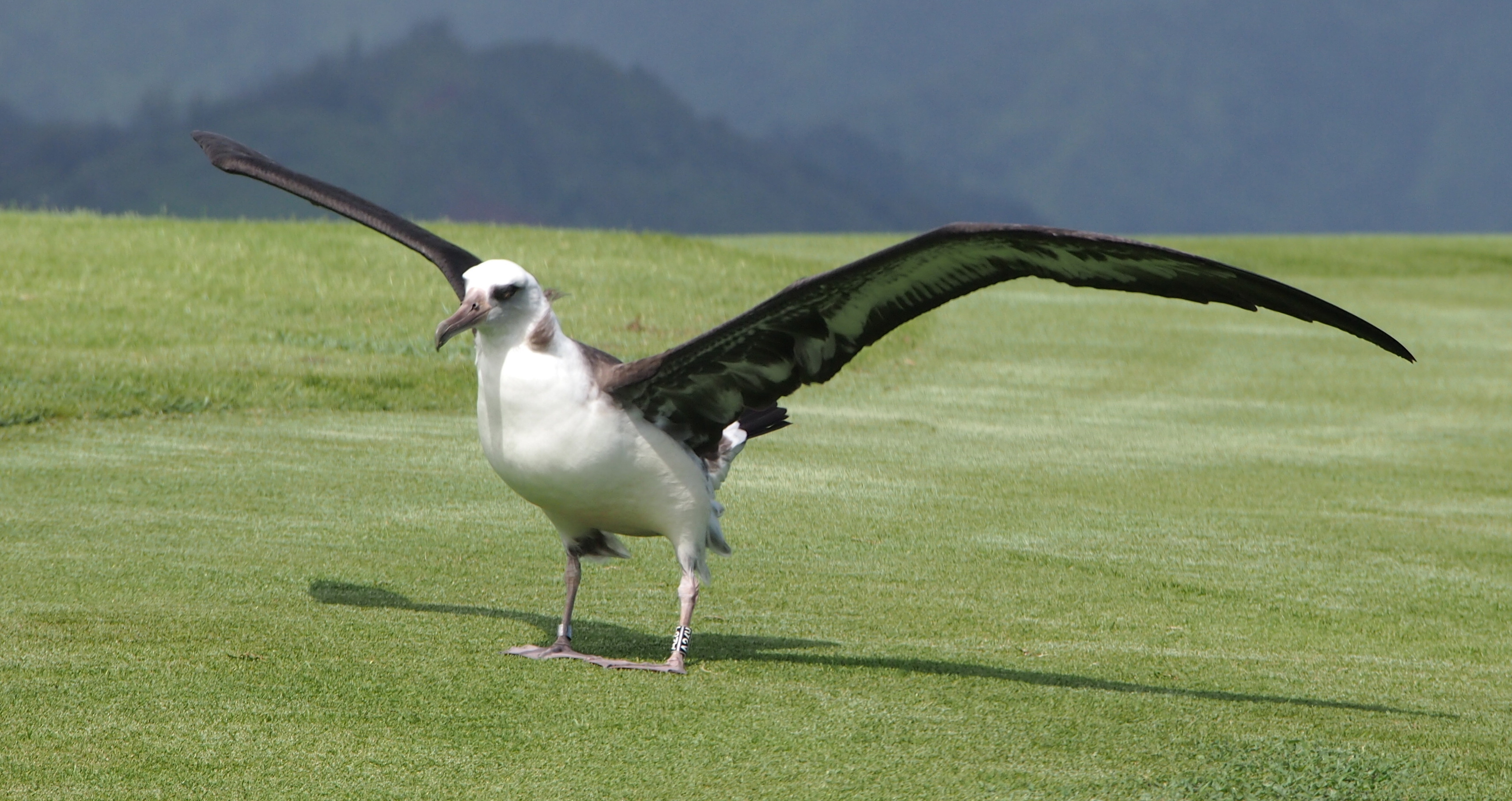
Update to my last entry

I last wrote about 531, his former mate, A378 and his current mate, K407. He relieved K407 on their nest on December 25th and spent about 2 weeks incubating their egg. A378 sat about 2 feet away from him for part of that time. I never saw them interact when 531 was sitting on his egg.

Then A378 left for 5 or 6 days. When she returned, K407 was on the nest.

A378 has spent most of her time here since then sitting about 8 to 12 feet away from K407. Occasionally she walks a bit too close to the nest for K407’s taste, and gets severely clacked at. She always retreats a bit further from the nest, but stays in the same backyard. Is she waiting for 531 to return? One time she walked about half a block away, but when another albatross tried to engage her in a display, she turned away and walked down the street.

It is not her fault, it is not her mate’s fault, it is not anyone’s fault. Her close relationship with her mate was totally upended and neither one had anything to do with it. Will she still stay near his nest as he raises his chick with K407 in the months to come? Will K407’s former long-time mate find someone new to nest with? She has been mingling with other singles on the golf course lately.

And the Big Question: Will 531 return to A378 next season?

Posted in Uncategorized | 1 Comment

An albatross making difficult choices

One character who has been here since I moved to Princeville in 2001 is 531. He raised 6 chicks with his former mate, 467, between 2004 and 2010. In November of 2010 they had an egg but treated it differently from previous ones. They did not build a nest. 467 laid it on bare ground and they both abandoned it soon after. 467 left Princeville and did not return until the end of December.

Meanwhile, 531 stayed behind and started meeting and displaying with other birds. These birds spend more time on land than they are given credit for in the literature, which is primarily written by people who do not observe them more often than once a week, or even less. They miss a lot.

One of the birds he interacted with was A378. He spent more and more time with her, and 6 times they engaged in the quiet contact typical of couples. It may sound as though 6 times is not very much, but couples have nested together after fewer instances of that behavior. The two seemed to quickly develop a close relationship, spending more and more time together. In contrast, 467 was in close contact with 531 only once.

The next season, both 467 and A378 laid eggs. 531 made his choice, he relieved A378 on her egg. Eventually, 467 abandoned hers.

531 and A378 went on to raise two chicks together. Then last season, 531 abandoned their egg. It was generally a bad year for nests; out of 34 nests, only 10 chicks hatched. But when they finally reunited, 531 and A378 spent many hours in close contact. When both were here, they were always together.

Unfortunately, at the end of January A378 was hit by a car. The rehab experts at Save Our Shearwaters thought that her auxiliary band actually protected her leg from more serious injury. Fortunately her leg was not broken and she was released here about a week later. She flew away soon after.

531 was not around when A378 was hit by a car, and he was not there when she was released or on the one day in March when she returned to Princeville. As far as he could see, she was gone. He began to spend time with K407, who had been nesting with another female since at 2001 and possibly earlier.

K407 and her mate, 466, had six failed nests from 2008 until 2013. Every year after their nest failed, they would decide where to meet the following year and spend about two weeks in that spot. Last season was no exception, they sat in front of a neighbor’s house. But K407 started hanging out in the area where 531 always nested. I saw her display with him five times, and four times they were engaged in quiet grooming sessions. In contrast, I saw her grooming with 466 just twice. K407 was in Princeville on at least 42 days after the nest failure, 466 was there just 15 days.

This year, K407 and 531 were among the first albatrosses to return to Princeville, and on November 25th 531 was sitting on an egg. That same day A378 sat near him, but he acted aggressively towards her, biting at her.

The next day A378 was sitting on an egg about 2 feet away from 531’s nest. She had abandoned it by December 6th. 531 continued to sit on his current mate’s egg, but when K407 returned on December 10th to relieve him, he moved over and sat on A378’s egg. He certainly gave the appearance of being the father of that egg.

531 was gone by the next day, leaving A378’s cold egg alone.

On December 24th, A378 had returned and was walking not far from K407. I continued to collect data on other birds when I heard a loud scream coming from that direction. 531 had returned and was attacking his current mate, K407, stabbing at her with his bill. He then went over to A378, who was sitting on her old nest, and attacked her. He was doing the screaming both times and was clearly very agitated. For the next 20 minutes or so he sat next to A378 and they gently groomed each other as K407 watched. In all of my years of observation, I have never before seen an albatross attacking the mate on their nest, nor have I ever seen one grooming another bird while the mate sat on their egg and watched.

In this film, 531 is on the left, A378 is sitting to the right of him, and K407 is sitting on their egg in the background.

531 would periodically try to sit near K407, but she clabbered at him and lunged at him. In the second film segment below she included A378 in an apparent display of her emotions. Is it anger? Frustration? Fear of losing the only albatross who would have any interest in helping her raise her precious chick? All of the above?

In this segment 531 approached K407. After all, he had come back to relieve her at their nest. That is a very strong motivation for an albatross. Clearly K407 was not ready to allow him to get close to their nest, and they had a hearty domestic squabble. Again, I have never seen this behavior in a nesting couple. Did he then return to A378 to be comforted?

On December 25th, 531 was on the nest, K407 was sitting close to him, and A378 was sitting about 8 feet away from them.

On December 26-28, K407 was gone, 531 was on the nest and A378 was sitting about 2 feet away from him. She was also sitting near him on December 31st, January 1st and January 2nd.

Since then, 531 has been sitting on the nest alone, with neither A378 nor K407 nearby.

My feeling is that 531 will help raise the chick, I have never seen an albatross abandon a chick. But is impossible to predict his choice of nesting partner for next year.

They are complicated creatures, these albatrosses.

Posted in Uncategorized | 2 Comments

Stella reclaims her spot on my lawn

The albatross who spent many days on my lawn calling to flyers overhead last season returned to my yard at the end of November. I named her Stella because she is often at her post when I am walking my little dog in the early morning darkness, so she really is “Stella By Starlight.”  I can hear her at night sometimes clacking to herself as she sits under my office window.

OLYMPUS DIGITAL CAMERA

Stella’s mate left her for another in 2009, and she has been returning to this neighborhood every year since then.  Last year she was here on 56 days.  Much of that time she sat on this lawn, calling to the albatrosses who glide above my neighborhood to check it out, then occasionally drift down to have a look around.  On 43 days I did not see her interacting with any other birds.   On 13 days she was was involved in social interactions with 13 different birds, mostly displaying with them, sometimes with two or three at once.  Nobody ever stays with her, they all seem to leave her to see who else is available here.  She never gives up.

In this little video the sounds of displaying albatrosses are prominent.  Stella was not invited to participate, and she is clacking to herself as she builds a nice little nest, showing that she has not forgotten how to make a home for a little bundle of seabird.

When her mate first nested with another female, Stella would sometimes sit near the nest.  I never saw any interaction, she just sat and watched.  What would be her reason for sitting there?  She never acted aggressively to either adult or to the chick.  As long as she did not get too close to the nest, the parents ignored her.  But I have seen the male snapping at her when he was not nesting.  She never responded to his aggression, she just moved on.

There is so much variation in the social behavior of the Laysan albatrosses and there is not much written about it, perhaps because most observers do not watch the albatrosses very frequently.  As someone used to observing one of the most social animals in the world, the chimpanzee, it has been a very pleasant surprise to discover birds that seek each other out specifically to interact with each other.  Sometimes the observer can attach meaning to behaviors, for instance nesting couples greeting each other after being apart for some time.  At other times all the observer can do is to record the behavior and fit it mentally in the “What was that?” file. I would like to think that as time goes by, that file will decrease in size. I have a feeling that while parts may be moved over to the “Oh, I think I get it” file, there will be plenty more new entries to keep me from ever thinking that I know everything about these birds.

Posted in Uncategorized | 2 Comments

First Egg

KP515 on the first egg of the season

KP515 on the first egg of the season

The first egg of the season was laid by a female that I call Bipolar Momma.  She and her mate, KP515, have been together for at least 10 years.  KP515 has proven to be a steadfast parent, Bipolar Momma has a somewhat spotty record.  So far:

One year they didn’t nest.

Years they successfully raised a chick: 2

Years they had a bad egg, which broke: 2

Years BPM abandoned the egg: 3

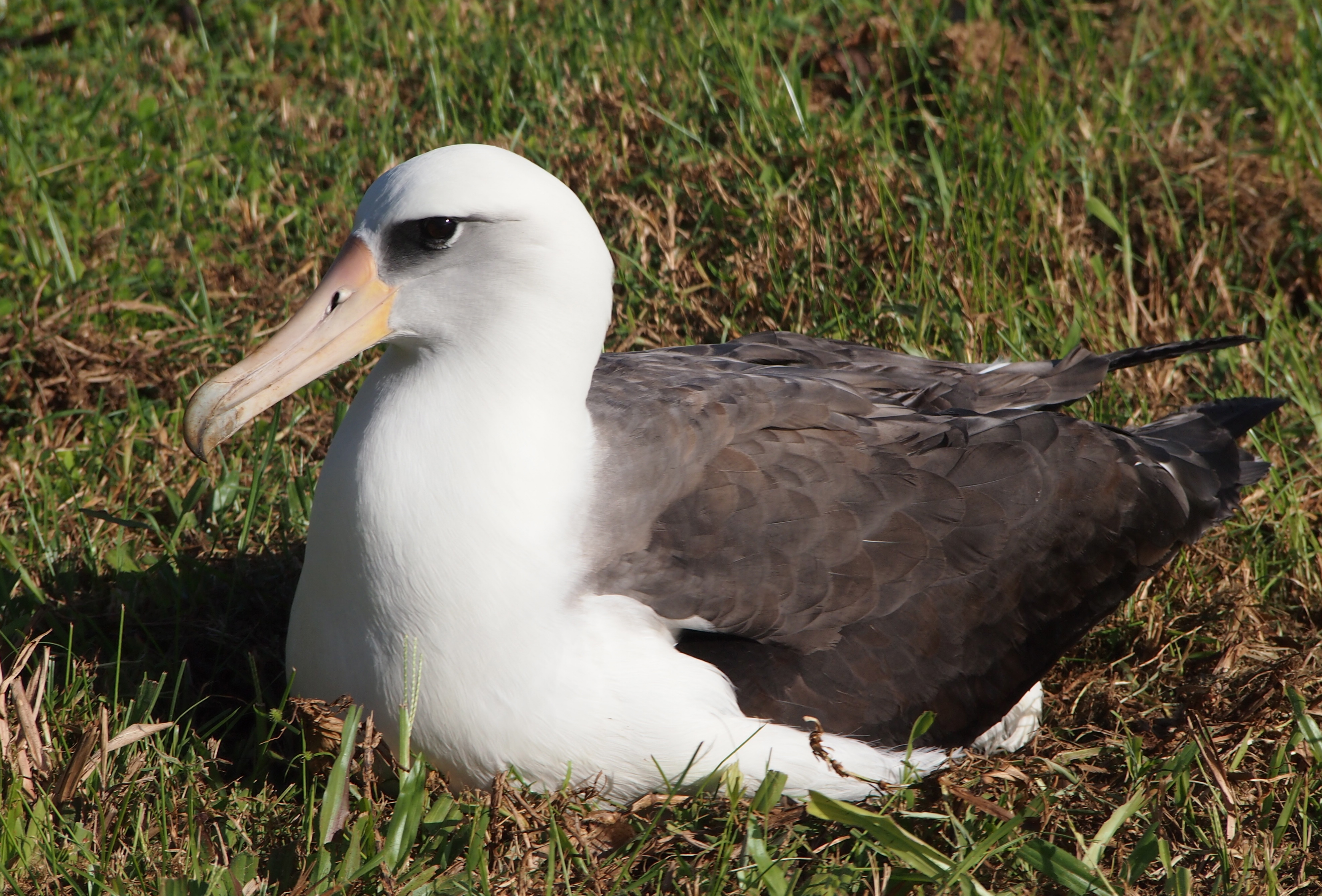
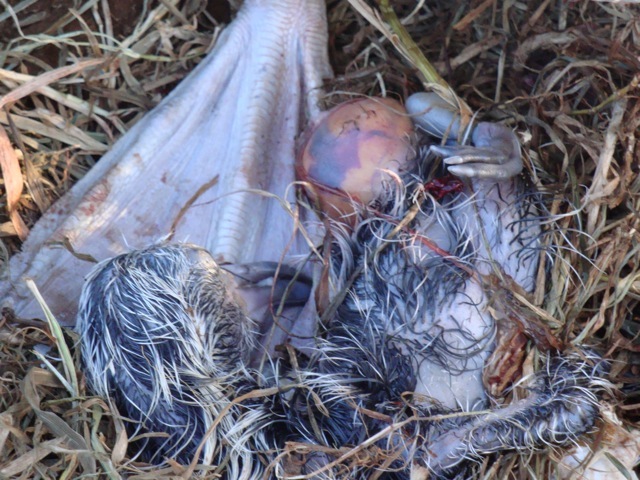
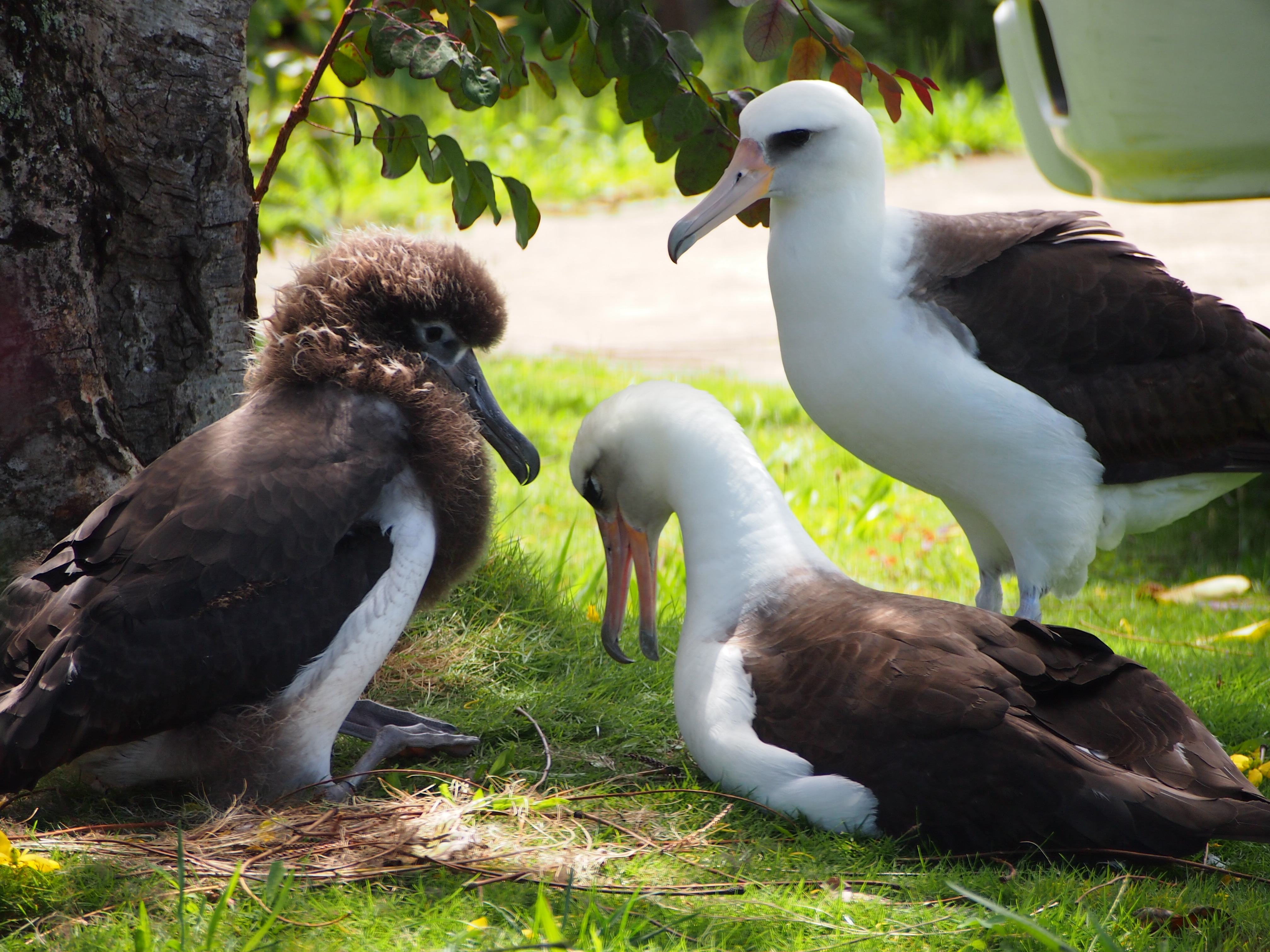
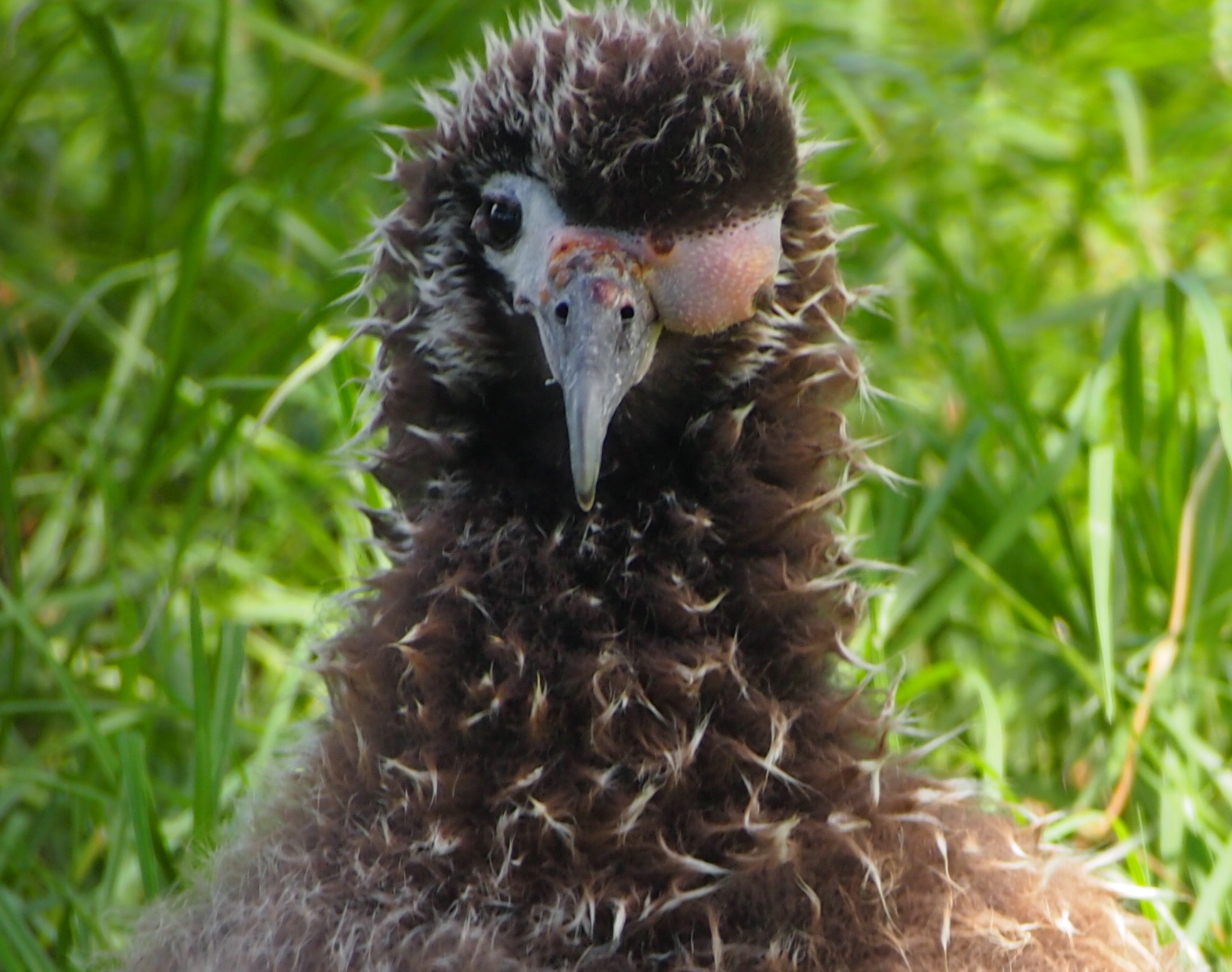
Another year BPM pulled the shell off of the chick in one day.  The chick lived very briefly with the yolk sac still attached.  During hatching the chick is supposed to peck a hole in the hard shell of the egg, then break bits of the shell off until he is free of his former home.  It usually takes from 2 to 4 days for an albatross chick to break out.  The parents are supposed to let the chicks hatch by themselves; the chicks use a temporary structure on the bill called an egg tooth to chip away at the shell.  The egg tooth is the white spot at the end of the bill in this photo.  This happens to be Bipolar Momma with her chick from 2012, a good year for this couple.

Close-up of egg tooth

Close-up of egg tooth

The parent usually talks to the chick during hatching, but they never help with shell removal.  Except for Bipolar Momma, that is.  The chicks should absorb the yolk sac by the time they hatch, but this one had not had time to do that before the shell was pulled off of him.

Dead chick with yolk sac still attached

Dead chick with yolk sac still attached

Two of the times that BPM abandoned her egg she first left it the day after she laid it. KP515 came back the next day and resumed incubation, then BPM abandoned it again later on. The other time KP515 had taken his first incubation shift, and she abandoned it the day after she came back to relieve him at the nest.

Here is hoping that this couple can get through incubation and hatching with no problems.  Once the chick is safely out, Bipolar Momma knows how to be a good parent, she has proven that in the past.  She just never totally got that whole incubation/hatching thing.

Posted in Uncategorized | 1 Comment

This is starting out as an unusual season

I knew that I was seeing more albatrosses than I usually do at this time of year, so I checked my Excel files.  This table shows, for each of the last 10 seasons,  the number of albatrosses that had appeared in Princeville by November 13th.

Season                               Number of albatrosses

2005-2006                                     3
2006-2007                                     0
2007-2008                                     1
2008-2009                                    4
2009-2010                                     4
2010-2011                                      3
2011-2012                                      3
2012-2013                                      3
2013-2015                                      5
2014-2015                                     17

Checking every day is important, because the birds are coming and going; they may not be here every day.

What does it all mean?  Does it mean anything?

Posted in Uncategorized | 2 Comments

The Albatross Soap Opera: Episode 1

If you were to walk through my neighborhood yesterday you would have seen four albatrosses.  You would have appreciated the poetry that is “albatross,” the beauty, the grace, the pure white feathers, the albatross essence.  I see that, but I also recognize individuals, each with a unique personality.

I think everyone who reads this blog has read accounts of albatrosses somewhere, of their lives at sea, their dedication to raising their chicks, the way they can glide with little effort, the chicks’ bold flight into the adult world, all of the aspects of their lives that Carl Safina wrote about so eloquently in “Eye of the Albatross.”

But I observe them every day.  I see their individual personalities, I see the social behaviors that cannot be appreciated without knowing something about each albatross.

This is what I saw yesterday.

K065 and KP505

K065 started coming here during the 2010-2011 season.  The first couple of seasons she was here a total of 9 days, that’s all.  I would love to know if she went to other areas on Kaua’i as well.  She traveled to different parts of Princeville, perhaps trying them out to see which she liked best.  In 2013-2013 she narrowed it down to my neighborhood and one area of the golf course.  She was here on 30 different days.  One thing that I have learned in the last 9 years is that the albatrosses are on land more than most people give them credit for.

Last year she met KP505.  He is a patriarch in our albatross community, a grandfather.  His daughter used to nest less than a block from him, until her mate disappeared last season.  Unfortunately, KP505’s mate also did not return to Princeville last year.  In December I first saw him sitting with K065, gently grooming her.  It is impossible for a human to predict how an individual albatross will approach finding another mate.  Some start looking right away, some may take years.  Please do not try to interpret that as a measure of how much they cared about their mates, unless you are an albatross.  And if you are, bravo for learning how to read.  Can you answer a few questions for me?

These are birds and we cannot interpret their behaviors using human emotions as a guide.

He built a nest in bushes next to his favorite yard, the property where he raised chicks with his last mate.  Males often seem to be more attached to particular areas than females, more reluctant to move somewhere new.  Females started to stop by to visit and he often displayed with them.  But when it came to the type of behavior we see most often in a nesting couple, sitting close to each other in mutual grooming sessions, K065 was the one he clearly favored.  Generally albatrosses that plan on nesting together the following season develop a routine, meeting each other at one particular location.  This is important in an area where views are obstructed by buildings.  Once there was a couple who nested in my neighborhood in a different location each year.  One year they could not seem to find each other and missed a possible nesting opportunity.

I was happy to see K065 return on November 8th, but surprised to find that she was not waiting for KP505 in the spot where they had spent all of their time together.  She moved several backyards away to an area that cannot be seen from the place where they were together last year.  Sure enough, when KP505 returned yesterday, he walked straight over to his favorite spot.  The two did not see each other.  She stayed in her yard while he eventually took off again.

K007

K007 has been coming to Princeville for the last 8 years.  She has never found a mate.  I have seen her in my neighborhood and on the golf course.  She has displayed with a variety of albatrosses, male and female, but she has never found one to nest with.

K407

K407 has been coming to Princeville for as long as I have been collecting data, for 9 years.  For all of those years she has been with another female, KP466.  Unfortunately, in the 7 years they nested they raised just 2 chicks.  The other years they spent many days incubating eggs that were infertile.  Their last chick fledged in 2009.

Every year K407 and KP466 would pick a spot where they would meet the following season.  They would go to the same spot for at least 10 days and both would return to that place the next year.  Last season they had another bad egg, which broke on January 10th.  They seemed to have chosen a meeting spot in the bushes in front of a neighbor’s house.  KP466 showed up there, but K407 started going to another area.  She met a male there and she was with him more often than she was with KP466.

Yesterday K407 was sitting in the area where she had spent time with the male.  KP618, still waiting for his mate, tried to get close to her.  She immediately jumped up and chased him away, clacking furiously.  He fled and did not try again.

——–

UPDATE:

This morning KP505 moved to a spot in his yard where he can see more albatrosses, a street corner.  Unfortunately, he could not see K065 walking in from the ocean bluff at the end of my street.  She was closely followed, much to her annoyance, by KP618.  She avoided him as if he were covered in avian pox.  He finally got the hint,  gave up and walked back to his favorite yard to wait for his mate.  She walked back out on the ocean bluff and took off.

KP505 is still waiting on the corner.

Cue the sad music.

KP505 waiting for K065

KP505 waiting for K065

SECOND UPDATE:

Later this morning, 3 albatrosses landed at the end of my street.  KP505 could see them coming down, but he stayed in his spot and called to them.  I saw KP618 running after KP505’s daughter.  She ran away from him across several yards, then ended up across the street from her father.  They briefly vocalized, she crossed over, stayed briefly and then went back.  He did not follow her.  Does he know that they are related?  If any albatrosses are reading this, would you please let me know?

She then walked over to an area where she and another female seemed to be competing for the attentions of another male last season.

K065 returned, too, but she never went far from the landing area.  I think she may have taken off again.

KP505 is still waiting on the corner.

Posted in Uncategorized | 3 Comments

The first albatross of the season returns to Princeville

The same bird who was first last year, KP618, has returned. He fledged from Princeville 10 years ago and he is sitting in the yard where he was a chick. He raised 3 chicks with his mate. Unfortunately, she disappeared during incubation of their last egg two years ago. But last year he met a female whose mate also disappeared two years ago. She has also helped to raise 3 chicks. Last year I observed this couple sitting quietly together in gentle grooming sessions on 9 different occasions, and neither one was interested in anyone else.  Based on their combined experience, they will be good parents.

It is interesting how quickly some albatrosses find a new mate, while others have a much more difficult time.  How are they different from each other?  I would love to know the answer to that one.

KP618, waiting for KP252

KP618, waiting for KP252

Posted in Uncategorized | 4 Comments

CJ

Albatross chicks start to leave their nests as they become more physically coordinated. They rarely go very far, and they are almost always within sight of the nest. Sometimes they are moving to a shady area, away from a nest that is always in the sun.  I still do not know why some parents choose full, all-day sunlight for a spot to sit in for days on end, particularly when they are used to flying through wet, cold skies.  The chicks usually build a nest in the new location, often flimsier than the one built by the parents.  When it is time for them to catch their own food, this practice at using their bills for manipulating bits of nesting material will validate all of their building attempts.

A parent who has flown in with a meal will vocalize upon landing. It sounds like three descending notes, “Eh, Eh, Eh.” Translation: “Where’s my chick?” When the chick hears that he will usually run to the parent with an excited 2-note response, also descending, that sounds to my human ear like the albatross version of “Daddy!” or “Mommy!” On Midway, where the nests number in the hundreds of thousands, this vocalization is most important for parents and children to locate each other. In Princeville the parent can usually see the chick, but occasionally the little one moves a bit further afield and the vocalization is necessary for the speedy reunion of parent and child.

There are also chicks who have not read the albatross rules book and will insist that the parents join them in their new digs. A couple of seasons ago Lanea moved next door to her nest yard and sat on a tree stump, and would not come when called. She did not miss out on her meals, the parents rewrote that chapter and started to join her.

Lanea and Dad

Lanea and Dad

CJ never really went very far from his original nest. He had two favorite spots, one within sight of the nest, one a few feet over on the neighbors’ lawn. He occasionally tried out his wings when it was windy. He would wait until I was walking my dog near by and did not have my camera with me; it was uncanny how he could time his practice sessions. A couple of times I managed to come equipped for photos, but by the time I got got my camera out he would be sitting calmly in one of his favorite places, assuming the I’ll-never-fledge position.

One morning he seemed to be very restless, trying his wings out on his lawn, right in front of me, then walking all over the place. He was leaving his safety zone, which precedes fledging.  I saw him walk out to the ocean bluff.

For two hours he was out there. A few times he tried out his wings, it was windy enough for a takeoff.  Then he would sit down and contemplate. I waited patiently for him to soar into the sky, inspiring everyone with his grace and fearlessness. Instead, he sat. And sat. And sat a little more.

Finally he stood up and walked back out to the lawn he liked to sit on. I spent the next four hours or so checking on him at regular intervals. My day was ruined, he showed no interest in trying his wings again until later in the afternoon.  By that time he had made up his mind.  He was not going to wait another day to start his new pelagic life.

Here’s hoping we see him back here in a few years.  With any luck he will make his first landing somewhere in Princeville.  If so, I just may see him wobbling around on his sea legs, or I may get a call about an injured albatross who is having difficulty standing.  There is no greater reward for my hours of observation than to share those first moments back on land, to remember the funny little lint ball that turned into a more serious but still somewhat clumsy copy of an adult.  Who says I have to be one hundred percent scientific and objective when I write about these birds?

Posted in Uncategorized | Leave a comment

Sochi, the last to fledge

Sochi never seemed to go very far from the nest, she seemed to enjoy staying in her yard and in the front yard next door, not very far away.  Her father, KP497, was banded as a chick in 1997.  I do not know the background of her mother, but she has one of the older bands.  They have been nesting in my neighborhood since 2004, always in the same yard.

Here is a photo from taken in June of Sochi, a parent and Valentine, a 6-year old female who loves to visit the other albatrosses in the neighborhood.  Sochi made a very rudimentary nest, just some dead leaves and twigs to sit on.

Sochi, parent and Valentine

Sochi, parent and Valentine

Sochi started moving around more as it came close to fledging time.  I just missed seeing her leave, but fortunately, a local resident, Gregg Kravitz, was there.  Like the Pied Piper, Sochi led a small group of humans out to the ocean bluff.  Fortunately, the people knew that this was a special event.  Anyone who has visited our neighborhood to watch the chicks becomes used to seeing them sitting in the same area for days on end; changes in the routine can be significant.  Sochi walked with a purpose, away from everything she knew.

Gregg is a big reason why I finally broke down and bought a “smart” phone to replace my dumb one.  I will not be ignoring the people I am with to answer an email, but the ability to film something without carrying my camera everywhere is a powerful incentive for embracing the new technology.

In this film, Sochi has already left her yard and is now two front yards away, further than she has ever been.

Here she is moving closer and closer to the ocean bluff.

Bye bye Princeville!

The people who were renting the house where CJ’s nest was saw an adult sitting near the nest area around this time.  It was probably one of CJ’s parents.  People always used to say that the chicks leave when the parents stop feeding them.  Since I have not watched every nest for 24 hours every day, I cannot say that this never happens, but I can say that I have seen a parent return to a nest after their chick has fledged.  I once had a parent return several times after her chick had left.

One interesting fact about CJ’s mother is that she was banded as a chick in 1989 on an island that has since been covered by the rising sea level.  The biggest threat to the future survival of Laysan albatrosses is the loss of Midway to the ocean.  It is too horrible to think about, but we must.

Posted in Uncategorized | Leave a comment

Jesse

Before I started to collect data about the Princeville albatrosses in 2005, there were two couples who regularly nested in a spot called the Pepelani Loop. This was a half circle of unused land that bordered Ka Haku Road, the main road through Princeville. In the 2004-2005 season, building began on two condominium developments on this property. Neither couple nested that year. I was not collecting data then, so I do not know if they came back to meet up with each other. I have no reason to think they didn’t.

The next year, as work continued on the condos, one of the couples chose a terrible spot for a nest, right across from the Pepelani Loop close to Ka Haku Road. Tour buses regularly stopped near the nest, sometimes allowing people to get out and to surround the nest. My sister Cindy and I put a number of signs around the nest area. Most people stayed behind them, but there are always the ones who think they are different and should be allowed closer than other people. Note to all of these special ones: the real bird people never do this, they stay at a respectful distance. Birders are interested in observing the animals; observers do not get too close because their nearness may influence the animal’s behavior.

The other Pepelani Loop couple did not nest that year. I saw them at various locations around Princeville. I saw the female, KP459, on 19 different days. I saw the male, KP496, on 32 different days.

Usually when a couple who have nested before come back to an albatross colony, they will return to the area where they raised their last chick. Where else would they meet each other? But this couple had lost their familiar topography. How would they know where to meet? The answer appeared to be that they did not know where to find each other at first. I first saw the female on a street in Princeville where I had never seen an albatross. She spent two days sitting there, then a few days later she showed up in my neighborhood.

The next day I saw them sitting together on a vacant lot across from the Pepelani Loop. It was about as close as they could get to their old nesting area without being surrounded by buildings. To be honest, I do not know why they didn’t choose this area for nesting, it was so close to the old area. In the months that followed, I saw them together or separately in several areas:
1. across Ka Haku Road from the area on the Pepelani Loop where they used to nest, down a ways from where the other Pepelani Loop couple were nesting
2. on a part of the golf course that overlooks the ocean, where other albatrosses were already nesting
3. across Ka Haku Road from this part of the golf course, where no albatrosses were nesting

The area where I saw them together or separately the most often was the first on this list. It was an unsafe spot, way too close to Ka Haku Road. My last sighting of both of them together was in the last place. And that was the place where they chose to nest the following year, far away from an ocean bluff and from the other albatross nesters.

Their new nest site was behind a fairway on the part of the golf course across Ka Haku Road from the ocean bluff. They successfully raised a chick that year. Volunteers kept an eye on the chick when he started practicing his flight skills on the fairway during a golf tournament, and gently walked him back to his nest area. Some days later I got a call from a woman who had seen the chick walking across Ka Haku and who had made sure he was not hit by a car. She then followed him into a residential area. He was walking through yards, getting further and further away from the ocean bluff he needed for his first flight, so I took him to a spot with a grand view of the ocean. He later fledged successfully.*

The following two years they began the season with an egg in a nest. The first year we had 7 inches of rain the day after their chick hatched. Cindy and I found the chick washed 4 feet away from the nest, dead. The mother was still sitting in the nest. Albatross parents seem to be hard-wired to stay on the nest, no matter what. That does not make them bad parents, it makes them parents who operate on instinct much of the time. Perhaps staying on the nest no matter what is the best way to keep a chick alive in most cases.

The second year after another heavy rain the egg ended up totally submerged in running water below the fairway. The golf course has since been reconfigured to better handle drainage from the pounding rains that we get here.

They raised a chick together in 2009-2010. On June 21st, the Kilauea Point National Wildlife Refuge got a call from a man who had seen the chick trying to walk across Ka Haku Road, and he said that he had walked the chick back to his nest area. When I checked later, the chick was sitting near his nest. The next day I could not find him. I got another call from KPNWR. A resident had reported seeing a chick in a residential area across Ka Haku. I went there to see where he was. He was headed towards a greenbelt, a heavily vegetated area. Four years previously a chick had broken a wing flying into a tree there so I had to bring him to a safe takeoff area. The next day he fledged.

The following year they raised another chick who fledged successfully. While he was practice flying he got closer and closer to Ka Haku, until I finally moved him across the street to the golf course. In less than half an hour he was gone.

In 2011-2012, KP496 returned on November 23rd, but his mate never returned. When an experienced nester does not come back, I always assume he or she has died because they never return. I made a silent prayer to the albatross gods that KP496 would decide to relocate across the street on the part of the golf course that overlooks the ocean. He would never have to cross Ka Haku, nor would his chicks face that scary obstacle at fledging time. Unfortunately, the albatross gods laughed at me, as they usually do, and brought him two females to join him on the wrong side of the street. KP788 had raised 3 chicks with her mate, but he had not come back after the 2009-2010 season. KP416 had nested the previous year and either she or her mate had abandoned the egg.

He chose KP416, and they raised the first of two chicks in the 2012-2013 season.

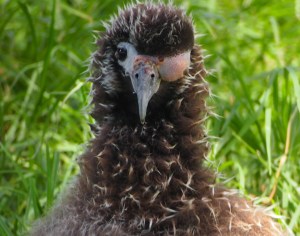
Their second chick was Jesse. Jesse is a Biblical name and it means “gift.” I worried about his ability to fledge safely, not just because he was on the “wrong” side of Ka Haku Road, but because he had been afflicted with avian pox and one of his eyes was misshapen. I was afraid that would affect his ability to see.
Jesse

Jesse

I was also worried about Jesse walking across Ka Haku. I knew that if he was practicing short flights near that road, it would be time to bring him across to the ocean side of the golf course.

In July I had a call from Lisa, who had watched Zorro walk down fairway 6 to the ocean bluff and take off. She said there was a chick near hole 6, which is close to the area where Zorro had fledged. There was only one chick left in that area, and that was Jesse.

I got over there as soon as I could, and called another volunteer, John, who has helped keep an eye on the golf course chicks for the last few years. Of course, the chick was Jesse. Somehow he had managed to get himself across Ka Haku safely and make his way to the ocean bluff. As golfers ignored him, Jesse did some serious wing flapping.

Jesse gets ready

Jesse gets ready

His eye was still not normal, but it was much better than it had been.

Jesse's eye

Jesse’s eye

We were there for a very short time before Jesse left us. I was so impressed with the slow, strong wing strokes that took him out to sea the way all of the adults who nest here go, down to an area below hole 6 that leads out to the ocean. If he had not had some of his fluffy baby feathers left, he could easily have been mistaken for an adult. I had never observed him doing practice flights, in fact I had never seen him doing much more than flapping his wings vigorously. I heard that he did make some short flights, but this is the first chick in that area that I never had to keep an eye on because he was getting too close to the main road. How was he able to fly so superbly on his first attempt? The albatross gods did not desert me, after all.

—————————————-
* This chick came back in 2011, at the age of four. That year, I never saw him anywhere near his old nest area, he was always on the ocean side of the golf course. The following year I saw him once across Ka Haku, away from the ocean bluff. That year while walking across the road, he was hit by a driver going too fast. As a result of his injuries, he had to be euthanized. My April 18, 2012 post was dedicated to him.

Posted in Uncategorized | 3 Comments