Doc and Zorro

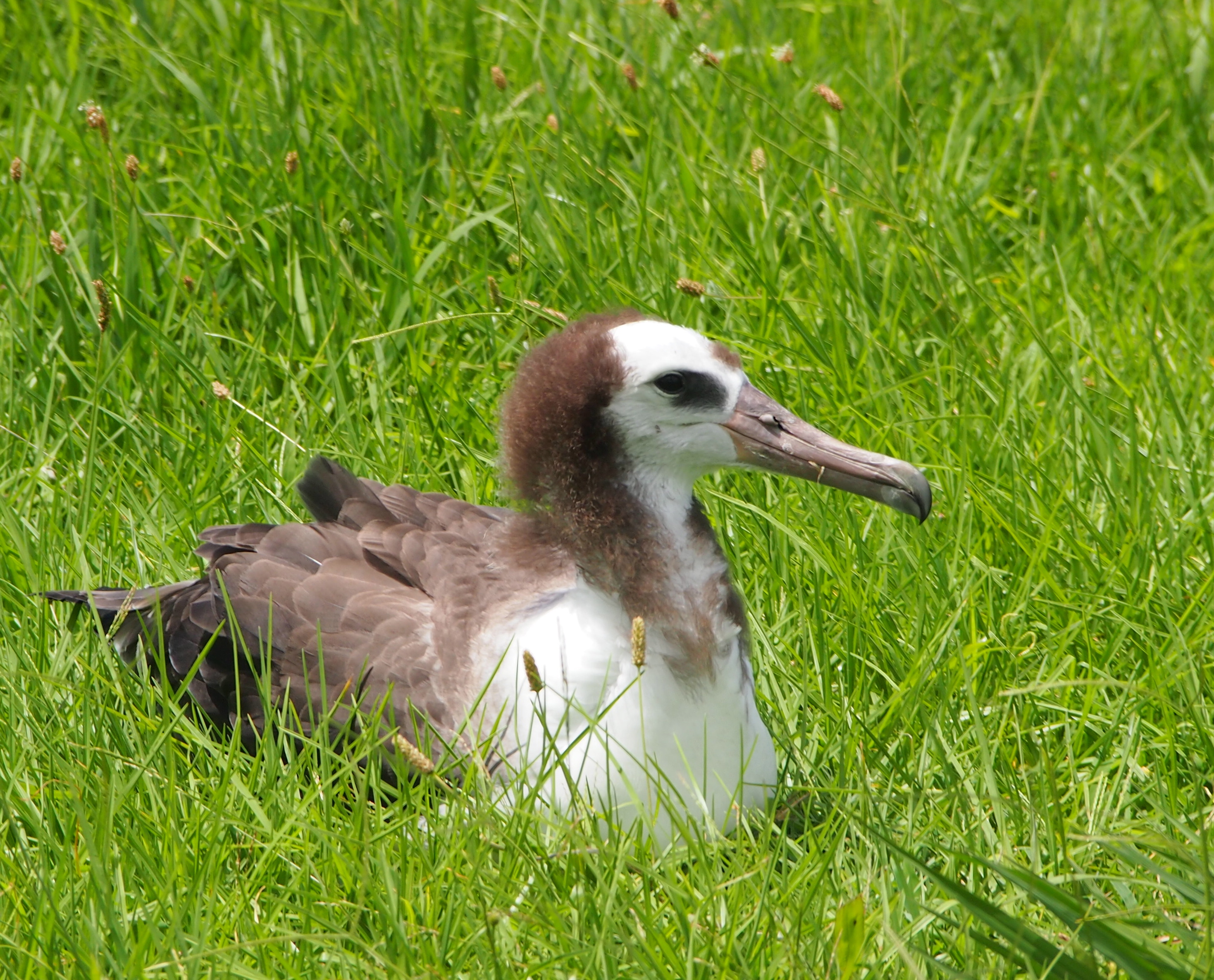
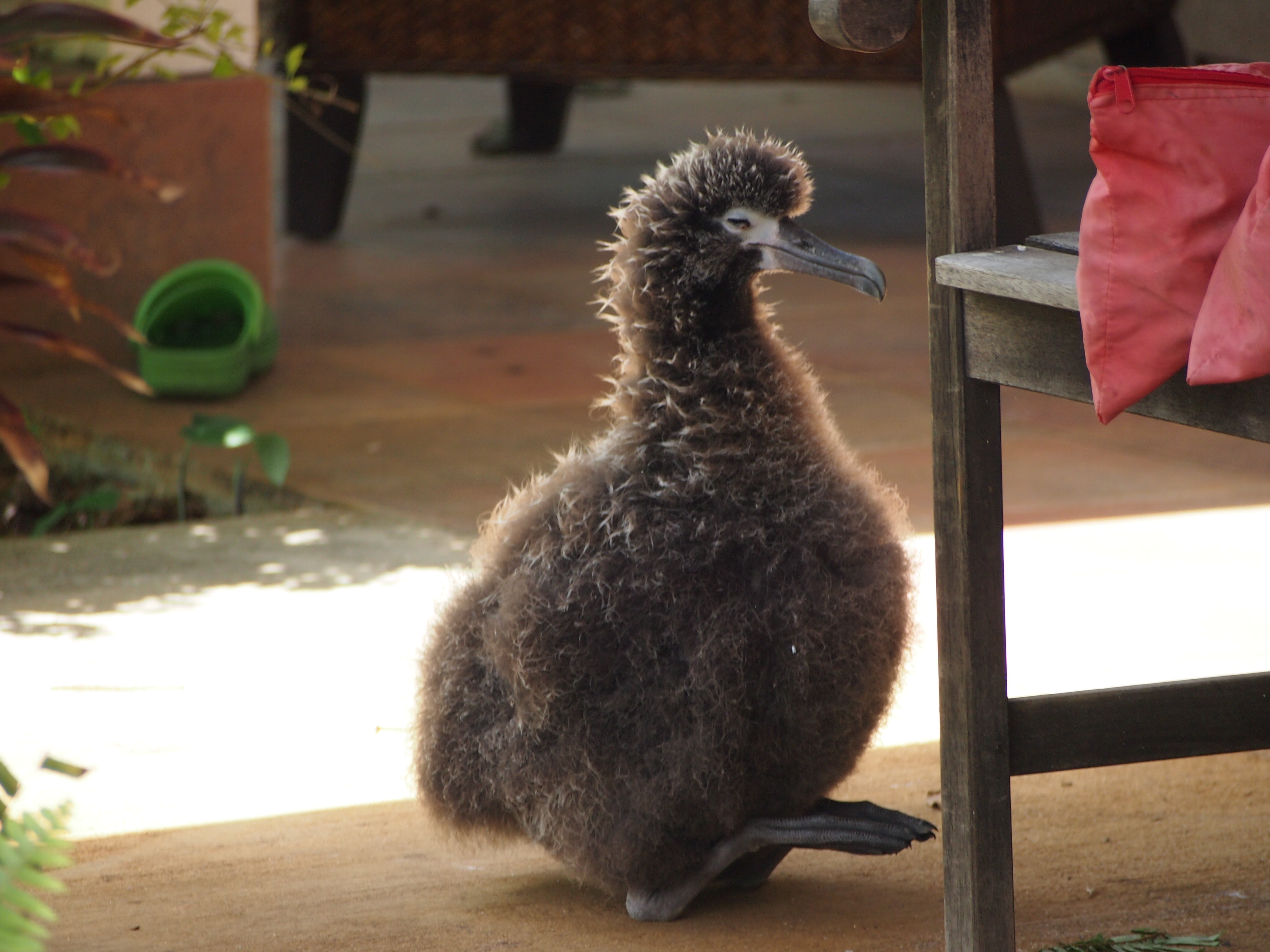
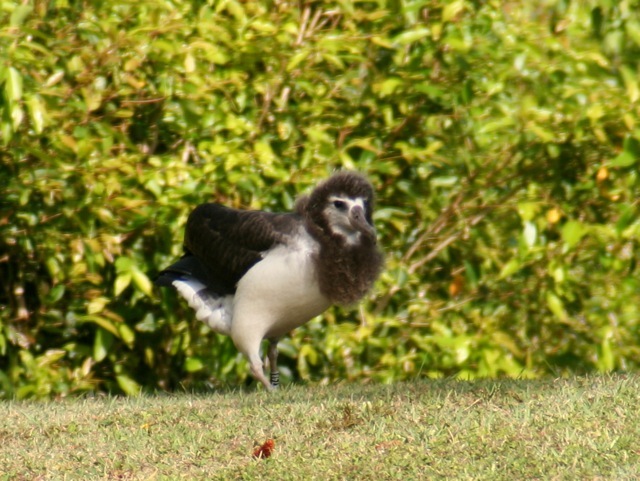
Doc was next on the list to fledge. One late afternoon he was sitting around, the next afternoon he was gone.  A neighbor who was sharing his back yard with Doc said that in the early afternoon he saw the bird doing practice flights across a couple of yards.  He was gone by 2:30.  I took the morning off and had a birthday lunch, checked on him a little later than usual, and just missed seeing him fledge, perhaps by minutes. The class of 2014 mostly left with little fanfare, in a businesslike manner befitting individuals who have no time for indecision, no need for hanging around a lengthy period of time to practice their flying techniques. Take too long at your birthday lunch and a chick will leave while you are gone.

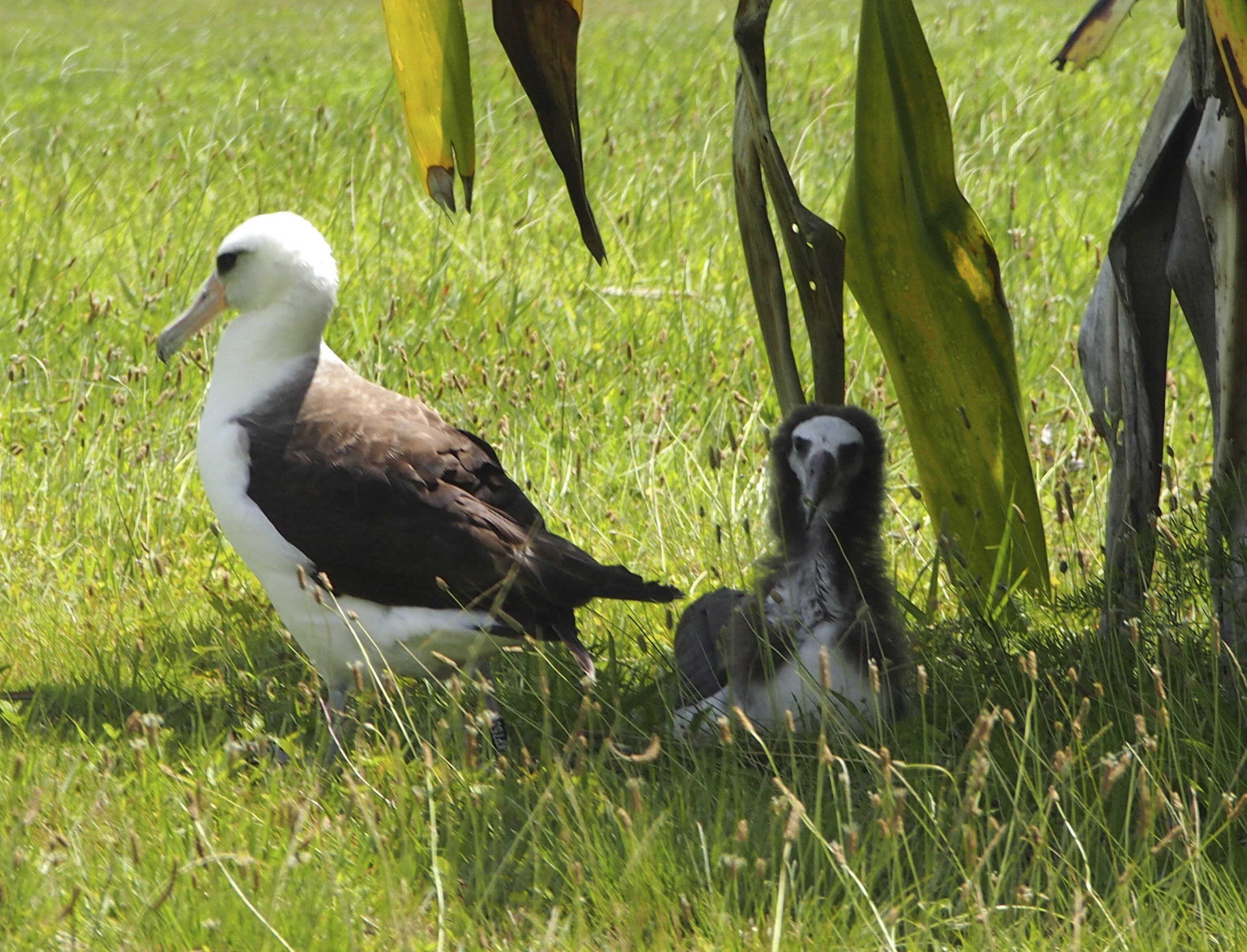
Zorro had a visit from one parent 9 days before he fledged.

Zorro and mom

Zorro and mom

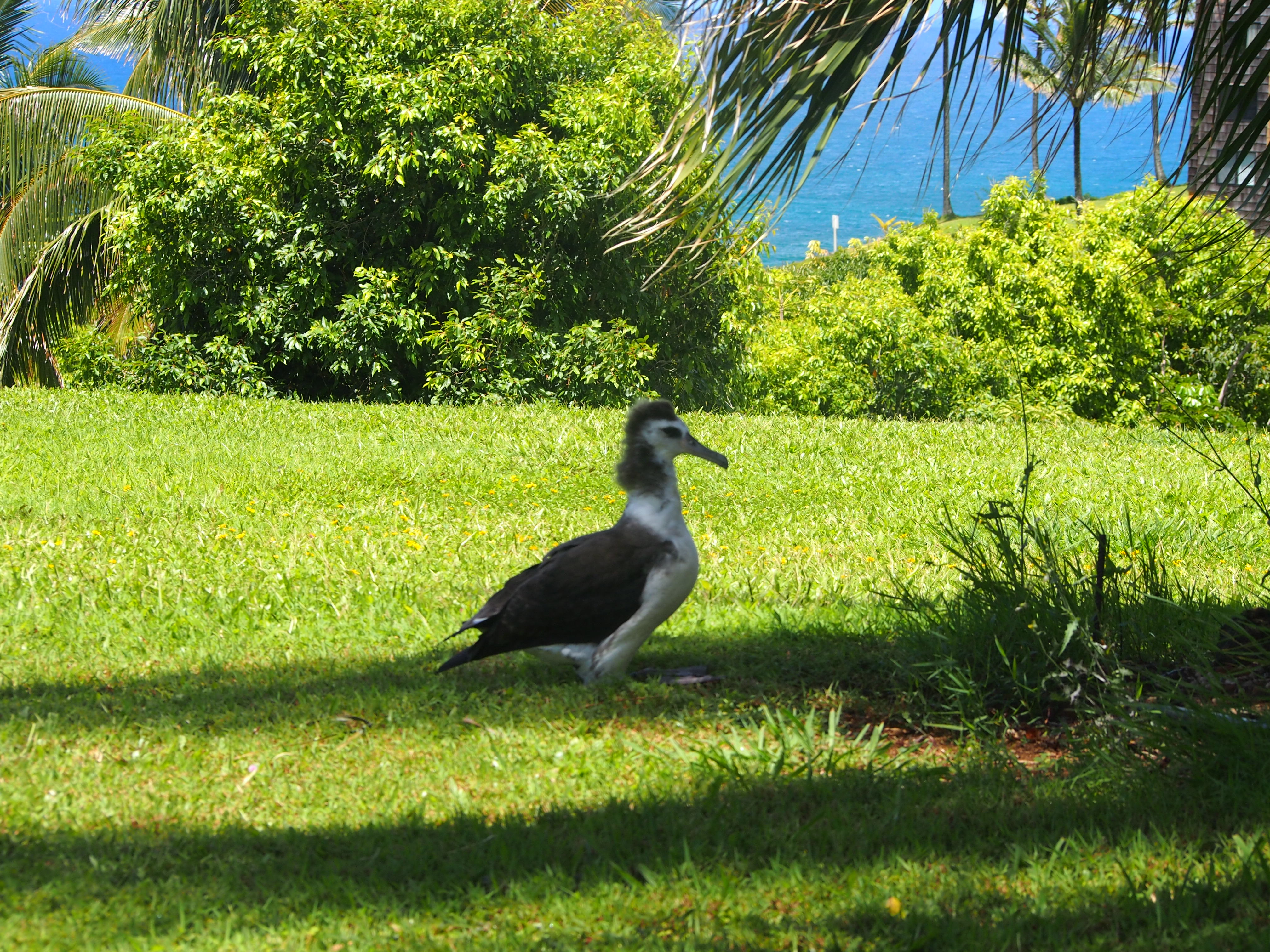
On a Sunday morning he walked down the golf course to the ocean bluff.  Golfers did see him, but none of them paid much attention to him. Picture a large white seabird walking slowly down a fairway, largely ignored by people hitting a small ball along the grass. The game may be important in their human world, but it does not even register with any albatross senses.

He walked with the confidence of a being that feels the ocean breeze blowing his way and finally hears the message it brings to leave everything familiar and venture into new territory. This is a bird who stayed in or close to a smallish patch of uncut grass for his entire life. What is it that called him, how did he know that it was time?

Lisa, who lives here part of the year in a house that overlooks the 6th fairway saw him coming and watched him from her balcony.  She knew what his walk down the fairway meant and she was not going to miss any of it. It took him a while to walk slowly all the way from his nest near Tee 6 to the bluff near Hole 6.  With little hesitation, he took off. She said that from a distance it looked as though he had just stepped off the cliff.

To a human this seems to be such a brave act. Is it courageous if the actor cannot consider possible bad outcomes? Does the albatross chick feel any fear? We cannot read their minds, but I have seen chicks that spent a couple of days near an ocean bluff before running off into the air. Why don’t they always fledge immediately when they have left their homes and any hopes of future meals from parents? Is the wind less than perfect, is there some aspect of fledging that we humans are unaware of that can halt their first steps into adulthood? Or do some of them feel a fear of the unknown that others can overcome more easily?

Here is one more fledging story to confuse you.

One morning in 2006 a chick named Hanae fledged from a popular take-off bluff. Everything seemed fine, although we could not see him over the ocean because trees down below us obscured our view. By the end of the day, Hanae was sitting back in his nest, covered in little bits of shrubbery. It took him all day to walk uphill from wherever he came down. Why did he decide to go back? How did he know where to go? He was not following an ocean breeze, he was making his way back “home” over unfamiliar territory.

Hanae rested up for two days, then left again. He came back in 2011 and has returned every year since then.

Once again I feel as though instead of adding to my readers’ knowledge about these birds I am just throwing more questions at them. I always start out by sharing what I have learned, and I seem to end up by voicing my frustration at seeing my solidly woven foundation of knowledge of albatross behavior slowly being pulled out from under my feet.

Before you know it I will lose my footing and start to slide down the hill. But I think the strands of new information that I get by observing them every day and recording that data in a way that makes it easy to see their connections to each other and to Princeville will help me to keep my footing and to expand our understanding of the rich variety of behavior we can see in these birds.

This is a project worthy of lifetimes of study by curious humans.
 

Posted in Uncategorized | 2 Comments

Fledging, week 2

The second week of fledging it was Peg’s turn to leave.  I wrote about Peg on May 27th, she is the chick who was spending time sitting with her 4-year old sibling, Junior.  Three days before she fledged, her mother came back and spent the next 2 days sitting about 50 feet away from her.  According to my neighbor, Marion, Mom tried over and over to feed her chick, who had moved away from a favorite spot near the house and was sitting at the top of a grassy area that sloped down towards the ocean.  Peg was having none of it.  She continued to run  away from her mother, who finally gave up and flew away.

Peg contemplates the ocean

Peg contemplates the ocean

I often hear people say that chicks leave because the parents stop feeding them, but Peg chose not to eat any more.  In order to fledge, the ratio between wing length and body weight must be perfect.  Do the chicks have an instinct that tells them that it is time to stop eating?  Furthermore, I have seen parents come back to the nest after the chick has fledged.  I would assume that they do not know that the chick is gone and have brought him a meal.  Why else waste the time and energy to come back here so late in the season?  They do not come back now to meet their mates, that happens in November or December.   Once again I will repeat one of my albatross mantras, “There is so much that we do not know about these birds.”

My Bush Baby was the next to fledge, and if anybody saw him leave I have not heard about it.  I never saw this chick outside of the protection afforded by the overgrown weeds and bushes that surrounded his nest in the rough next to fairway 6.  If he tried his wings out, nobody that I know ever saw it.  I would bet that he did do some practicing, there are just too many minutes in a day and night to see his every movement.

And so two more albatross disappeared, one who showed all signs of getting ready to fledge, one who I would nominate for “most likely to blend into his environment so you hardly notice he’s there.”  Will they both survive life on the Pacific Ocean?  If so, when will I see them again?  That is what I love most about doing these observations, I get to know them as chicks, they leave here for at least 3  years, usually longer, then I get to see many of them return as adults.  Some of them quickly assert their adult personalities.   Some blend into the background and observe the older birds to learn albatross etiquette, how to interact with the others, how to make an impression on them and not scare them away.  If you saw my film of Tater’s first time back, you will remember that when he tried to display before he had his land legs, he actually fell against the other albatross.

Not cool.

For birds that spend so much of their lives alone out at sea, the days they spend on land trying to meet a mate are just as important to their leading a normal albatross life.  It seems to come more easily to some than to others.  Every year this admittedly sentimental human feels sorry for some birds because try as they might, they just cannot seem to attract a mate.  What is different about them?  I do not think we will ever know the answer to that one. It is the nuances of albatross behavior that most intrigue me, the behavioral differences that make them so interesting.  That is why I do not mind checking on them every day, the subtleties can only stand out if they are seen against a background of many hours of observing many different birds.  And after 9 years of almost daily observation, I can still say, “I never saw an albatross do THAT before!”

Posted in Uncategorized | Leave a comment

Fledging, Week 1

I collect albatross data almost every day, but occasionally the unfeathered part of my life intrudes and I have to spend time on the non-ornithological part of it.  The first week of fledging, there was a day when I was not able to observe the 5 chicks on the golf course. I returned the next day to check on them.

In the center of the golf course is a nesting area where two couples had been raising their chicks.  The fact that the lawn was mowed where I had grown accustomed to seeing one of the chicks indicated to me that he was gone before the mower guys finished their jobs in the early morning.  He had the perfect nest area, across the golf cart path from the ocean bluff, with a beautiful view of the Pacific and constant sea breezes.

The chick was gone.

Chick contemplates fledging

Missing chick

I walked around that end of the golf course checking the areas near the fairways, just in case he wandered off and got stuck somewhere.  I had never really seen this chick trying out his wings, he was always just sitting there when I arrived to check on him.  Even checking every day I miss so much.  I found out that others  had seen his practice runs.  He disappeared that morning and I have not heard of anyone who saw his departure.

The next to fledge was a chick from my neighborhood, Lexi.  Albatross chicks often cool down by raising their feet up off of hot surfaces, like my neighbor’s lanai, which is where Lexi was resting in this photo.

Lexi at rest

Lexi at rest

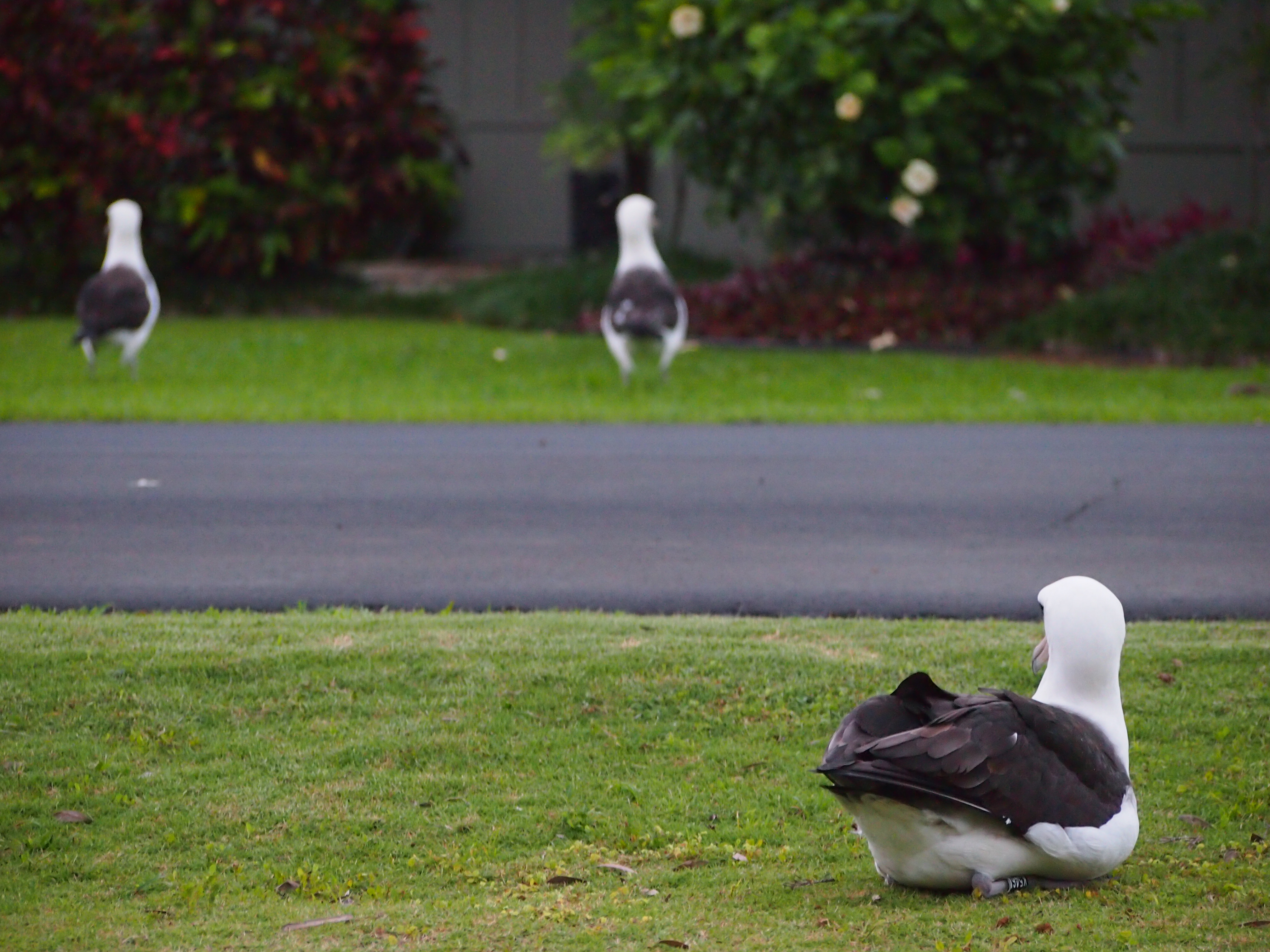
Recently I had seen her close to the street.  More than once she walked across to the yard that was her half-sibling’s territory; they both avoided getting too close to each other.  Albatross chicks generally do not enjoy each other’s company.  I am fairly certain that these two share a father, based on a neighbor’s observation, a neighbor with binoculars.  I know that some people think they can identify an albatross without checking the leg band, but no field biologist or trained observer would try this.  They really do all look alike.

I saw Lexi one morning and she was gone by the early afternoon.  Which way did she go?  Nobody knows, unfortunately, she left when none of us were looking.

The third to fledge, a bird I called Miracle, left less than an hour after I last saw her.  She was raised by two mothers who had never before had a fertile egg together, the only time they raised chicks was when they were given fertile eggs from the albatross colony at the Pacific Missile Range Facility.  Again, I never saw her trying out her wings, but I know others who did see that.  Miracle had become nervous about being near humans.  I stayed far away from her.  I was about 50 feet away when I took this photo, but she was looking straight at me.  In general, if you see a photo of an albatross and the bird is looking straight into the camera, the photographer was standing too close.  Fifty feet is not usually “too close” but this bird was definitely keeping a wary eye on me, so I left.  Rule number one of good observing: leave if your subject is spending most of his time watching you.

KP753 with Miracle

KP753 with Miracle

Week one of fledging in Princeville.  While the order in which chicks hatch can be predicted from the date when the egg was laid, we cannot predict the order of fledging.  I have numbered the nests according to when the eggs were laid, and of the 10 nests in Princeville they  left in the following order last week:  chick 5, chick 6, chick 4.

Posted in Uncategorized | 1 Comment

Fledging time

I have been asked when the chicks will be fledging.  I thought it would be interesting to see when they fledged in the last 8 years.

year            first fledged             last fledged      

2006                June 25                     July 30

2007                June 20                     July 22

2008               June 28                      July 31

2009                July 2                         August 21

2010                June 20                      July 11

2011                 June 28                      August 5

2012                 June 21                      August 13

2013                 June 18                      July 27

As you can see, the earliest fledging date so far was June 18th, the latest was August 21st.

One interesting note:  they do not fledge according to age, so it is impossible to predict who will leave first.

Posted in Uncategorized | Leave a comment

Albatross families

I have said before that nobody really knows if an albatross can recognize a relative.  They do have a very good sense of smell, something which is quite unusual for birds other than carrion eaters.  Is it possible that they can recognize individuals by smell?  If so, they may feel more comfortable around their relatives.  This came to mind when my neighbor, Marion McHenry, told me that her chick has had visits from his 4-year old sibling.

An albatross observer can tell you that the chicks often object to having strangers sit near them.  When they are uncomfortable around an adult they often assume a defensive posture, tucking their faces into their bodies:

In this photo taken by Marion, we can see how relaxed Peg the chick is, even though older sibling Junior is sitting as close as a parent would.

Peg sits with Junior

Peg sits with Junior

Marion told me that a parent was sitting nearby during one of these visits.  The parents of these two birds are a couple I know as Mr. and Mrs. Clackypants.  My sister named Mr. Clackypants when he was being banded.  He objected loudly to the lack of respect shown to an albatross of his stature, and clacked his bill together vigorously to make his feelings known.

Mr. Clackypants, also known as KP639, was originally banded in December of 1989 at the end of the road where his nest is located.  We cannot tell the age of an albatross, so when an adult is banded he is assumed to be 3 years old.  However, he was one of the first albatrosses to nest in Princeville, in the 1989-1990 season.  He must have been at least 5 when he initially nested, so he is probably 30 or older.  That nest failed.  He was rebanded in November of 2004.  Sometimes the original bands start to show wear and tear and need to be replaced.  He received his official USGS (U.S. Geological Survey) band along with an auxiliary band that can be read by someone using binoculars.   We are missing a lot of data about their early nesting years, and we do not have more records for him until he nested with his current mate, KP676.

Speaking of Mrs. Clackypants, she was banded at the Kilauea Point National Wildlife Refuge as an adult in January of 1988.  There is no record of her until the 1991-1992 season, when she nested with an unknown mate on the same street where her nest is located now, so she is probably at least 28.  She had at least one chick before forming a bond with Mr. Clackypants. These two have been nesting together since at least 2004-2005.  Peg is the sixth chick they have raised together since I have been observing them.  They are exemplary parents, working tirelessly to feed their chicks.  Marion has even observed the chick turning away from an offer of food, he was already so full from his last feeding. Mr. Clackypants is probably the father of other chicks in my neighborhood.

His nest area is located on a bluff that is a very popular landing and take-off spot for the local albatrosses.  On two occasions he was seen jumping on females from female/female couples who went on to have fertile eggs, and their chicks fledged successfully.  The male nesters are usually the first birds to return in November, and they will go after other females while they are waiting for their mates to return.  There is a local male who most likely fathered the chick being raised by two females across the street from the yard where he and his mate are raising Sochi.  My neighbor observed him mating with one of the females at the nest, and used binoculars to get his band number for me.  Thanks, Brad!

Since the nests in Princeville are so spread out, we do not have as many fertilized eggs as the places where the nests are protected in fenced in areas.  When some females return they run like crazy when approached by a male, so they are not very likely to have good eggs.  It is always sad to see a couple sitting on their nest day after day, devoting hours of faithful incubation to a chickless egg. So thank you, Mr. Clackypants, and all of the other males who have helped our female/female couples to have fertile eggs.  Your contribution to the survival of your species may be unintentional, but it is not unappreciated.

Posted in Uncategorized | 1 Comment

Westin

As of today I have seen 13 of the 18 chicks who fledged in 2010.  This is my 9th year observing these birds, and I have never seen so many four year olds.  They must be a very healthy group of individuals.  I am guessing that they will have many children through the years.  It makes me very interested to see next year’s group of 4-year olds.  There were 10 chicks who fledged in 2011.  That year I had an unusual number of regular nesters either not nest or nest and abandon their eggs.  Was it just a coincidence that so many did not nest?  Was there some type of occurrence, such as a decline in an important food source that caused this behavior?  If so, could this affect the survival rates of the chicks from that year?  So many questions, so difficult to get the answers to them.

When a chick fledges I write that in my field notebook, then on the Excel chart I keep for each year.  I yellow out the squares for the fledgling so I can easily see how many have left.  I carry lists of the chicks from each year and keep mental notes each season about which band numbers might indicate that an albatross has returned to his home for the first time since fledging.  Some birds lead rather unremarkable lives as chicks, close to a bluff that they are drawn to by the incoming ocean breezes when instinct pulls them away from their homes, and they take off with a minimum amount of fanfare.  The ones I remember most clearly are the chicks who wandered away from the easy path, the ones who chose to find a more complicated route to the ocean.

Seeing Westin sitting on a lawn not far from where his parents raised him reminded me of his unusual path to fledging.  His nest was next to the Prince Golf Course, across from a street lined with a number of condos.  At the end of the street is the Princeville Westin Hotel.  This is one of the busiest streets in Princeville.

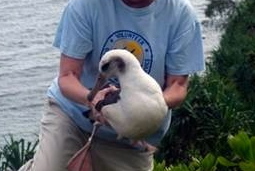
At the end of June in 2010 I got a call about an albatross chick that had shown up at the front door of the Westin.  I asked Bob Waid to give me a ride and was prepared to catch the bird, wherever he was now, and take him to a safe fledging spot. I never know what I will find when I answer one of these calls.  In this case, I was directed to the engineering department at the Westin.  The albatross was boxed and ready to go!  One of the employees there had put a towel over him, picked him up and put him in a cardboard box with holes in it to allow air in.  I generally do not encourage inexperienced people to pick up any albatrosses.  The chicks are not as likely to bite a person as an adult is, but it is possible to injure a wing if the bird is not handled correctly.

In this case, the chick was fine. I looked up his band number on my list of chicks to find that this bird had managed to get himself across the Prince fairways and then walked down the busy street before presenting himself at the Westin’s from door.  His nest had been on an empty lot and he had not been named, so the obvious choice for his name was Westin.

Westin comes home

Westin comes home

If Westin had followed the path both of his parents regularly took to get back to the ocean his fledging would have been uneventful.  They simply flew down the golf course, straight into the ocean breeze.  I have no idea why he did not go that way.  Perhaps the wind had died down when the urge to leave overpowered his attachment to the area near his nest.  I cannot begin to imagine what motivated him, he is a bird, after all.  Instinct guides these chicks, sometimes to safety, other times to awkward situations.

Thankfully, there are many humans who love these birds, so the odds are good that a caring person will see one who needs a bit of help to find his way out to his new home, the Pacific Ocean.

I look back over the last nine years and remember some of the people who helped the occasionally errant albatross.

I see the lady who escorted a chick across Ka Haku Road, then called to tell me where he was.

I see the truck driver who saw me bend down to pick up a chick who started walking inland.  He called out, “Hey, you’re not supposed to touch those birds!”

I see the Princeville Patrol officer stopping to escort a chick out of the middle of the road.

I see the employees at the Cliffs condos, holding hands and walking towards an albatross who had landed on the tennis court and could not fly out of the fenced in area.  The bird had no choice but to walk out of the open gate.

I see the people who sat on lawn chairs and kept an eye out for a chick who seemed determined to walk down a vertical hillside to a rocky beach below.

There have been many more. Thank you, Friends of the Albatross.  Your love of these birds guarantees that they will have a happy, safe future to look forward to in Princeville.

Posted in Uncategorized | 2 Comments

Class of 2010

March and April are the months when I am most likely to see albatrosses that fledged from Princeville and are returning for the first time.  The Class of 2010 has been the source of most of my new sightings this year.  So far, out of 18 fledgelings, I have seen 11, and of these I have seen all but one for the first time.  I have even seen one from the Kilauea Point National Wildlife Refuge and one from Na Aina Kai Garden.  Two of the Princeville alumni had such interesting experiences while fledging that I thought I should share their stories.

Niko was a big, healthy chick who lived in my neighborhood.  When he heard the call to fledge, he walked down the end of the road to land overlooking the ocean, as many chicks have done before him.  Instead of going straight out onto a bluff where the breezes off of the ocean can give a fledgeling the boost he needs for a takeoff, he took a sharp left and walked down into some heavy underbrush.  Fortunately, a vacationer saw him and got a photo of him before he began his trek.

NIko pre-trek

NIko pre-trek

He went down into a canyon greenbelt between my road and the condos on the other side.  It was such thick vegetation, I was afraid that he would hurt himself trying to plow through, or get hopelessly lost. Two days later the vacationer called me.  She had seen an adult albatross at the condos across the way, and he seemed to be having difficulty trying to take off from the bluff.  He kept sliding down the hill.  She was afraid that he would slide all the way down the bluff. My friend and neighbor, Bob Waid, drove me over there.  Fortunately, the bird was not too far down the bluff, so I climbed down and grabbed him, then carried him up the hill. It was Niko!

Niko post-trek

Niko post-trek

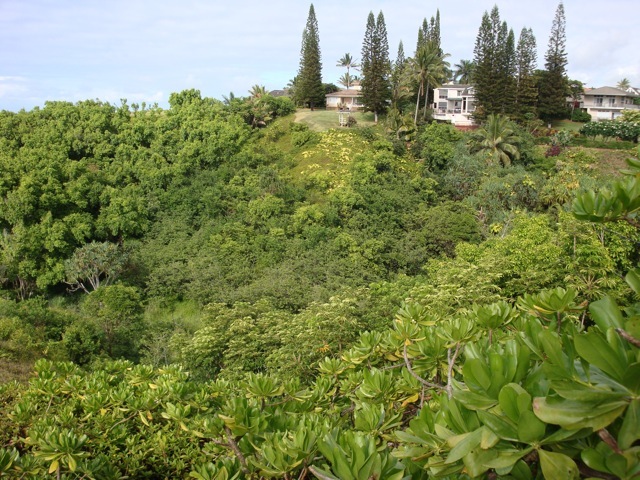
As you can see, he lost most of his chick feathers in the brush during his 2-day trek. This is a photo showing where he started out (near the house at the top) and where he ended up (where I stood when I took the photo.)

Niko's trek

Niko’s route

We brought him to the property that was blocking the breezes to the bluff that he was trying to fledge from.  Almost immediately he felt the wind off of the ocean, ran into it and took off.

Why did he head down into the green-belt when it was time to fledge?

Put that on the list of “Things to ask an albatross when we learn to speak their language.”

Or maybe, “The lengths an albatross will go to just to keep my life interesting.”

Posted in Uncategorized | 4 Comments

a happy ending

Sometimes when I have been checking albatross chicks and the non-nesters that are attracted to them it starts to feel like a routine, as though everything is proceeding smoothly according to the Master Plan of albatross activity in Princeville.

Then I get The Call.  Someone is reporting that an albatross may be injured, that he doesn’t look right.  He may be holding his wing oddly, or limping, or any variation on the theme.  So when the manager of the Cliffs condos called to report an albatross that seemed to be having difficulty walking, I had visions of all kinds of catastrophic injuries.

The albatross was sitting on the side of one of the large lawns that are bordered by the condos on one side and ocean bluffs on the other.  He stood up as I approached.  Both legs were identical, the same color, no swelling, and he was not favoring either one.  He seemed to be standing just fine.  Then I saw the tiniest bobble, as though he might sit back down suddenly at any moment.  I had recently seen a similar albatross movement on the golf course, when my old buddy Tater returned to land for the first time since fledging from Princeville.  I checked Barney’s band number against my list of all of the chicks who had fledged from here in the last 10 years or so.  I keep track of when (or if) I saw them again in Princeville.

It was Barney!

Barney's first day back

Barney’s first day back

Barney was raised in a nest next to my neighbors’ house.  His father was only 6 when Barney hatched, very young for a parent.  My neighbors, Bob and Joyce, saw him fledge early one morning in late June of 2010.  Barney’s grandmother currently is raising a chick on the golf course.  She relocated there after her mate disappeared in the 2008-2009 season.

The management at the Cliffs is very supportive of local wildlife, and they allowed me to put up a sign telling people about Barney and asking them not to get too close and not to feed him.  The first time back on land is a big event in the life of an albatross, we want them to have the least amount of stress possible.

He was gone the next day.  I left the Cliffs to check on some chicks on the golf course.  A couple of adults were in the area.  Non-nesters often hang out near the chicks, it is definitely a great place to meet other birds.  One of them was Barney!  He was walking like an old pro, and he was not very far from his grandmother’s chick.  He definitely needs to practice his displaying techniques, but he is only 4 years old and has many years to perfect his moves.

That’s Barney on the right in this photo.  His partner is trying to get him to participate in the display.  Barney was trying to figure out what he should be doing, which way to move his feet, what he should say.  He is just beginning the long process of finding the perfect nesting partner. He is only four, he has plenty of time to learn the moves.

Barney's first display

Barney’s first display

Welcome home, Barney.  May you live a long, peaceful life and raise many healthy, happy chicks.

Posted in Uncategorized | 4 Comments

Our latest nestling

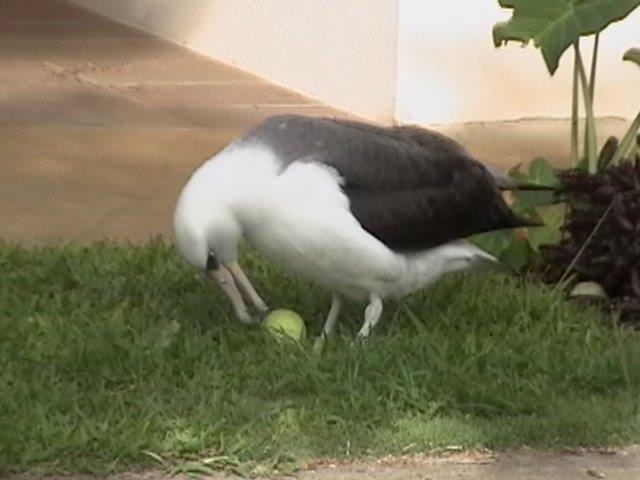
This week I have been observing a most unusual nest.  It is long past nesting season for the albatrosses.  I have never seen a nest built past December, nor have I seen a fertile egg laid past the third week in December.  Occasionally an albatross who is not nesting will sit on an abandoned, infertile egg, or even on an inanimate object.  One of the successful nesters in my neighborhood once tried briefly to incubate a tennis ball.

730 talking to tennis ball

730 talking to tennis ball – photo by C Brookman

I have never seen an albatross spend more than an hour attempting this kind of incubation.  I have also never seen an albatross build a new nest in February or March.  Until now.  We have a bird who has built a simple nest around the sawed off cap from the end of a PVC pipe.  This nest was approximately 2 weeks old when I first saw it, and as far as the homeowners know, the bird did not leave it during this period of time.

I went to check on it yesterday, and found a male albatross named Kaulele interacting with the “nester” as she careful tended to her “egg,” moving it underneath the brood patch on her abdomen that keeps an egg in close contact with warm skin.  I know that the visitor is a male, so I am assuming the one on the nest is a female.  Kaulele is 7 years old and has never nested before.

Why is she staying on this nest, on an object that has rough edges and looks uncomfortable, nothing like an egg?  Has she ever nested before?

Will the male take over incubation duties for her or does he know that there is something wrong with this picture?

UPDATE:  Kaulele has taken over incubation duties of the PVC cap.  How is that for a first-time nesting experience?  I am hoping that he and his partner return to nest next November.  They have chosen a good area, where the residents all keep an eye on the birds and the chicks can easily fly/walk down the golf course to an ocean bluff, to spread their wings and launch themselves into the updrafts that will help to carry them safely out over the ocean.  Of course, this does not explain the chick who made his way across the golf course to one of the busiest roads in Princeville and walked on down to stand patiently at the lobby door of the Princeville Westin Hotel.  I think they do things like this so humans like me will never get to the point where we think we  know everything about them.

Note to all the albatrosses:  I retreated from that point long ago!  I’m the one waving the white flag!

Posted in Uncategorized | 2 Comments

Happy Valentine’s Day!

Among the chicks who fledged in 2008 was one named Valentine.  She was the third chick her parents had raised; they went on to raise numbers four, five and six, setting some kind of a record for most chicks raised without a year off in between.  They have always nested in the front yard of my neighbors.  I am happy to see them there because I know that they are appreciated and their chick will be safe.

This year her parents did not nest.  However, they have been together many days here, more than 30.  The most successful nesters seem to be the ones who spend quality time with each other in years when they are not nesting.  On this day in January, I found them in the yard next door to their usual nesting place.  Sitting in the yard across the street from them was Valentine, just watching them.  At one point, her mother walked half-way across the street towards her, looked at her, then walked back.

Valentine watches her parents

Valentine watches her parents

What were they thinking?  How can we possibly know?  I say we just enjoy observing these birds and leave the motives up to them.

Happy Valentine’s Day to Valentine, to her parents, to all of the other albatrosses in Princeville and to all of the human beings who love them.

Posted in Uncategorized | Leave a comment