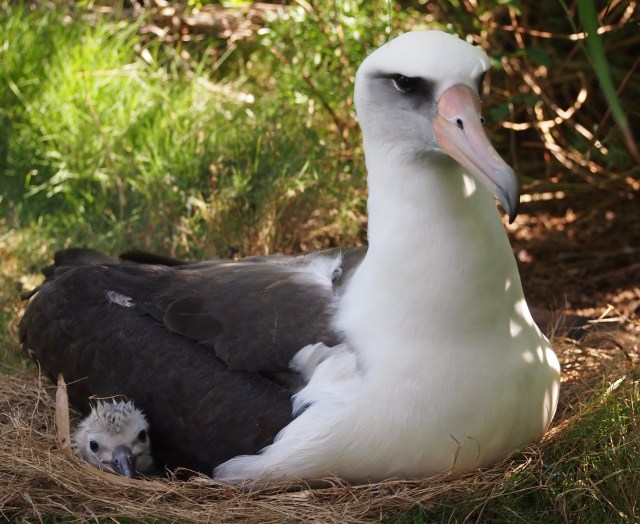
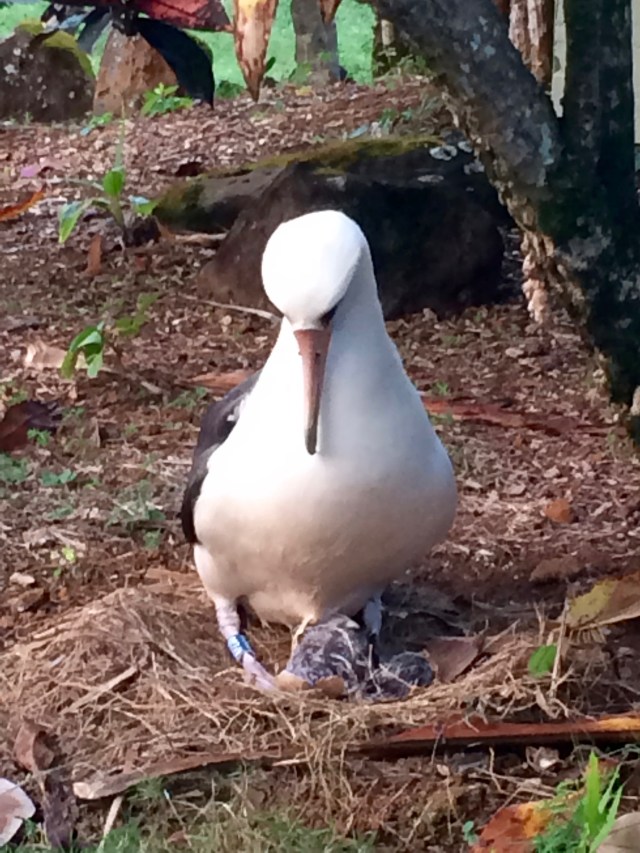
Meal time in my yard

One of the questions I am asked most frequently is, “How often are the chicks fed?”  There is no easy answer to this.  Each parent is on a different schedule, and their feeding times vary from week to week.  And of course, unless someone is watching them 24 hours a day, 7 days a week, nobody will see all of the feedings.  I was once awakened very early in the morning by the sounds of Kirwan, the chick in my yard, begging for food, and I could hear him being fed.  I would not shine a flashlight on the birds so I do not know who was there, Mom or Dad.

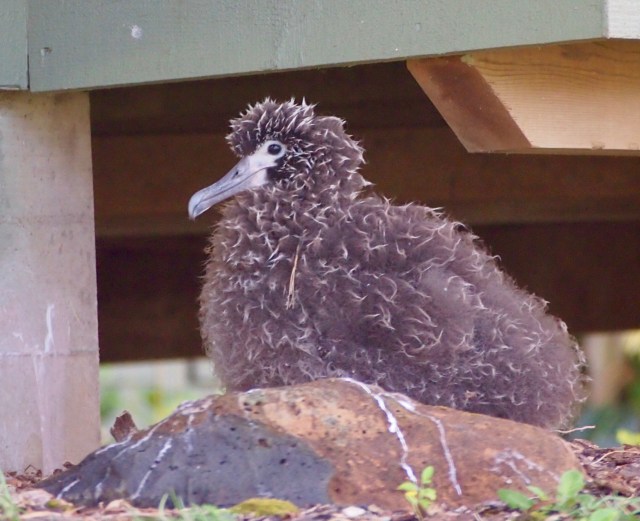
A few days ago, Roger, Kirwan’s mother, returned to feed him.  Kirwan had moved around the corner from the nest he had hatched in.  He was now in my backyard, sitting on a stump.  A stump is actually a pretty nice thing to sit on.  It gives you a slightly elevated view of the world, and you are less likely to end up sitting in mud when it rains.  Kirwan often sits in the rain.  With waterproof feathers, that is not a problem.

Kirwan on his stump

Kirwan on his stump

Roger circled around a few times, much to the delight and anticipation of Kirwan, and landed not far from him.  She vocalized as she walked within inches of him, but she did not even turn to look at her chick.  She walked around the corner to the original nest, as Kirwan frantically tried to keep up behind her, and she would not acknowledge his presence until she had reached the old nest.

Roger and Hanai will only feed Kirwan at the original nest site.  On Midway, where the nests are crowded together, this might be a survival technique.  The parent wants to be certain that the chick getting the food is his.  Every meal is important to these chicks, they cannot afford to miss a meal, and the parent cannot easily find replacement food.  Very little time is wasted, too.  The parents come and go so quickly now, every minute counts.

Not all of the parents of chicks in Princeville feed their chicks at the original nest.  In some cases the chicks have not moved very far from home, and there are no other chicks nearby so he is clearly visible.  I would hesitate to make a statement like, “They always” or “They never,” because I actually see very few feedings.

When I edited a little film showing Kirwan’s latest feeding, I noticed something that I did not see when I was taping it.  At the end of this film you will see a tentacle in Mom’s mouth.  Kirwan has grabbed it and is trying to pull it out, but Roger sucks it back in.  Maybe it was a little something she was saving for herself.


Roger stayed just 15 minutes to feed her chick, then she walked briskly down the street towards a favorite takeoff point on an ocean bluff.  Kirwan returned to his stump, watching his mother as she walked away.

The parents are coming and going so quickly now that I rarely get to see them.

And I think their chicks would say the same.

Posted in Uncategorized | 9 Comments

Thanks to the golfer….

…who did not keep this ball in play.

Chick and golf ball

Posted in Uncategorized | 2 Comments

The meaning of “cute”

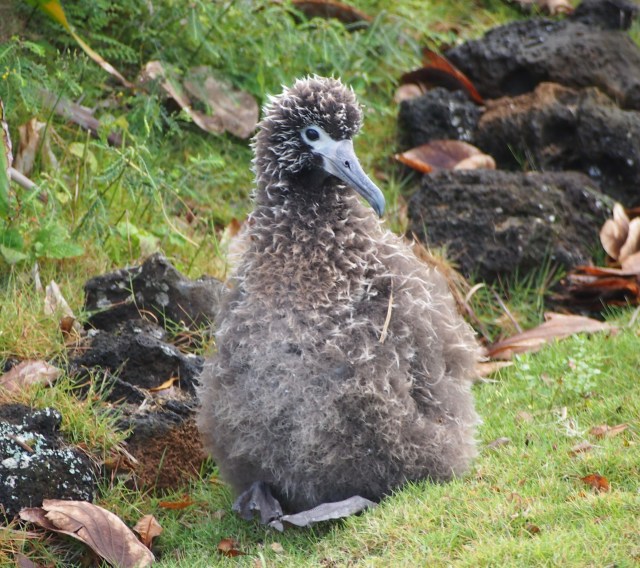
Behold my nominee for a place on the list of the all-time cutest chicks in Princeville.

Kirwan contemplates life

Kirwan contemplates life


This is my garden chick, the Irish chick, Kirwan.

At this time, Kirwan mostly walks plantigrade.  Birds are digitigrade walkers, they walk on their toes.  Most of the chicks are not quite up to that,  they walk plantigrade, like humans and bears; weight is borne on the whole foot.   Sometimes people think birds have backwards knees, but they are actually seeing the ankle and heel.  In this photo of a father and chick, the band is technically on the bird’s foot, not his leg.  The joint above that is his ankle, not his knee.

KP618 and chick,1-31-15

KP618 and chick,1-31-15


Lately Kirwan has been waddling down to street level to give his many fans a treat: a glimpse of his endearingly chubby, clumsy self.  His plantigrade locomotion just adds to the overall impression of a kid who has not quite stepped over into the realm of adulthood.


He ended up sitting on his rocky throne, surveying his kingdom of admirers.  He had left souvenirs of previous visits to this spot.

Kirwan surveys his world

Kirwan surveys his world


For those of you who walk by my house to see Kirwan, who is now featured on the tour bus that goes through my neighborhood, you may have to look around for him now.  He is exploring his world and strengthening his limbs.  If you are very lucky, you may see him being fed by his mother or father.  If, on the other hand, he is hiding his head or pecking at an adult, that is one of those annoying non-nesters that stop by periodically to bother him on their neighborhood patrols.

He does not “suffer fools gladly.”


Posted in Uncategorized | 7 Comments

Siblings

Today I saw an adult approach a golf course chick.  A quick glance though my binoculars and I could tell from the band number that this was the chick’s older sibling, a 5-year old I had named Gaga.  I had chosen that name for her when she was a chick because of the artistic arrangement of her new, adult feathers.

Gaga 2011

When I saw Gaga walking towards her sibling, the sentimental part of me that likes to think that albatrosses are just like us thought, “This is the part where Gaga sits close to the chick, who snuggles in happily next to the older brother or sister, and I will see definitive proof that they can tell who a relative is.”

Take a look at an adorable show of sisterly or brotherly love:


Perhaps they are more like us than we would like to admit.

I do not speak albatross, but I think the last thing the chick said was, “Take a hike!”

Posted in Uncategorized | 4 Comments

Playing house

I was going to write one or two lines about an albatross couple playing at being nesters, with a cute photo, of course, but as usual this couple brought to mind so many other things about albatrosses that I became weighted down by the bigger picture.

I think that the purpose of my blog is to present life histories of individual albatrosses, the stories I observe every day; not to gloss over that and to just write stuff that has already been well-written in books like Carl Safina’s “Eye of the Albatross.”  Why bother observing them if I do not share the details of how I have seen them living their lives?  Furthermore, since there are some “facts” about albatrosses that are not actually supported by my observations, I would rather let their behaviors speak for them.

This ran through my mind when I was observing one of my favorite individuals, Charlie.  He has always been an interesting bird.  I speak not just for myself, but for neighbors who have come to know him.

First of all, Charlie’s parents are not typical.  He had two mothers.  About 30% of the couples here are female/female couples.  One of Charlie’s mothers was originally banded at the Pacific Missile Range Facility, the other was banded as an adult in Princeville in 2005.

The only times Charlie’s moms ever had a viable egg were when their infertile egg was replaced with a good one from the PMRF.  This happened three times.  Once the egg broke during incubation, once their day-old chick died, and the third time, in 2009, Charlie hatched.

So many times I have seen couples pick out a spot to nest in the following season.  They meet each other there for a week or more, then both return to that spot in November.  Charlie’s mothers did not do this in 2010-2011.   They had not chosen a meet-up spot, so when they returned from their time spent flying over the ocean the following season they were always sitting in different places.  Sometimes they were both here at the same time, but they missed seeing each other.

Could that happen in a crowded area like Midway, where there are usually close to half a million nests?  Are there ever couples who do not find each other when they return to their nesting areas there?  It may depend on how close they are to each other when they first land.  Charlie’s mothers were never actually very far apart, as the albatross flies.  But when there are houses in between, it becomes more complicated.  Each bird seemed to be waiting for the other one to appear, but they did not get up and walk around and look for each other.  I did finally see them together once, in February.  Sadly, I never saw one of the females again after that day in 2012.

The other one has returned each year, spending many days here, in fact.  She has occasionally displayed with other birds, but I have not seen her spending time with one special bird in the quiet contact I think of as “married couple behavior.”  Most of the time she is sitting by herself, often on her favorite corner, watching the albatrosses that fly overhead, occasionally greeting one or even displaying with one.  But the overwhelming majority of her time here she spends by herself.  That is something that they are not supposed to do, by the way, sitting here in Princeville, not doing much, when they can be spending their time getting food, or at least in the energetic pursuit of a mate.  She has been here anywhere from 41 to 62 days in a season, often spending the night here.  Hasn’t she read the books?

Charlie lived in the middle of my block., away from the ocean.  When it was time to fledge, he flew into the wind, as the chicks always do.  Unfortunately, the wind was blowing the wrong way for fledging, and he flew away from the ocean.  My sister and I rescued him as he was flying further away and brought him to an ocean bluff, where he fledged.

This is why when someone tells me that they would love to have chicks on their property that is not on an ocean bluff, I advise them that it would be a selfish thing to do.  My friend Bob Waid calls it “lawn ornament albatrosses.”  The chicks need to be near the ocean.  They will fledge into the wind, whichever way it is blowing.  If it is not blowing off of the ocean, they can end up in some dangerous places.  During fledging season I check on the chicks every day, and residents, Princeville Patrol officers and visitors to Princeville report anything that does not look right.  One time, a chick who had grown up within sight of the ocean ended up a mile away in the parking lot of landlocked condominiums.  Another time one ended up by the side of the highway.  A ranger from the KPNWR happened to drive by, so the chick was taken to a safe fledging spot.  These birds will not automatically fly to the ocean, they fly into the wind.  They need help if they get lost.

Furthermore, if someone living on an ocean bluff tries to encourage albatrosses to nest there, they had better be willing to put that part of the land into a conservation easement, because the birds will keep returning to that spot for years to come.  If somebody buys it who wants their dogs to run around there, there is nothing anyone can do about it.  We have to look beyond the lifetime of one owner to see what will happen if someone buys it who is not crazy about albatrosses.  Unfortunately, being able to afford to live on land overlooking the ocean does not automatically come with an appreciation for wildlife.

One person who has set land aside for the use of current and future albatrosses is Mrs. Joyce Doty, who built the Na Aina Kai Garden in Kilauea and is leaving it for future generations of human visitors and albatross residents.  She deserves the thanks of everyone who loves these birds.  The albatrosses on her property live in correctly fenced colonies and those birds will always be safe, now and in the future.  Furthermore, there are volunteers dedicated to observing them and recording the data for posterity.

Thanks to all of you!  If anyone wants to see a colony of albatrosses that live on Kaua’i, I recommend Na Aina Kai Garden.

And, as promised, here is a photo of Junior showing Charlie how cute she looks in a “nest.”  I hope to be able to share a photo of their real nest next season.

Charlie and Junior and their "nest"

Charlie and Junior and their “nest”

Posted in Uncategorized | Leave a comment

Portrait of a new father

Maluhia hatched in a nest on the golf course in 2008.  His father had separated from his long-time mate and had this one chick with a different female.  The following year, he went back to the previous mate.  Yes, they really are more interesting than most people give them credit for.

Maluhia means peacefulness.  Somehow, that word does not describe this albatross.

He first came back when he was 4.  For the first couple of years, he spent some of his time on the part of the golf course where his nest was located, and some on a different part where he now spends all of his time on land.  In the 2013-2014 season, his personality asserted itself in a big way.  I would always find him within about 20 feet of where his nest is now located. There was a chick in that area, and Maluhia took it upon himself to defend the little one from all intruders, especially me.  All comers were greeted with ferocious clacking.  The first time I saw him there I assumed he was a parent protecting his chick from evildoers.

 First rule of albatross observation:  DO NOT ASSUME!

 Maluhia took this role on with no prospect of compensation.  He is no relation to the chick, so he is not saving any of his family genes.  And he would probably have to clear out when one of the chick’s parents returned to feed him.  So why was he taking on the role of Fearless Protector?

Moreover, the following season he protected the same couple’s chick, in that same general area.  They could not have asked for a better babysitter.

This season, Maluhia and his mate welcomed the last chick to hatch in Princeville.  When I checked the nest a couple of days ago, it was delightful to see the squiggling bundle of feathers squished beneath him .  I did not get close to them, but I still got the Clackmaster treatment.  He did not go on as long as usual because he was carefully watching his new bundle of joy.  The nest is in a good spot.  A tree shields it from anyone passing by on the golf cart path.  It is close to the takeoff course used by all of the adult albatrosses, and fledging should be almost effortless.  This first flight will be largely facilitated by the onshore ocean breezes, which also help to protect chicks from the mosquitoes that carry avian pox.


May Maluhia and his mate raise many more chicks in years to come.

May all of the albatross parents find enough good food to keep their chicks healthy and happy.

May all of their chicks find the way back home.


Posted in Uncategorized | 1 Comment

Albie 101: Bill Duel Part 2

Two days after I filmed “the bill duel,” I saw the same two birds interacting.  Their relationship seemed to be evolving into a more affiliative, less aggressive one.  The tension was gone, there was more an air of excitement.

They were no longer grabbing at each other in between the bill contact.  That action was replaced by self grooming.  I am no bird psychologist, but to me self-grooming appears to be used sometimes, in a variety of circumstances, to tone things down, to avoid aggressive interactions.

There are also some elements of the more familiar courtship display in this second bill duel.  You will notice some sky moos, arm-pit sniffing, and the exaggerated, bobbing walk that usually accompanies a display.  Is the bill duel a precursor to the courtship display?

These birds are so much more interesting than most people know.  I want to be able to categorize their social interactions, but some of the differences are subtle and difficult to put into words.  I do know that it takes frequent observation and plain old curiosity to notice them.  Plain old curiosity, by the way, is my biggest motivation to observe them so often, even when I am tired and I would really rather sit at home with a good book.  Without a need to know which birds are in Princeville, and what they are up to, I would be more likely to check on them just once in a while.  And I would miss the rich details that embellish the complicated texture of their lives.

I decided a long time ago that I am less of a “Oh, let me rhapsodize to you about how beautiful they are!” person and much more of a “Wow, did you see what that bird just did?  And did you know that’s his grandma watching him?” type.  People should expect to learn something new when they read a blog about a particular animal, otherwise why bother?

The next time you visit the albatrosses, watch any social interactions carefully and see what you notice.  It is impossible to get all of the nuances when you are taking still photos, but sometimes if you film them and look at the film carefully later, you will notice things that you did not see when you were watching the birds.  The more carefully you study these birds, the more likely you are to see the subtleties, the less obvious behaviors.  Before you know it, you will find that you are spending too much time observing them, time that could be better spent doing chores, or pursuing other interests.

Welcome to my club!


Posted in Uncategorized | Leave a comment

Incorrect date on a post

I just posted “Albie 101: the bill duel” but WordPress put it under February 8th.  So anyone who might be interested in seeing a little film about one of the more common albatross social interactions should check that date in my blog!

Posted in Uncategorized | Leave a comment

Peaceful wishes

Peace and Mom wish everyone a Happy Valentine’s Day!

Especially if you are an albatross!

Peace and Mom

Peace and Mom

Posted in Uncategorized | 1 Comment

the chick in my garden

When I was looking at places to live in Kaua’i,  I knew that I had to live in this neighborhood.  Albatrosses nest here, how could I live anywhere else?  I was giving up my volunteer work with the best group of chimpanzees outside of Africa, I needed to have a direct connection to wild animals.  I had no idea that I would be living amongst the closest thing to a chimp that I could have found in Kaua’i.  And I do not mean my human neighbors, either —  although they do have a kind of enthusiasm for life that does sometimes remind me a bit of Toto and his cohorts — but with a bit less pant-hooting.

I found birds that have distinct personalities, individuals that have unique ways of dealing with the world that they are forced to share with human beings.

And occasionally, a couple would choose my yard to nest in, what more could I wish for?

It usually takes several days for the chick to hatch and the parents do not help the physical process at all.  Wednesday morning, one of the chick’s grandmothers stopped by for the second time (that I know of), hoping her son would let her get a glimpse of his chick, but he clacked at her and she backed off.  Last year Grandma and her mate raised a chick at my neighbors’ house.  Even though they’re not nesting there this year they often meet up with each other there and sit quietly together for hours.  That is something many albatross experts will assure you that they don’t do, since it’s a drain on them to fly here, then back to the ocean for food, etc.  But albatrosses can’t read, so they don’t know any better.

This photo was taken around 1:45 last Wednesday.  I could hear the chick’s squeaky voice and I could see his bill moving.

blu230 with chick pipping

This is what the chick looked like about 3 hours after I took the previous photo  He was an exhausted lump of wet feathers and flesh, resting on Dad’s feet.  It had taken him 3 days to break out of his shell.

blu230 and wet chick

blu230 and wet chick

The next day the lump at his feet was dry and fluffy, but still exhausted.The chick finally began to sit up and practice what chicks are best at—looking cute.

blu320 and his 1-day old chick

blu320 and his 1-day old chick

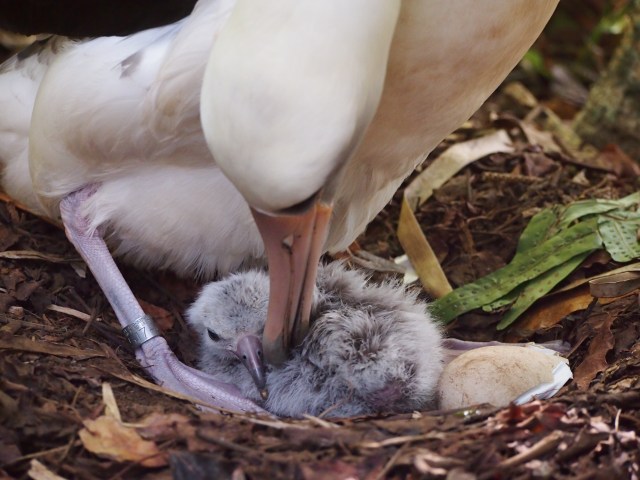
By the following day, Mom was on the chick.  Even though Dad had been at his nest for about two weeks, he was able to feed the little one some delicious, fragrant fish oil.  When an albatross feeds at sea, digestion begins in an upper stomach.  It is broken down into a lower layer of compounds that continue down to the lower gut to be digested, and a lighter, oil layer, which floats on top.  That is the food that a parent stores to feed to a chick.  When Mom came back, she fed the chick some fresh oil.

Usually a parent stands up and bends over to feed the chick.  It may be more difficult to remain seated, as Mom is doing here; perhaps that is why there is so much grunting involved.

Sometimes oil falls onto the chick.  Grooming the chick is perhaps the most pleasurable part of the whole process, for both parent and chick.

blu230 and chick

KP393 and chick

Posted in Uncategorized | 5 Comments