Lucky chick Part 2

Wednesday morning workmen cut the branches and most of the trunk of the tree I wrote about in Tuesday’s post, the heliotrope on the golf course that was blown over during our recent rainstorms.  The albatross nest next to the tree had not been touched when the tree fell over; the chick was unharmed.  While the men were working, I moved the chick a little ways off, not far from another chick.  He thanked me be spitting up fish oil on my pants, but at least he did not get any on his feathers.  I would rather scrub my pants than add to the the poor little chick’s trauma by wiping fish oil off of him.  An important part of his world had come crashing down, narrowly missing his nest—-how scary is that for a little seabird?

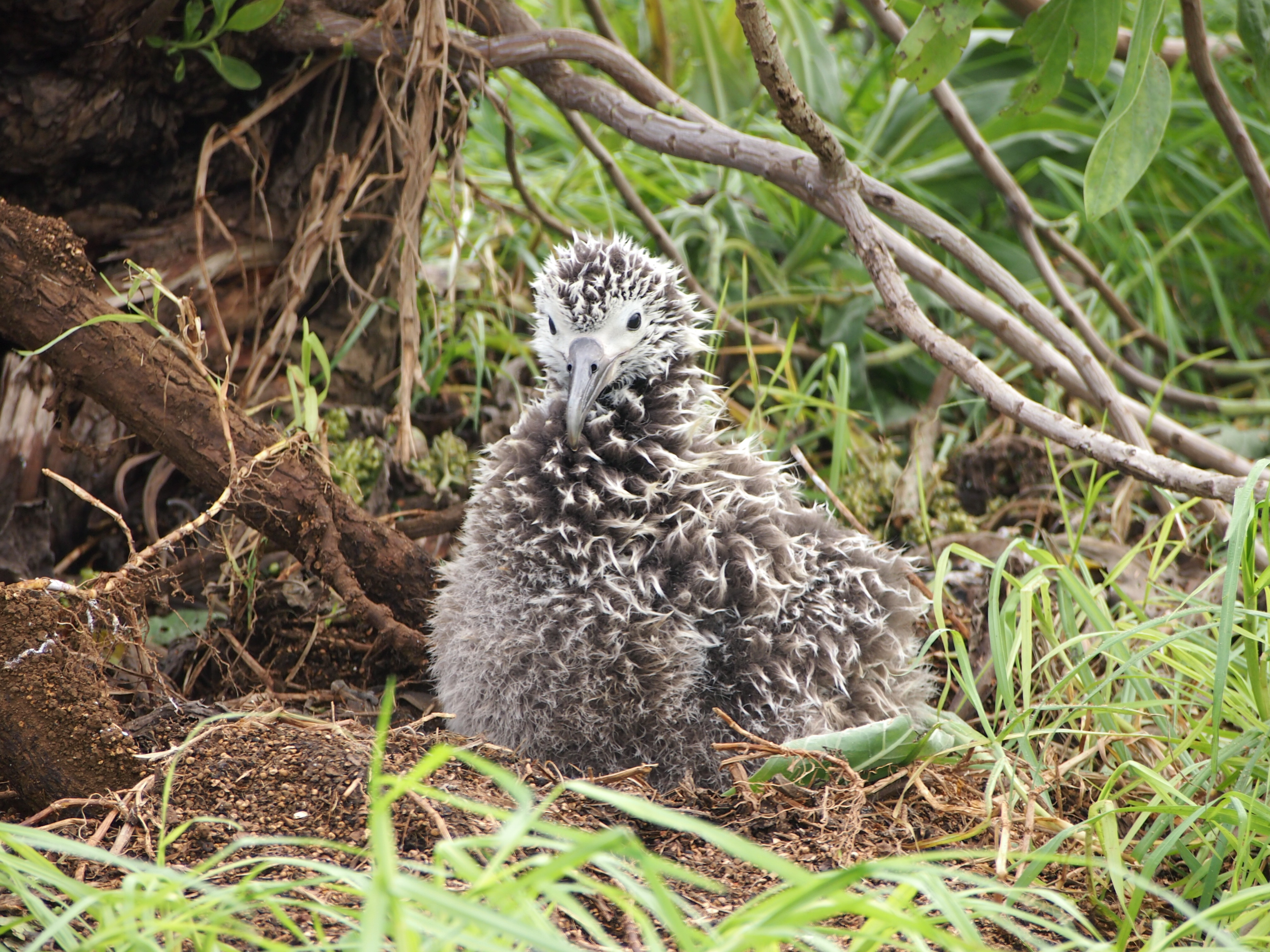
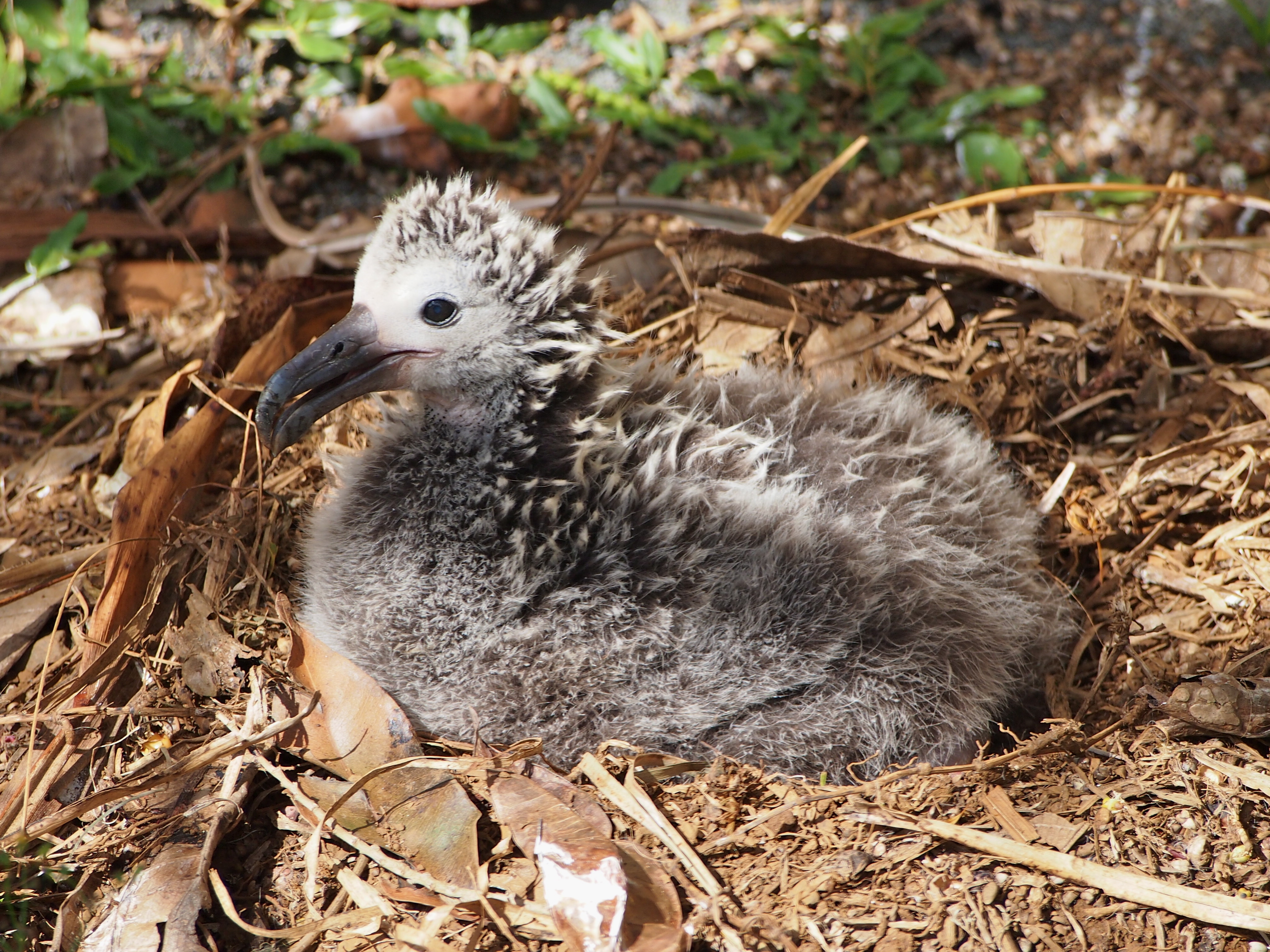
Chick sits in his nest by a stump

The workmen moved quickly and left the nest intact.  The chick is back in his safe zone waiting calmly for his next meal.

And I am washing my pants for the third time.  There is nothing that can match the aroma of upchucked fish oil.

Home sweet home!

Posted in Uncategorized | 1 Comment

Lucky chick!

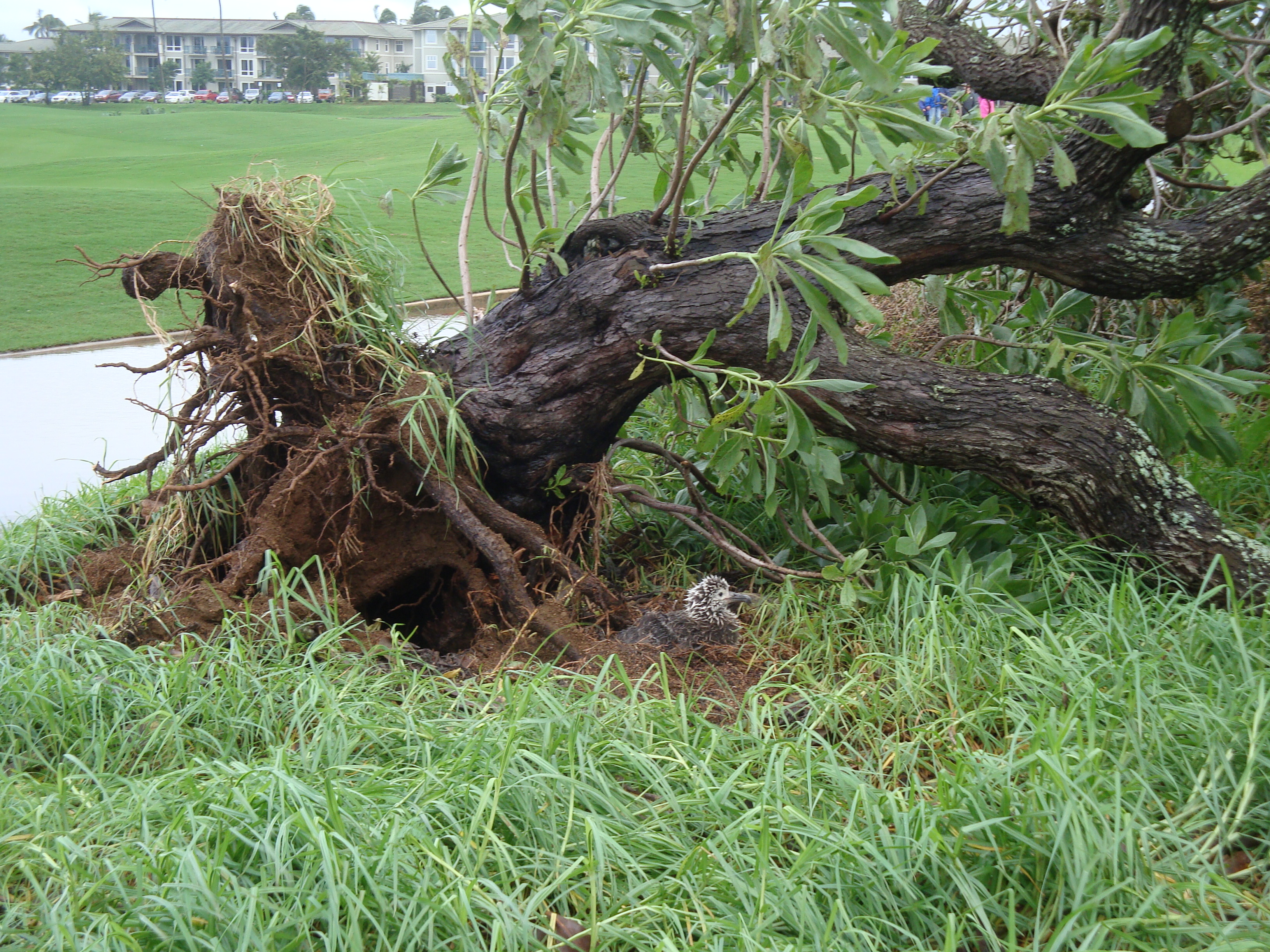
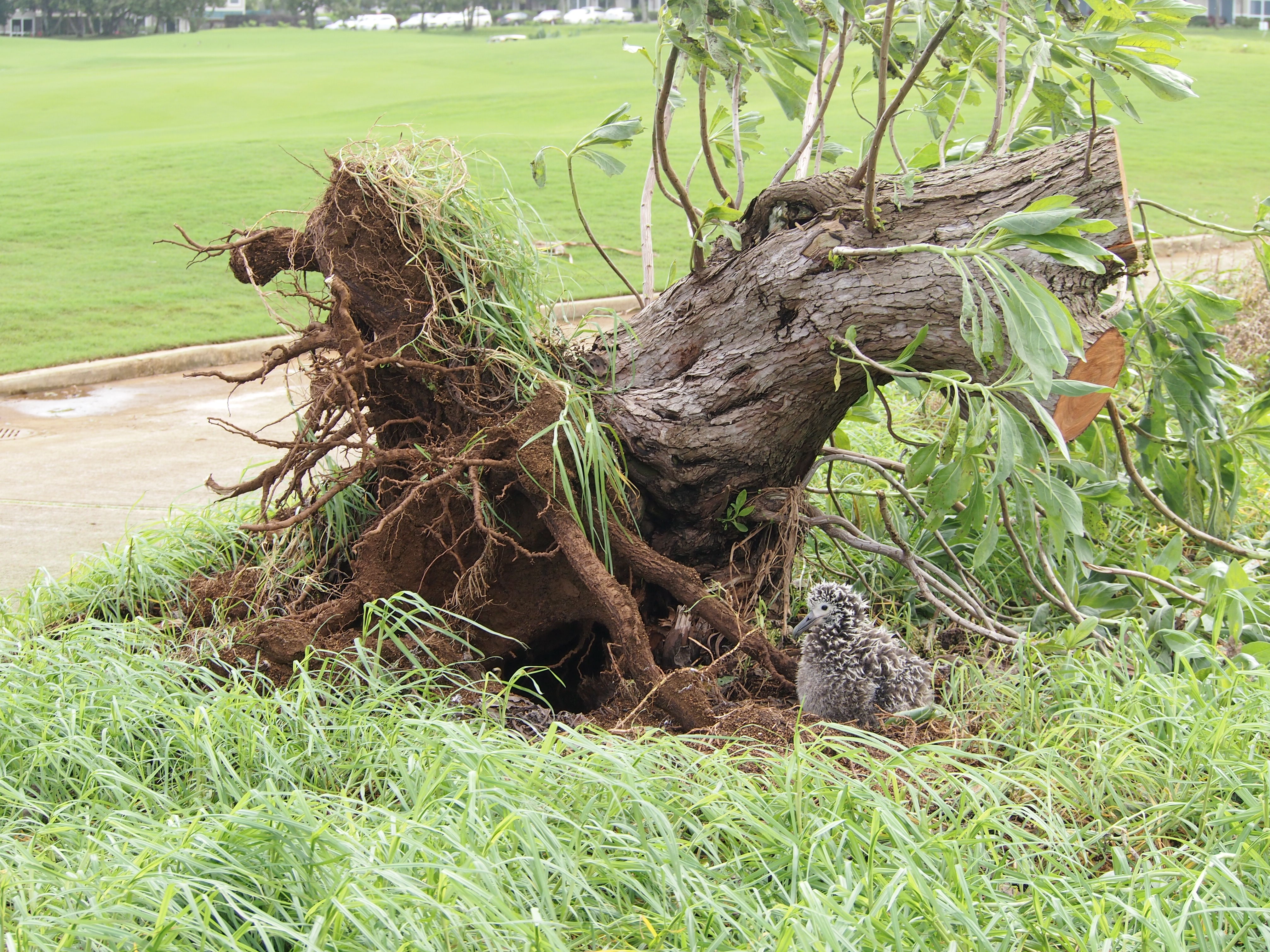
There is a beach heliotrope tree on the golf course that albatrosses have chosen as a nest site through the years.  This year, a couple who first nested there two years ago built their nest under that tree and have a healthy chick residing in it.  During the storms that hit Hawaii between Saturday and Tuesday, the tree was uprooted and fell over.  The nest was in the perfect spot and the chick survived with every feather in place.

Chick at nest 14 adjusts to big change

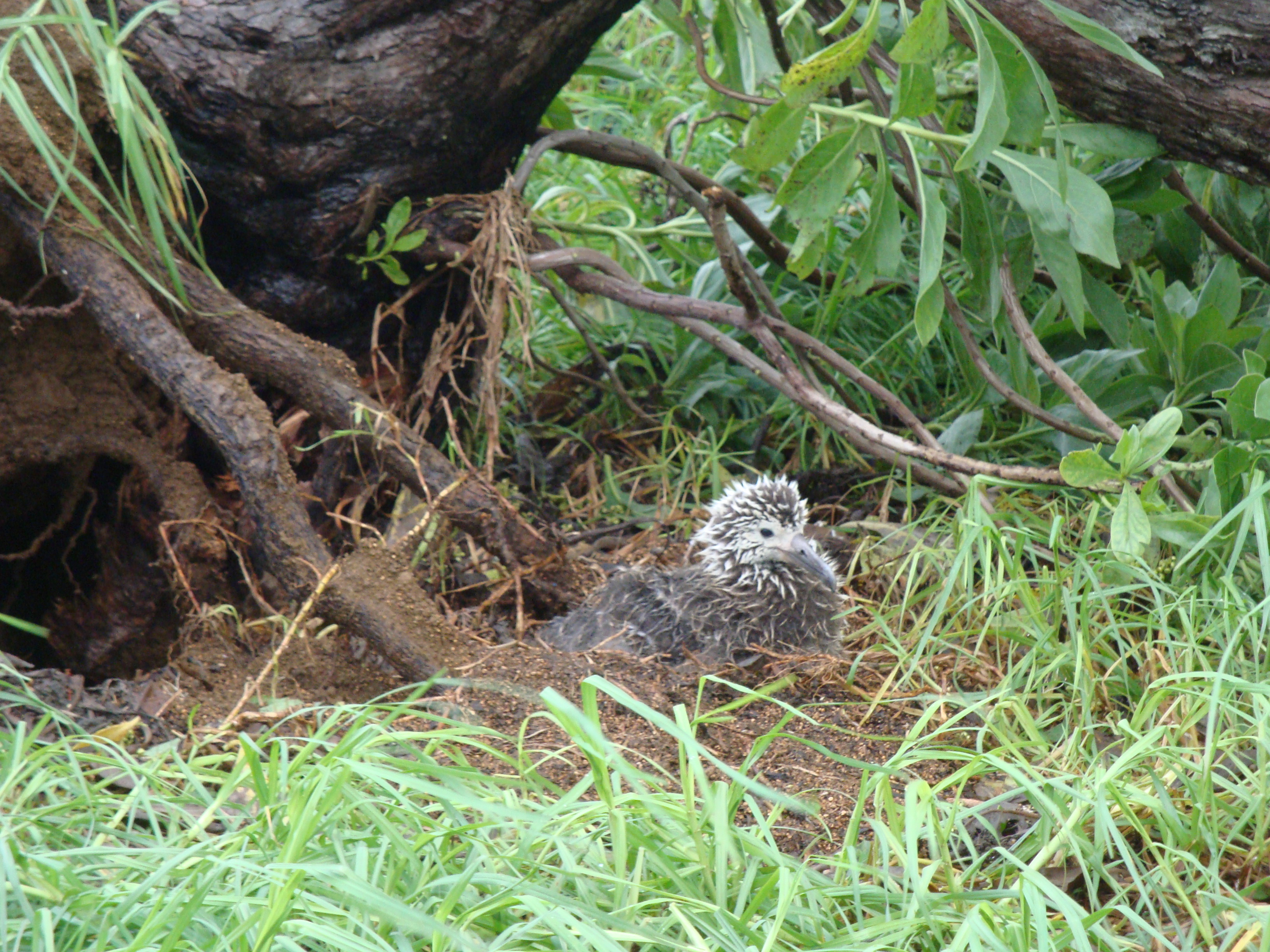
The nest is in between two roots.  The little guy could have been seriously hurt if it had fallen another way.

Closeup of chick and fallen tree

Posted in Uncategorized | Leave a comment

Visits to chicks by unrelated adults

Even when their chicks are still in the egg, albatross parents are talking with them.  The whole time the chick is pipping he is communicating with the parent on the nest.  So it is no surprise that when the parents start leaving the chick alone to find food for him, their return from the sea is a time of noisy vocalization by parent and chick.

The parent often makes a 3-note greeting on approaching the nest; to a human with anthropomorphic tendencies it sounds like, “Where’s my chick?”

The chick responds with an excited 2-note,”Mommy!” or “Daddy!”  (WAY too anthropomorphic…)

On Midway, where the albatross nests number in the hundreds of thousands, vocalization is the best way for parents to find their chicks, and for chicks to beg from the right adults.  As chicks get older they start wandering away from the nest, so the parents need a way to find them quickly.    As for the chicks, they could get clobbered asking the wrong parent for a meal.

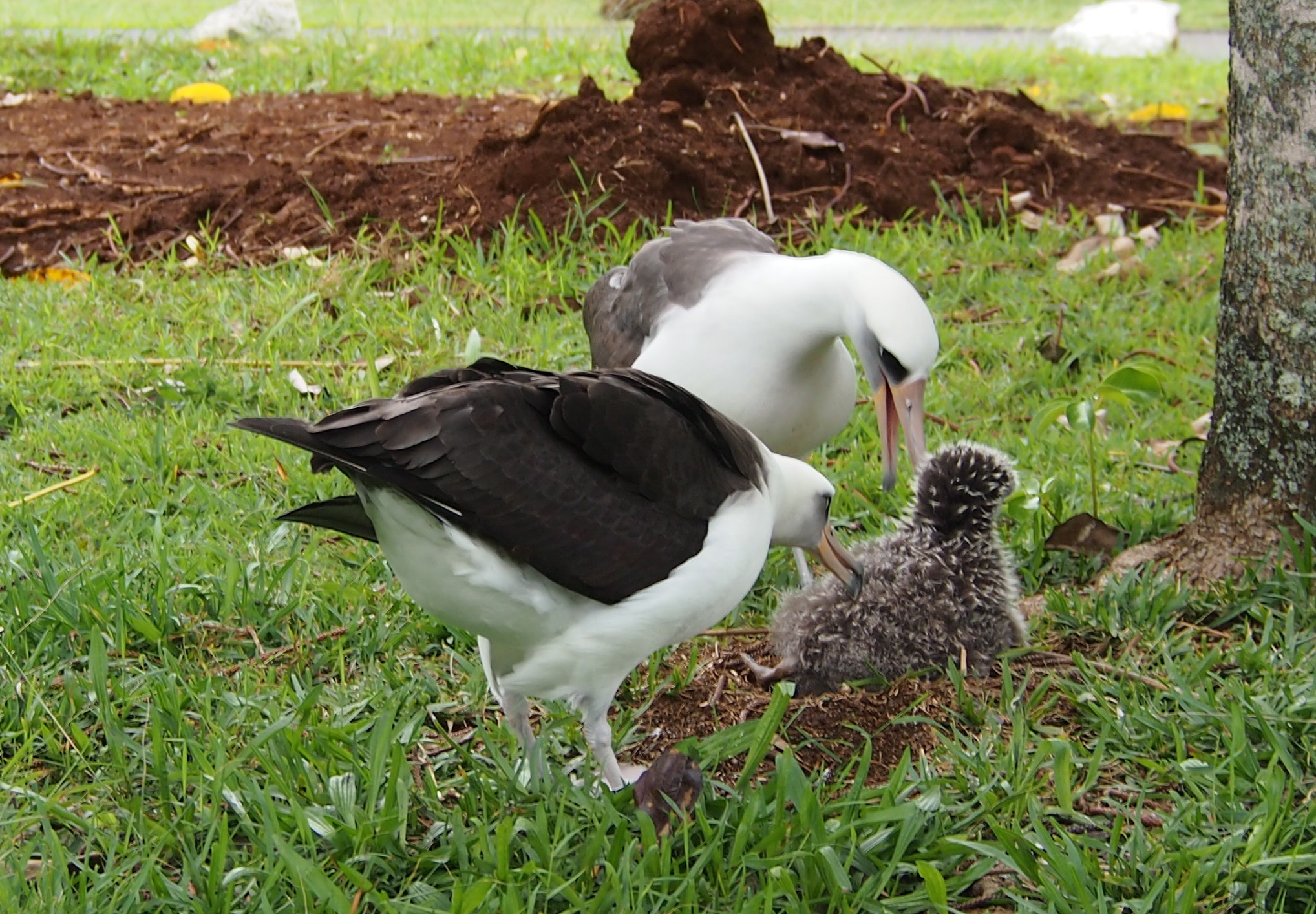
A chick generally does not vocalize excitedly when a non-parental adult comes by the nest.  Sometimes they appear to be unbothered by the visitor.  I don’t know if this stems from recognition of the adult or if the chick’s personality is the reason for this apparent acceptance.  The chick in this photo did not seem to be upset by the two adults checking him out:

KP943 and K240 visit chick at nest 16

But a chick can actually be hurt by an adult.  Parents of other chicks may act aggressively towards the chick, even attacking him.  I have seen parents go out of their way to visit a chick and peck at him.  I can think of a couple of occasions when I chased one of these adults away from a beleaguered chick.  Some adults who are not parents try to groom chicks and are somewhat clumsy; they may actually poke the little ones or pull on feathers too roughly.

Here is a film of a chick being visited by an adult.  The chick does something I often see, he assumes a defensive posture.

Posted in Uncategorized | 1 Comment

The chicks are growing…

On February 21st, the 20th Princeville chick hatched.  This is the latest chick we have had here, at least in the last 7 seasons.  The same couple also had the last one in 2011.  This makes our total twice the number of chicks that fledged in 2011.

I didn’t even try to take a photo; when the chick first hatches the parents are at their most protective, for obvious reasons.  I can usually tell when a chick has just hatched by the parent’s behavior; they stay firmly in place and clack their bills at me if I get too close.  The tiny little things are so vulnerable and helpless, and I have no interest in upsetting an albatross parent to take a picture.

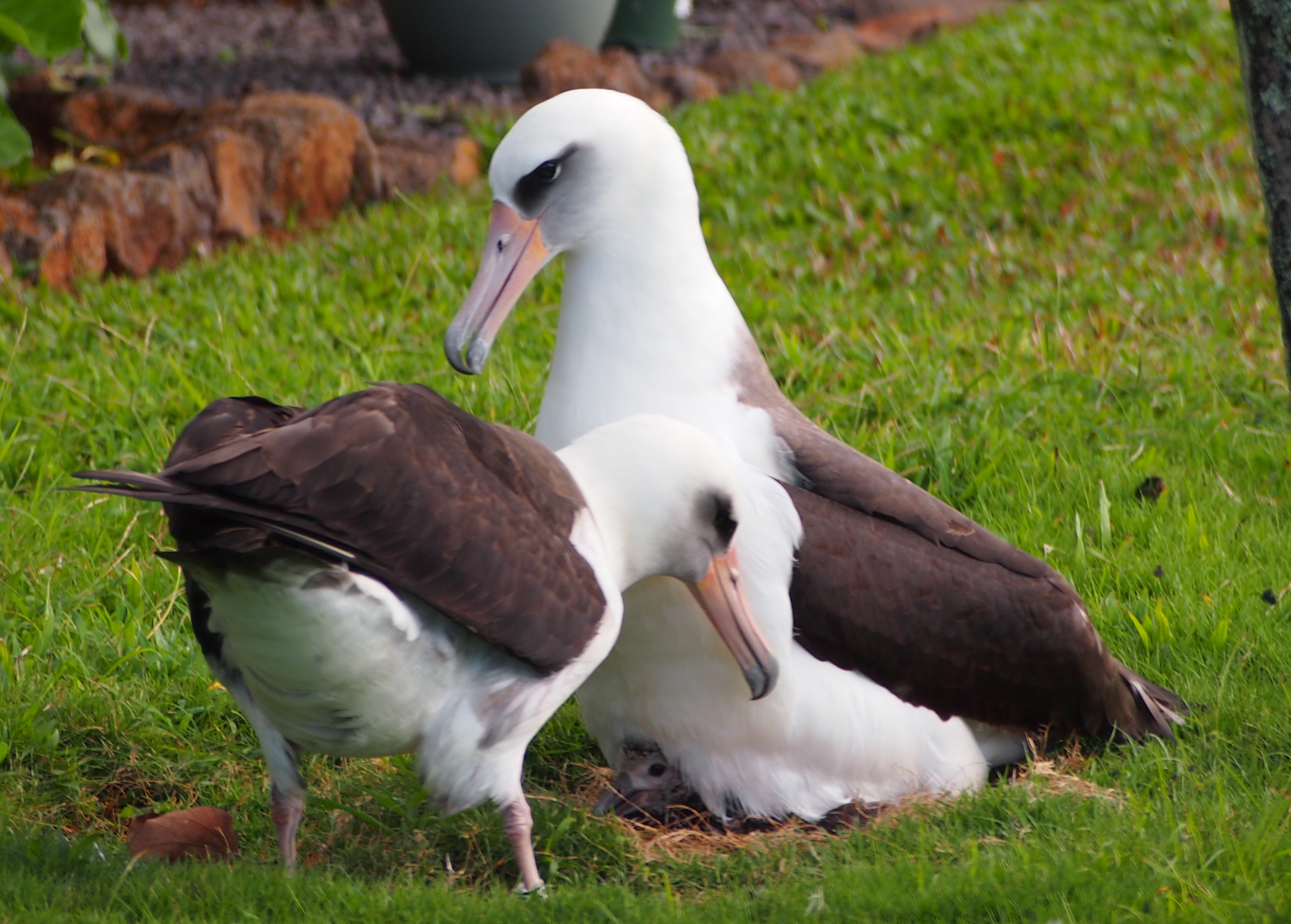
I always enjoy watching parents switch babysitting duties at the nest.  Often the returning bird can hardly wait to be with the chick, while the nester is reluctant to part with him.  Sometimes they change position relatively quickly.  When the male at this nest returned, I went to my car to get my camera and he had already switched places with the female when I got back.  That’s the female to the left, taking a last look at the chick.  She has to fly out to sea and get food for herself and for her chick.

KP650 leaves, KP493 stays

The chicks are growing fast.  Most of them are really too large for the parent to totally cover.

Let me out!

The parents are leaving their chicks alone at the nest more and more frequently.  As I explained in my last post, I put signs up to tell people that this is normal albatross behavior.  The parents will spend less and less time at the nest, and their visits will get shorter and shorter.  People should not assume that the parents are not visiting their chick if they don’t see the adults there.  I check the nests almost every day and as the season goes on I probably miss most of the parents’ visits to their nests.  The chicks are all getting big and fat, so someone must be feeding them!

Waiting for the next meal....

Posted in Uncategorized | Leave a comment

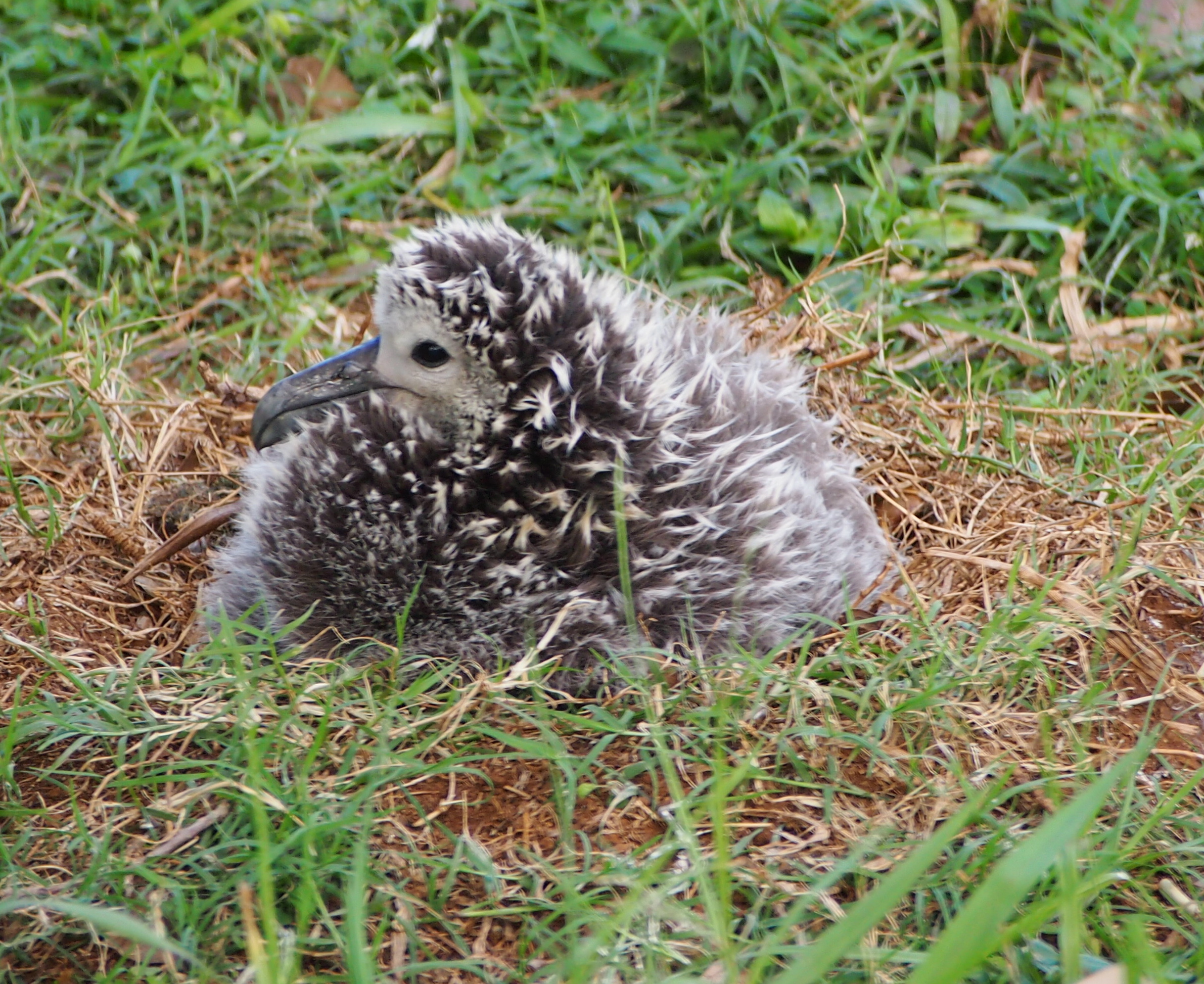
Chick alone!

Now is the time of year when parents start leaving their chicks alone in the nest.  Take this little guy:

515 and 494's chick

Chick alone

People in Princeville will start to see this sign:

Parents are searching for

food and leaving chicks

alone.

 Please don’t scare chick by

getting close !


I always worry that if a parent comes back to feed a chick and finds humans standing near the nest, he or she may be afraid to come close.  Every meal is important to albatross chicks, that is why they need both parents to feed them.

I also worry about cats.  If you are someone who believes that killing one of these chicks would just be part of nature for domesticated cats who did not evolve anywhere near albatrosses and who were bred to live WITH humans, then you will not relate at all to this post.  These little chicks are so vulnerable.  They need protection from predators.  An adult albatross can defend himself from a cat, but a chick who has just been left alone by Mom and Dad (or Mom 1 and Mom 2) for the first time is at a big disadvantage.


Posted in Uncategorized | Leave a comment

Good and bad eggs

It has not been a good year for the incubator eggs from nests at the Pacific Missile Range Facility (see http://www.acap.aq/2011-news-archive/sixth-year-for-the-laysan-albatross-egg-swap-on-kauai-hawaii-deemed-a-success) that were placed under 8 of the birds in Princeville.  One broke a few weeks ago and 4 of them never hatched.

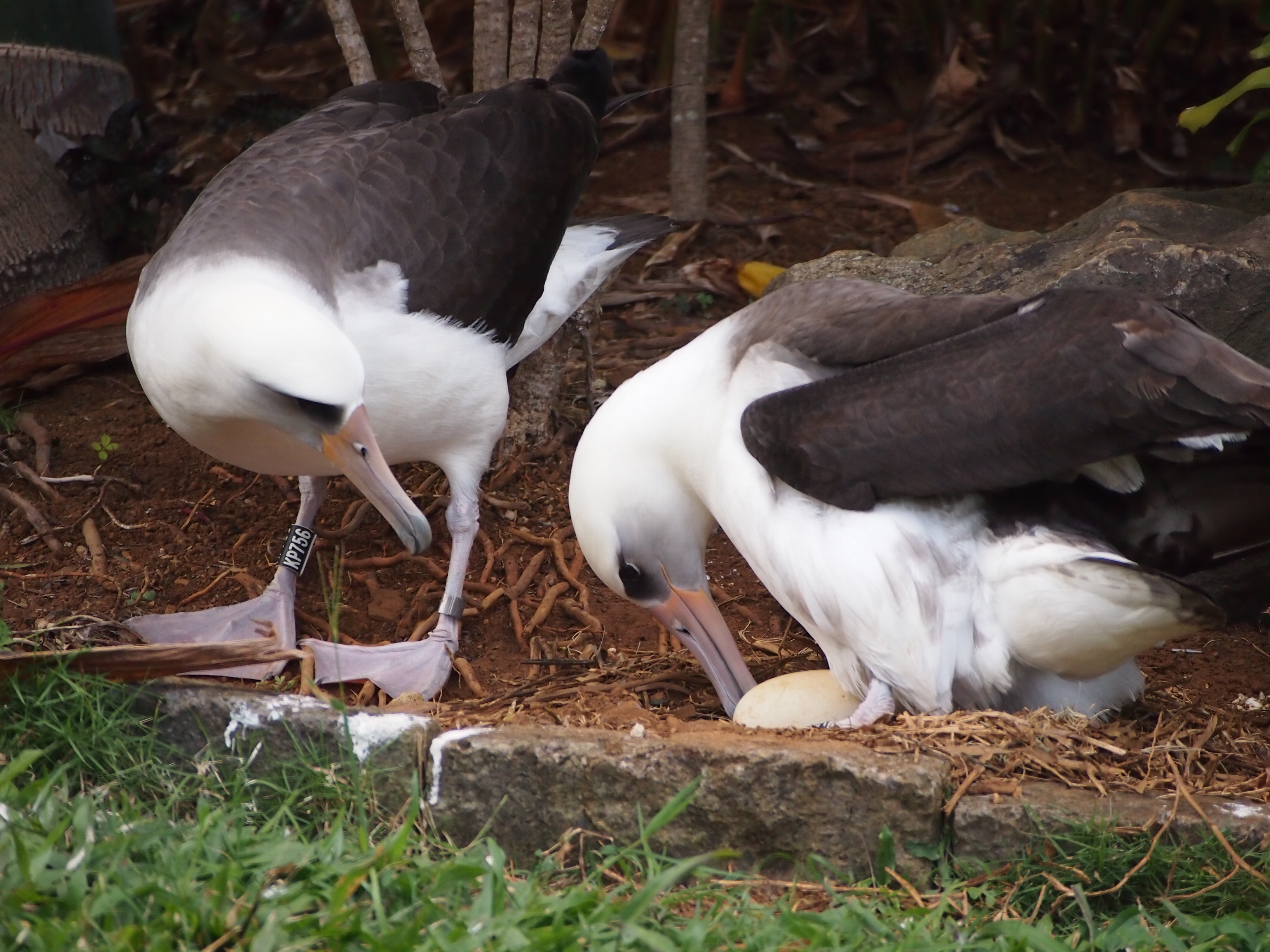
This is a photo of KP756 and KP404.  They nested this year for the first time.  KP404 fledged from my neighborhood in 2003.  So far, all of the birds who we know fledged from Princeville have chosen mates who did not fledge from here.  I think that is very interesting, since birds who fledged in different years from the same area could be siblings.

They were given a PMRF egg and KP756 abandoned it on February 10th, long after it was due to hatch, but KP404 was back incubating the egg the next day.  Since then, Kp756 has spent some time wandering around and some time sitting with KP404.  Kp404 has not given up; some albatrosses do not abandon a bad egg until it breaks beneath them.

KP756, KP404 and bad egg

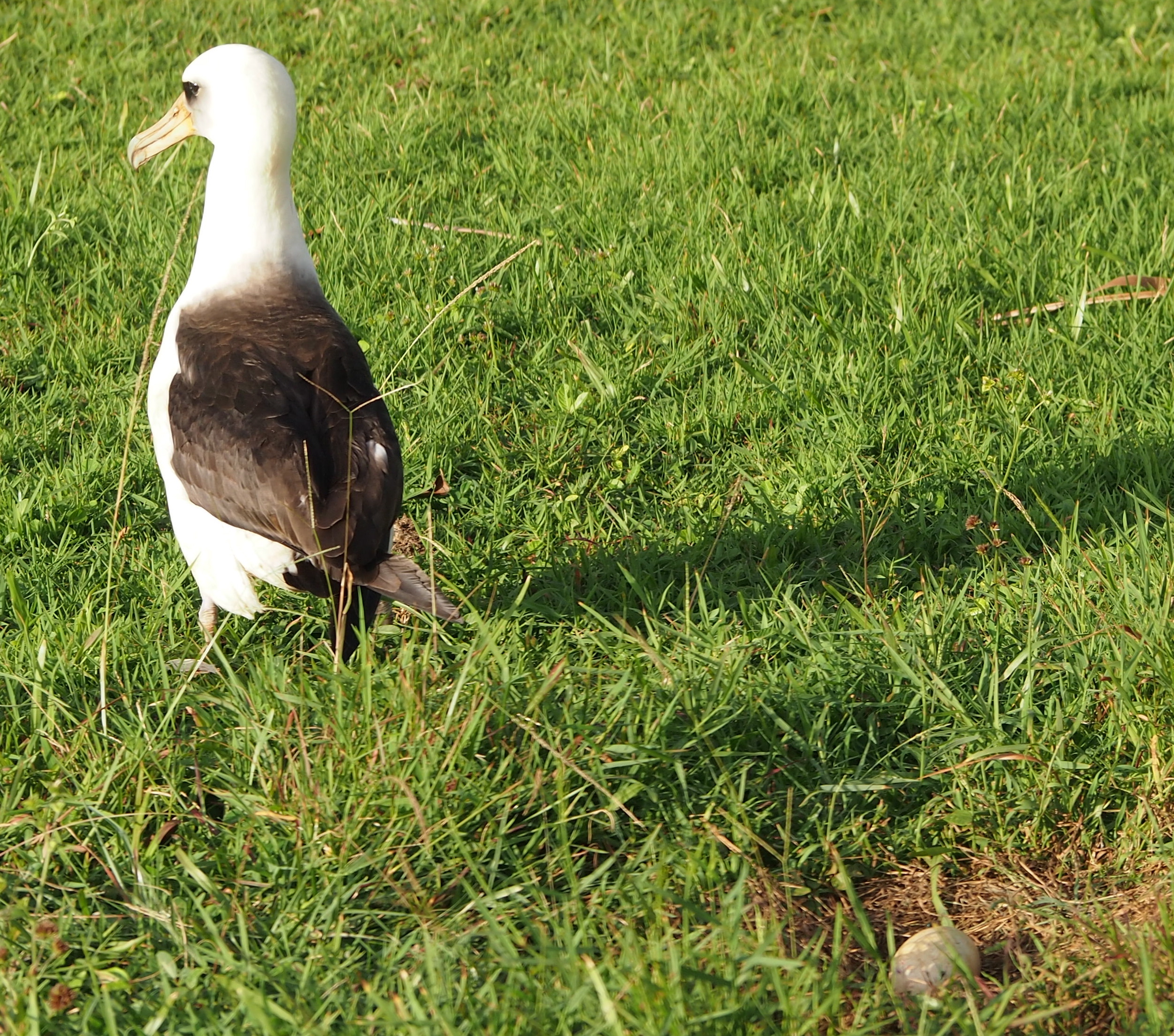
KP679 had an egg on December 18th.  With no mate to share incubation, she left her egg from January 4th to 24th, then sat on it until it broke yesterday, February 14th.

I would like to thank all of the residents of the Puamana Condos who have watched over KP679 and her nest.  The Princeville albatrosses may not know it, but they depend on people like you for their continued survival in our alien environment.

KP679 and her broken egg

Every year the albatrosses who raised chicks together here in previous years return to Princeville.  If one doesn’t, I never see that bird again and I presume he or she died.  The surviving mates do not all react the same to losing a mate.  Some start looking for a new one the same season, others seem to take several years to get back into the search.

One of my favorites is KP519.  From 2004 until 2008 Kp519 nested with her mate in my neighborhood.  In one of those years they were given a PMRF chick from an egg that hatched before it could be moved to a nest in Princeville.  Their infertile egg was removed from the nest and was replaced by the tiny new chick, a miracle which the parents happily accepted.  In the fall of 2008, her mate did not return.  KP519 waited until February 1st and then left Princeville.

In 2009 she returned and displayed several times with several different birds, not with one in particular.

In 2010, she was again involved in displays with different birds.  But twice I saw her with KP251 in the “quiet contact” typical of mated couples.

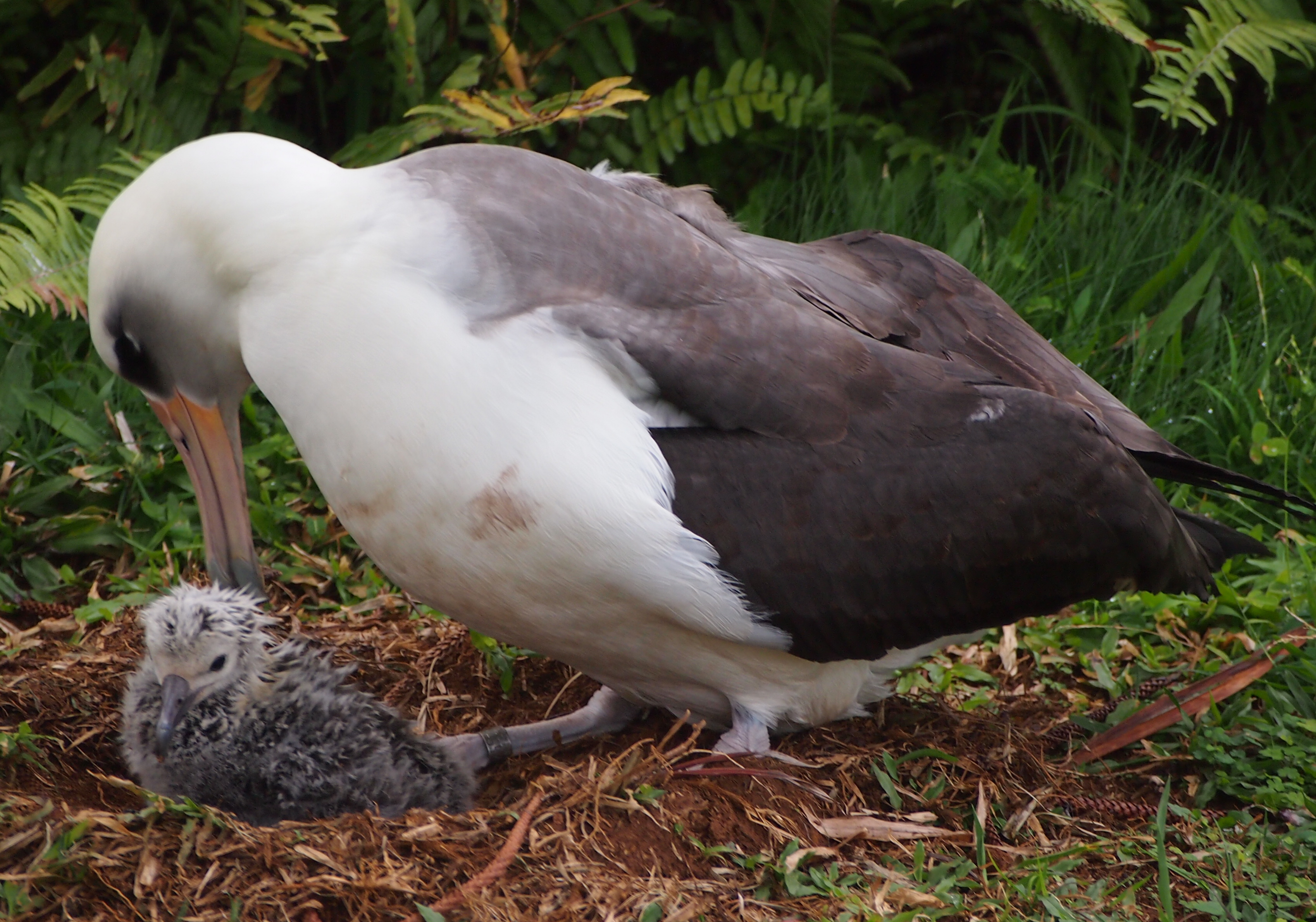
This season she nested with KP251 and they have a big, healthy chick:
KP519 and chick

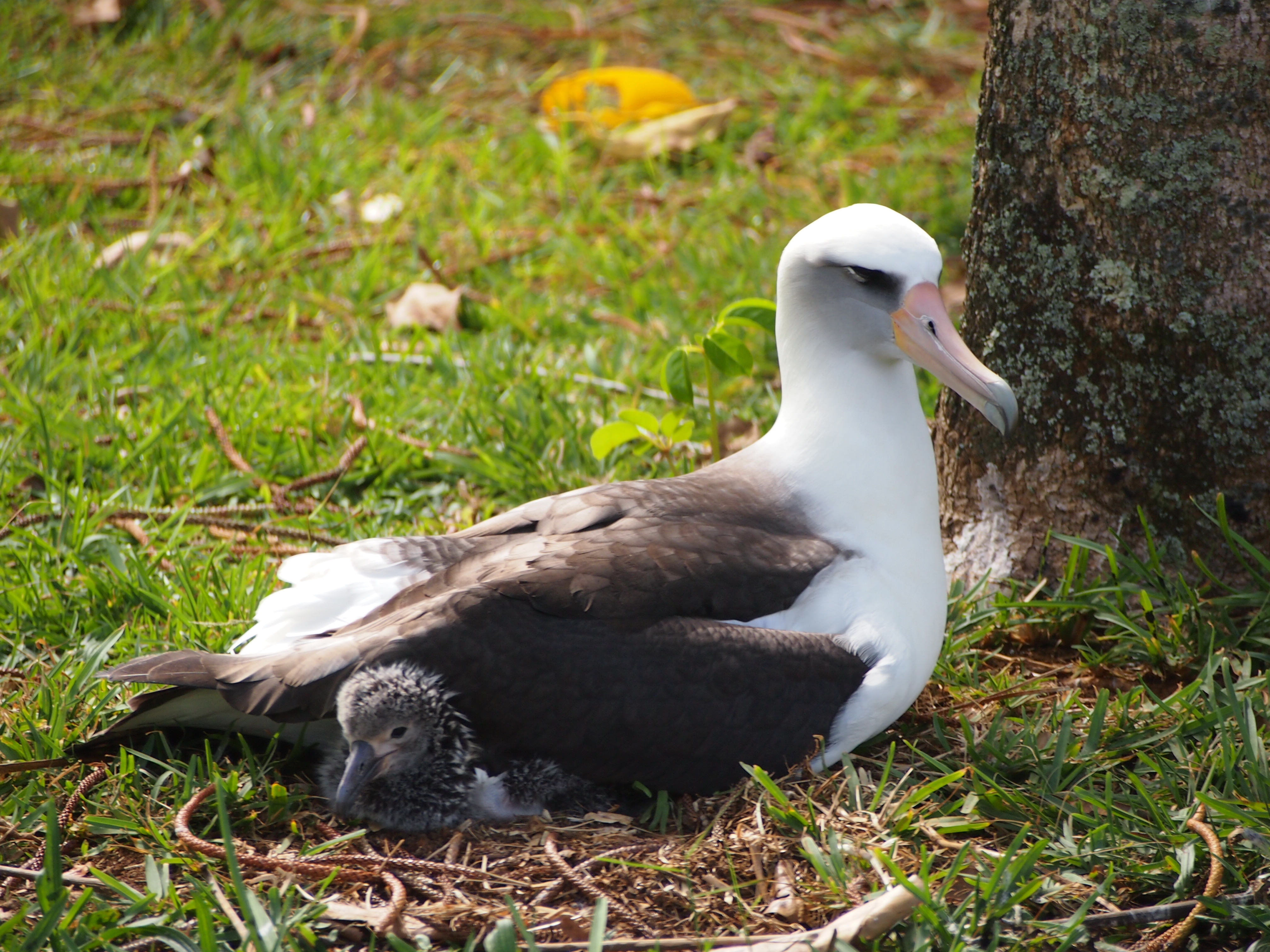
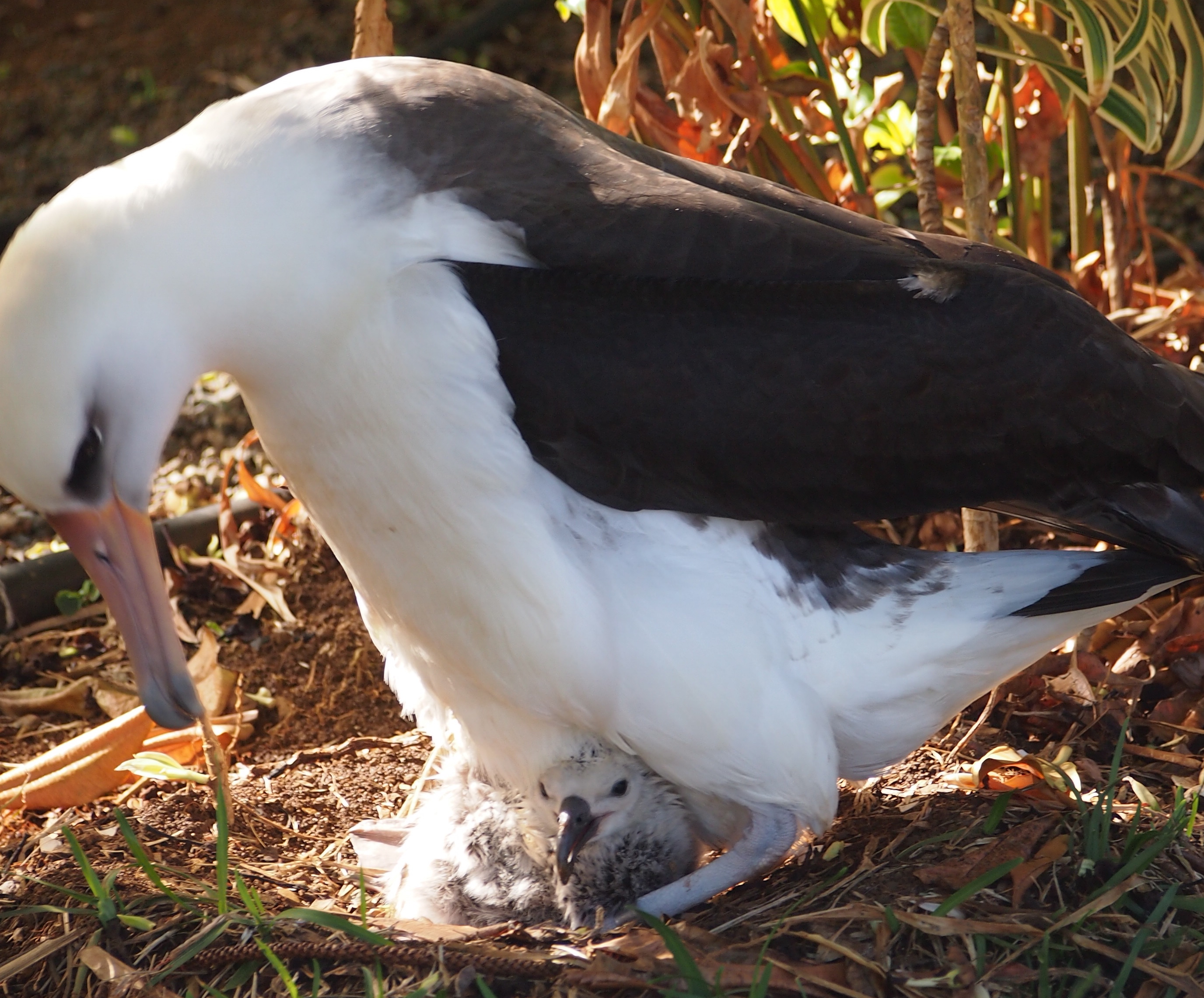
You will often see chicks sitting on their parent’s feet.  This position puts them close to the warm body of the adult and also prevents the parent from stepping on the chick.

I might be able to get better photos if I went closer to the birds or if I waited around for the birds to change position.  Unfortunately some people have harassed the birds in this way to get a good photograph, and can even convince themselves that the albatrosses actually enjoy their presence.   As an observer my first obligation is to cause minimal stress to the birds.  That means I get my data as quickly as possible and leave them alone.  Since I am not an albatross, I cannot tell precisely how stressed they are, but research has indicated that they react to stress by producing hormones that can have a detrimental affect on their physical well-being.

It is the obligation of everyone who cares about albatrosses to treat them with the respect that wild animals deserve; that means staying out of their world as much as possible and not inventing roles for them in ours.

Posted in Uncategorized | Leave a comment

Dads and their chicks

I have seen albatrosses abandon their eggs but I have never seen one refuse to take care of a chick.  There is something about a baby that is irresistible to an albatross.  When a parent comes home to the nest and the chick has hatched or is in the process of pipping out of the egg, the nester often refuses to budge, eventually doing so only after unrelenting prodding from the returning parent.

Raising a chick is a full time job for two; when I think of parental devotion there are few that compare to a bird who raised his chick alone a few years ago.

He and his mate had raised chicks before, and this season began as usual with both parents taking turns incubating the egg.  The female left when the male returned to the nest 21 days before the chick hatched; I never saw her again and I presume she died.  The chick hatched in four days and then the father spent another 14 days sitting on him to keep him warm until the baby’s body temperature stayed at a safe, constant level.

The father then followed the typical pattern of albatross parents, gradually spending more and more time away from the chick.  During all of this time he fed his baby with no help from a mate.  Raising a chick is a difficult job for two parents, and an almost impossible task for one.  He had to work twice as hard as other albatrosses but the chick seemed to be thriving under this care.

I could not believe that as albatross could raise a baby alone and I asked Brenda Zaun, the USFWS biologist who knew more about albatrosses than anyone else in Kauai to check on the chick for me.  Amazingly, it turned out he was the poster child for albatross health, and he fledged at the end of July.

———————————————————————————————————-

Every day now I see albatross fathers shouldering their parental duties.

This dad is giving his chick a bit of encouragement.  He did not help his chick break through the shell, but they had a nice conversation as work progressed.

KP618 and chick converse

Sometimes a father has to give his chick a good cleaning up, even if he must delay cleaning himself.

Dad grooming his chick

When I arrived at this nest, the father was standing over his growing chick and taking a break from trying to keep his large baby covered.  When Dad saw me, he immediately started positioning himself to protect his chick.

K233 gets ready to sit back on chick

But Big Boy (or Big Girl) was having none of it.  The chick was not quite big enough to wriggle all the way out from under Dad, but at least he could breathe a bit of fresh air.

I can't breathe under here!

Did it bother me that Dad felt he had to protect his chick from me?  I am happy that he is acting instinctively to shelter his little one from possible harm.

That is his job as an albatross dad, and I never tire of seeing it performed with such devotion.

Posted in Uncategorized | 1 Comment

Updates

Let me reiterate a point I made earlier.  I NEVER take a photo of a chick by sticking a camera close to him.  This would be extremely stressful for the parent; nobody who loves albatrosses and who cares about their well-being would ever do this.

———————————————————————————————————-

As of Saturday, February 4th, in Princeville we have 14 chicks, 3 more just beginning to pip, 4 that are overdue to start to pip, and 3 that should be starting soon.  The 4 that are overdue are PMRF eggs that spent over 2 weeks in an incubator.  Those eggs do not do as well as the others.

When the chick breaks through the shell, that is called pipping.  In one of my previous posts I referred to a temporary “egg tooth,” a hardened bump that develops on the end of the upper bill that helps the chick break through the hard shell that encloses him.  Here is a photo of that structure.  It’s the little white dot:

Close-up of egg tooth

———————————————————————————————————-

On January 3rd I wrote about KP679, a female who has only raised one chick since I started collecting data in 2005.  Her last mate left her to return to his first mate, and that pair now have a chick.  KP679 laid an egg that I never saw another bird incubating, and then left her egg on January 4th.  The egg never broke; she returned to sit on it on January 24th.  She has been incubating the egg ever since.  There is no way this egg could be viable, but I’m guessing that she won’t leave the egg until it breaks.  Some albatrosses seem bound and determined to have a chick no matter what insurmountable obstacles are placed in their path to parenthood.

———————————————————————————————————-

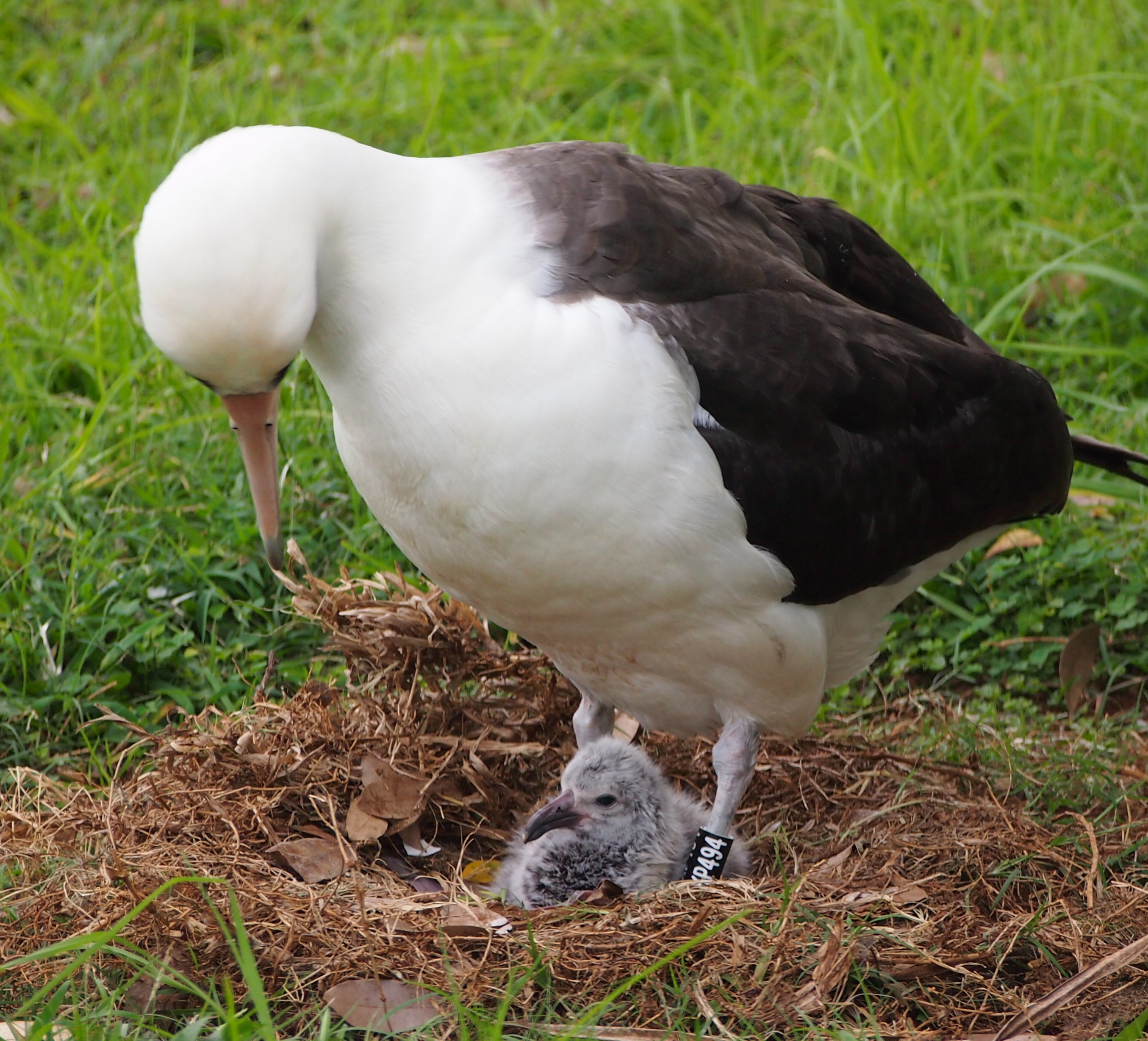
Last year a chick hatched with the yolk sac still attached.  The yolk sac provides nutrition to the developing egg and is normally absorbed by the time the chick hatches.  The mother was observed pecking parts of the shell away, “helping” the chick to hatch.  He came out before he should have, and died.  In other years she has abandoned the egg, but since 2004 she has also had two chicks who fledged.  This year this female has a beautiful, healthy chick.  She and her mate took turns incubating; the chick was hatching for a couple of days with Dad on board, then the third day I found it hatched, with Mom.

KP494 with her chick

Posted in Uncategorized | 1 Comment

Baby pictures

Albatrosses are known to be synchronous nesters:  The Laysan albatrosses here all lay their eggs from the end of November to mid-December, and they all hatch from the end of January into mid-February.  We are in the middle of our hatching season in Princeville, one of my favorite times of the year.

Being human rather than seabird, we do not necessarily know when an albatross is feeling stressed by our presence.  They react involuntarily by producing stress hormones in their blood.  This is actually detrimental to their physical well-being, and as an observer it is my duty to avoid causing this outcome.  That means I cannot sit by a bird waiting for the perfect photo.  I have a zoom lens on my camera and try to stay at a distance from the albatrosses, and I grab a few photos and leave.  Someone told me I should spend some time with them so they feel safe with me, but I do not want them to feel safe with any humans.  Not every human is their friend, it is better if the albatrosses learn not to trust any of us.

Here is a brand new chick, feathers still wet:

K674 and her new chick

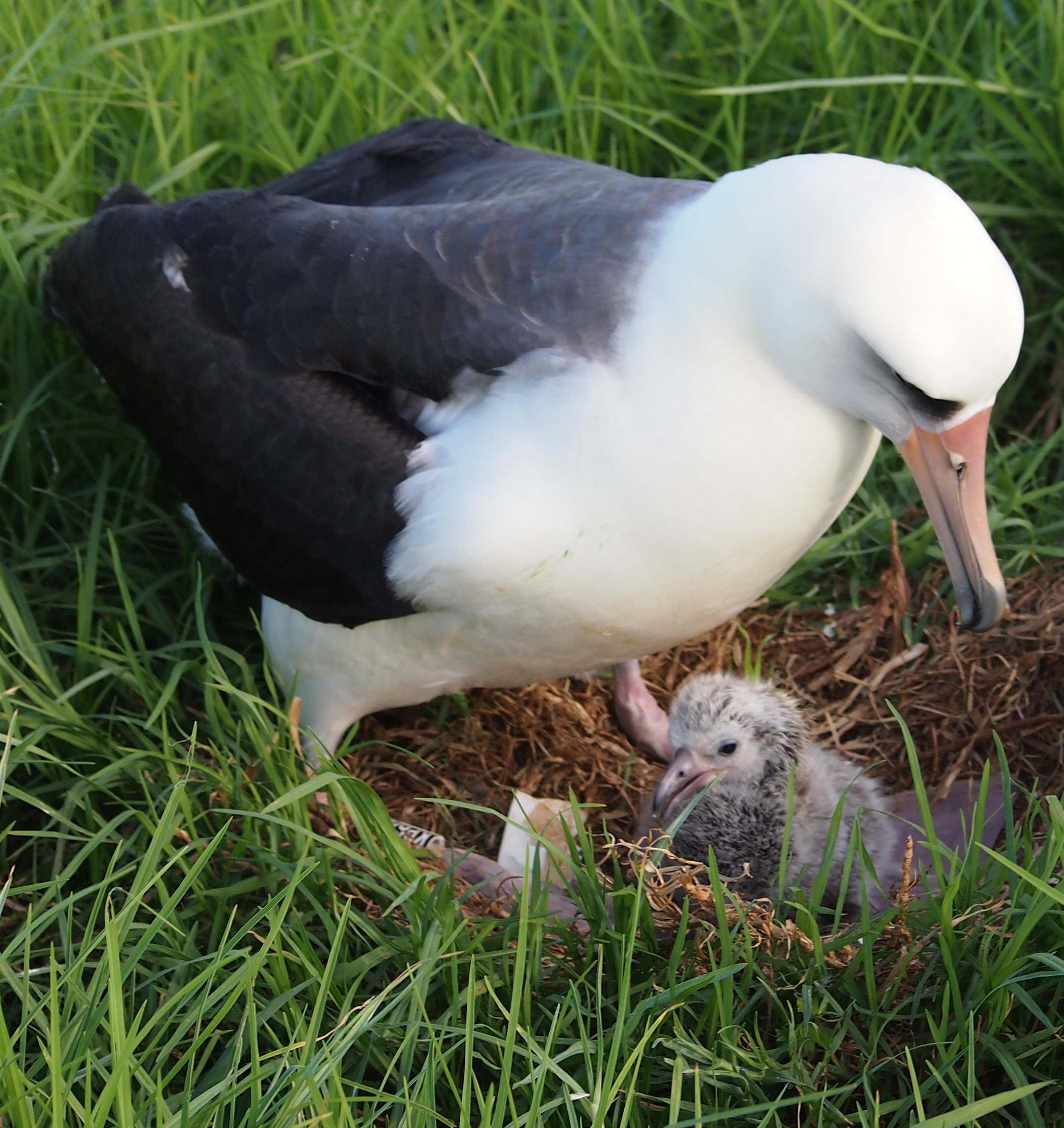
I wrote about KP680 in my January 3rd blog, “Biography of an albatross.”  She and her mate, KP731, split up when she missed a nesting season after getting stuck in a fenced in yard that she could not escape from without help.  Her mate met another female the next season and had a nest with that her the following year.  Eventually he returned to KP680.  This is a photo of KP680 and their newly hatched chick:

KP680 and chick

In the next photo another baby is welcomed into a big, scary world.  KP298 hatched in my neighborhood 10 years ago, but he chose to nest on the golf course.  Some birds nest close to where they first pecked their way out of their eggs; others prefer to move to another area.  Why the difference in behavior?  When I learn how to speak Albatross it will be one of the first questions I ask them, after “How do you choose a mate?”

KP298 welcomes new baby

Posted in Uncategorized | Leave a comment

It’s hatching time!

Checking on the albatrosses every day is a lot of work, but this is the time of year when I am rewarded for every moment.  Hatching has begun in Princeville.

Chicks usually take several days to break out of their shells.  The parents do not help, other than to carry on a conversation with the baby.  In a colony like Midway, with hundreds of thousands of nests, being able to identify a baby’s voice helps a parent save time locating the little one.  This is especially important when the chick gets older and starts moving further away from the nest.  It’s much easier for the parents of Princeville chicks to find their babies, but they still arrive vocalizing.

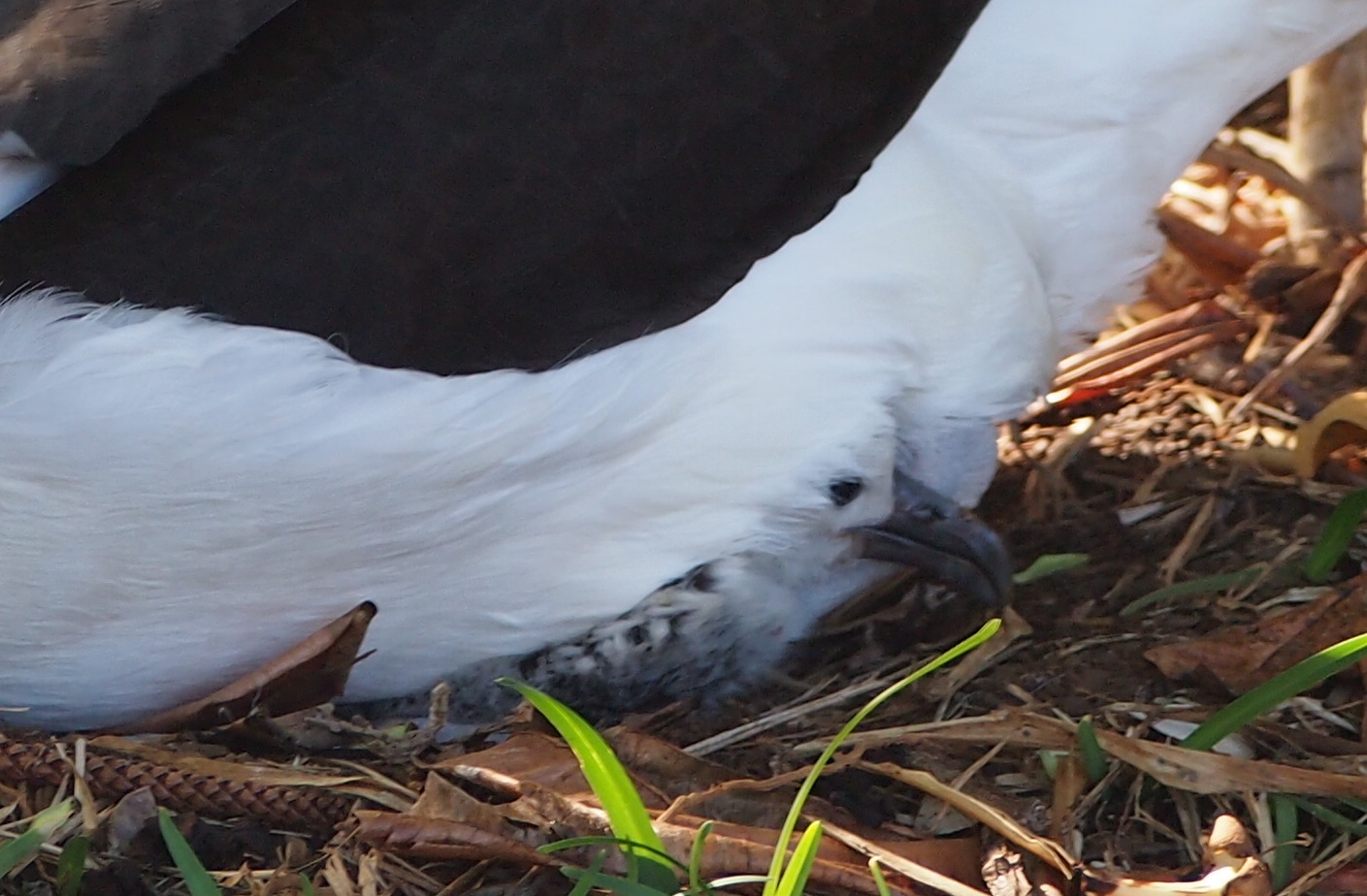
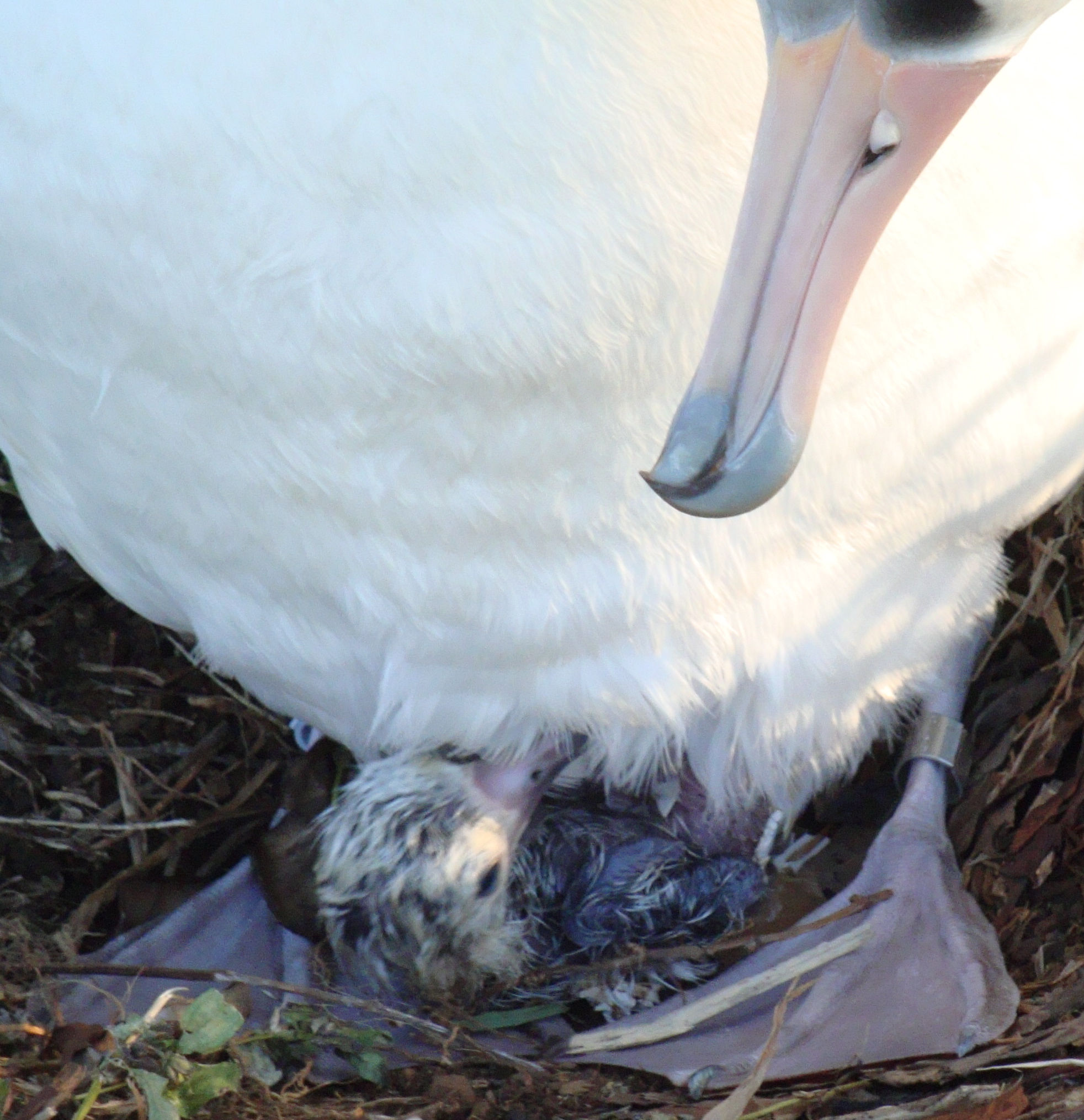
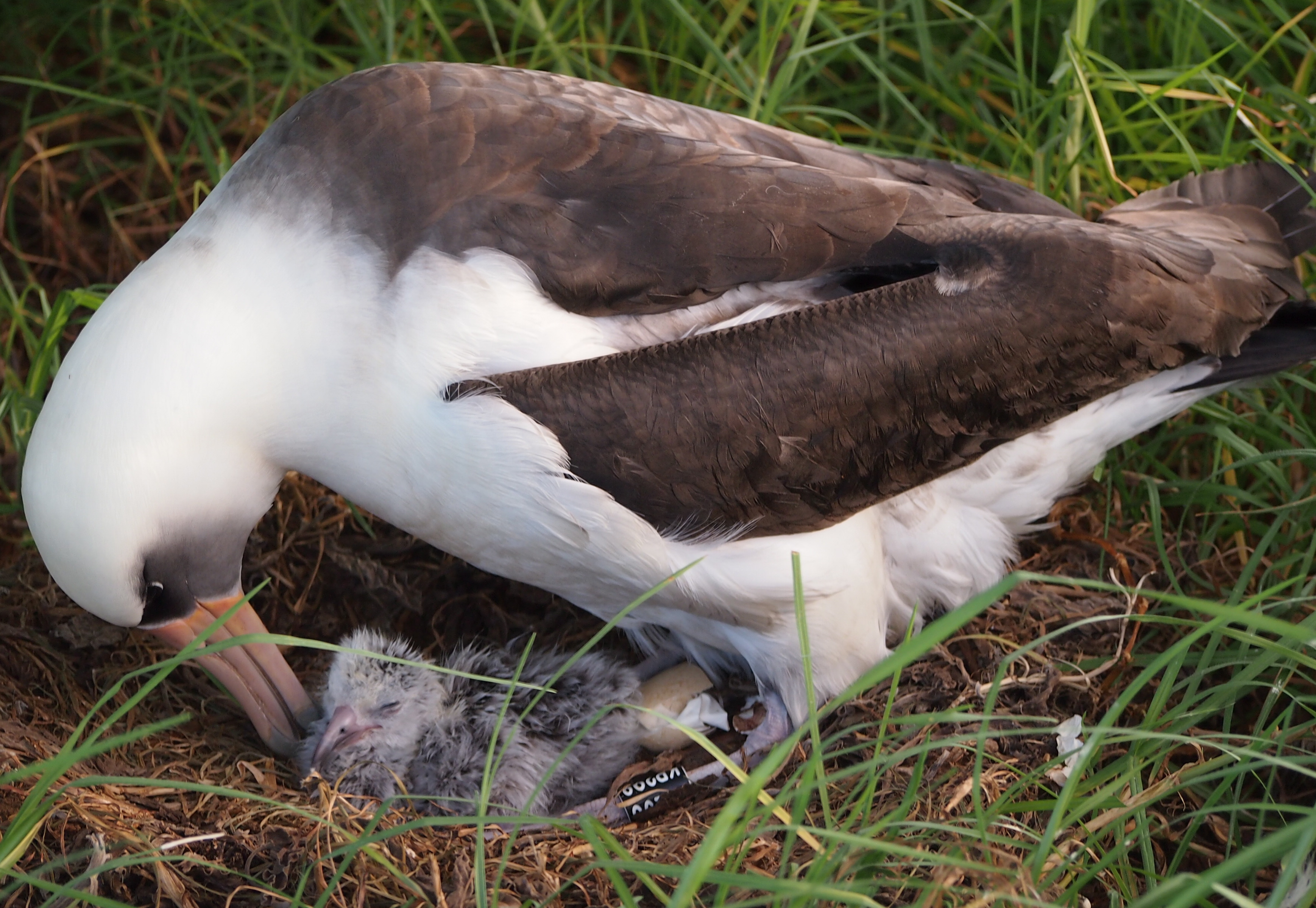
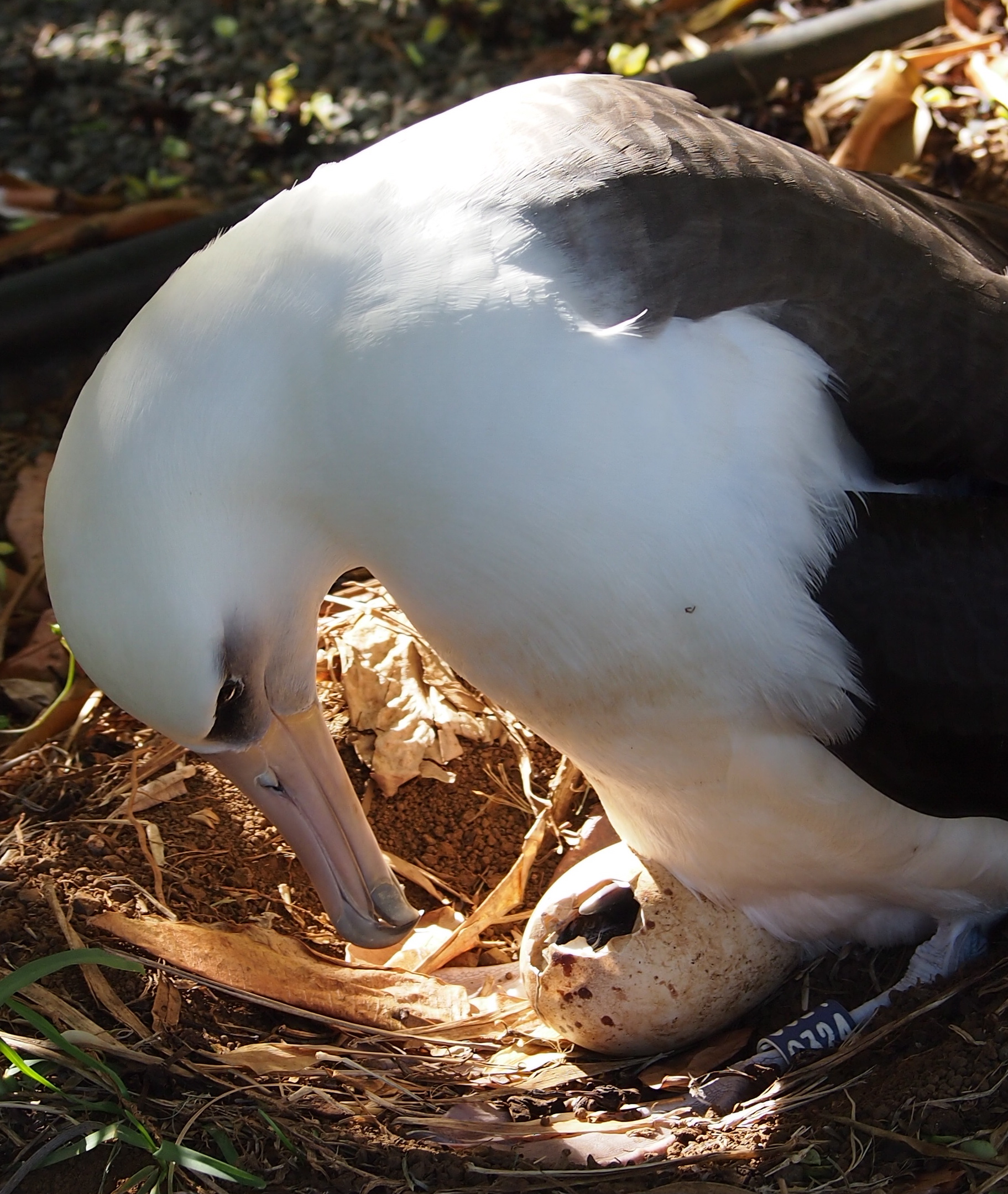
The parent in the photo below returned to the nest as the chick was pipping, or pecking through the egg shell.  The babies have a temporary “egg tooth,” a hardened bump on the end of the upper bill that helps them break through.  Yesterday he father of this chick was at the nest and did not want to leave, so the mother was actually trying to push him off of the nest.  When there’s just an egg in the nest, the incubating parent does not need to be encouraged to go out to sea and get something to eat, but when the chick is at least partially visible, a good shove may be necessary to get that parent off the nest.  The shove must have worked, because the mother was the one encouraging the chick today.  I guarantee the father will be back within a few days to see his new baby.

Hi, baby!

Posted in Uncategorized | 2 Comments